Export Control
EAR Export Classification: Not subject to the EAR per 15 C.F.R. Chapter 1, Part 734.3(b)(3), except for the following Service Bulletins which are currently published as EAR Export Classification 9E991: SBE70-0992, SBE72-0483, SBE72-0580, SBE72-0588, SBE72-0640, SBE73-0209, SBE80-0024 and SBE80-0025.Copyright
© IAE International Aero Engines AG (2001, 2014 - 2021) The information contained in this document is the property of © IAE International Aero Engines AG and may not be copied or used for any purpose other than that for which it is supplied without the express written authority of © IAE International Aero Engines AG. (This does not preclude use by engine and aircraft operators for normal instructional, maintenance or overhaul purposes.).Applicability
All
Common Information
TASK 70-02-06-220-501 IAE 1484 Microstructure For Metal Temperature Analysis
Safety Precautions
General
Refer to TASK 70-02-03-220-501 (METAL TEMPERATURE ANALYSIS) for the procedure to do a metal temperature analysis on nickel base alloys.
IAE 1484 is the specification for nickel-base, 10.0 percent cobalt, 5.9 percent tungsten, 5.65 percent aluminium, 5.0 percent chromium, 1.9 percent molybdenum, 8.7 percent tantalum, 3.0 percent rhenium single crystal investment casting. The microstructure standards for the heat treated and coated alloy are contained in separate paragraphs in this section.
The microstructure of the blade root or the vane shroud sections is not affected due to the relatively low metal temperatures obtained during engine operation. This microstructure provides an optimum baseline for comparison with the airfoil "hot zone" for metal temperature determination.
The typical microstructure of IAE 1484 nickel-base superalloy with a 2400 deg F (1316 deg C)/30 minute solution + 1975 deg F (1079 deg C)/4 hour AC + 1300 deg F (704 deg C)/24 hour AC is characterized basically by an array of quasi-rectangular gamma prime precipitates (Ni3A1) in a gamma matrix (nickel-base solid solution) as shown in Figure. In addition, a gamma/gamma prime eutectic phase along with MC carbides are seen throughout the microstructure.
Effects of Temperature on the Microstructure
The most obvious effects of high temperature on the matrix gamma prime precipitate, are changes in:
Concentration
Size
Distribution
Another effect of high temperature is:
Solutioning of the gamma prime eutectic.
Metallographic Standards
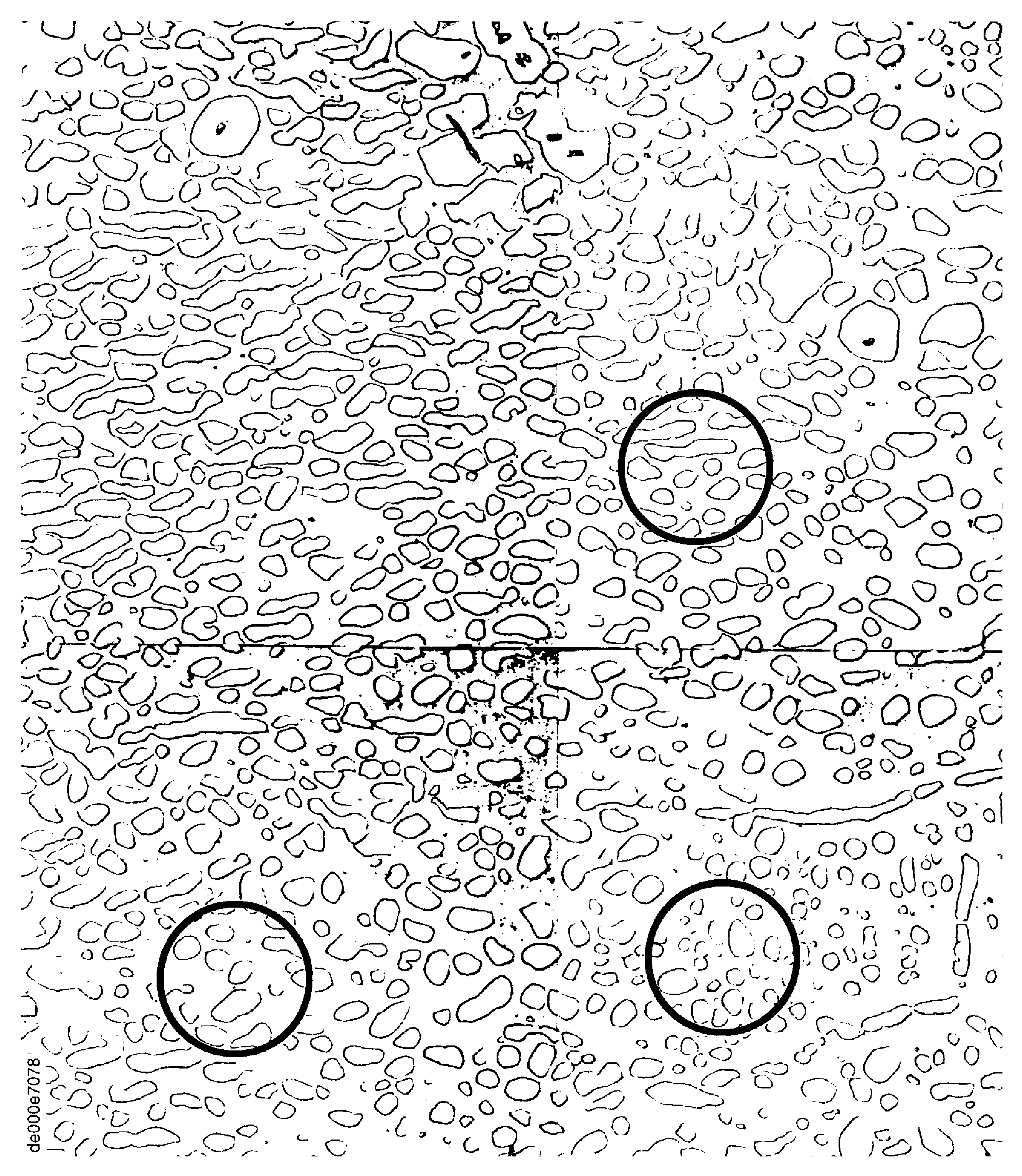
Metal temperatures less than 2150 deg F (1177 deg C) cause no significant changes in the matrix gamma prime precipitate. See Figure.
At 2150 deg F (1177 deg C), the gamma prime precipitate starts to agglomerate (that is, to gather into a ball, mass or cluster) and the space between the particles begins to increase. See Figure.
At 2200 deg F (1204 deg C), there is further agglomeration of the gamma prime. The gamma prime also starts to go into solid solution (gamma matrix). There is a further increase in the space between particles. See Figure.
At 2250 deg F (1232 deg C), there is significant coalescence of the gamma prime. Also, a large amount of the precipitate has been solutioned. See Figure.
At 2300 deg F (1260 deg C), there is further solutioning of the gamma prime with a reduction in the coalesced particle size. See Figure.
Illustration Titles
Figure: Microstructure of fully heat treated IAE 1484 single crystal nickel-base alloy characterized by a dense array of quasi-cuboidal gamma prime (Ni3A1) precipitate in a gamma nickel matrix (circles). Gamma/gamma prime eutectic islands (arrows A) and MC carbides (arrow B) are also present throughout. Etchant: Mixed acids.
Figure: Microstructure of IAE 1484 nickel-base alloy exposed to 2150 deg F (1177 deg C) showing some agglomeration of the gamma prime precipitate (circles) along with increased spacing between particles. Etchant: Mixed acids.
Figure: Microstructure of IAE 1484 nickel-base alloy exposed to 2200 deg F (1204 deg C) showing further agglomeration of the gamma prime precipitate (circles) along with some solid solutioning into the gamma matrix. Etchant: Mixed acids.
Figure: Microstructure of IAE 1484 nickel-base alloy exposed to 2250 deg F (1232 deg C) showing advanced coalescence of the gamma prime precipitate (circles) along with a significant amount of solid solutioning into the gamma matrix. Etchant: Mixed acids.
Figure: Microstructure of IAE 1484 nickel-base alloy exposed to 2300 deg F (1260 deg C) showing further solid solutioning of gamma prime (circles) along with a reduction in size of coalesced particles. Etchant: Mixed acids.
NOTE
Preliminary Requirements
Pre-Conditions
NONESupport Equipment
| Name | Manufacturer | Part Number / Identification | Quantity | Remark |
|---|---|---|---|---|
| Optical microscopic equipment | LOCAL | Optical microscopic equipment | 1000x |
Consumables, Materials and Expendables
NONESpares
NONESafety Requirements

WARNING
Procedure
Figure:
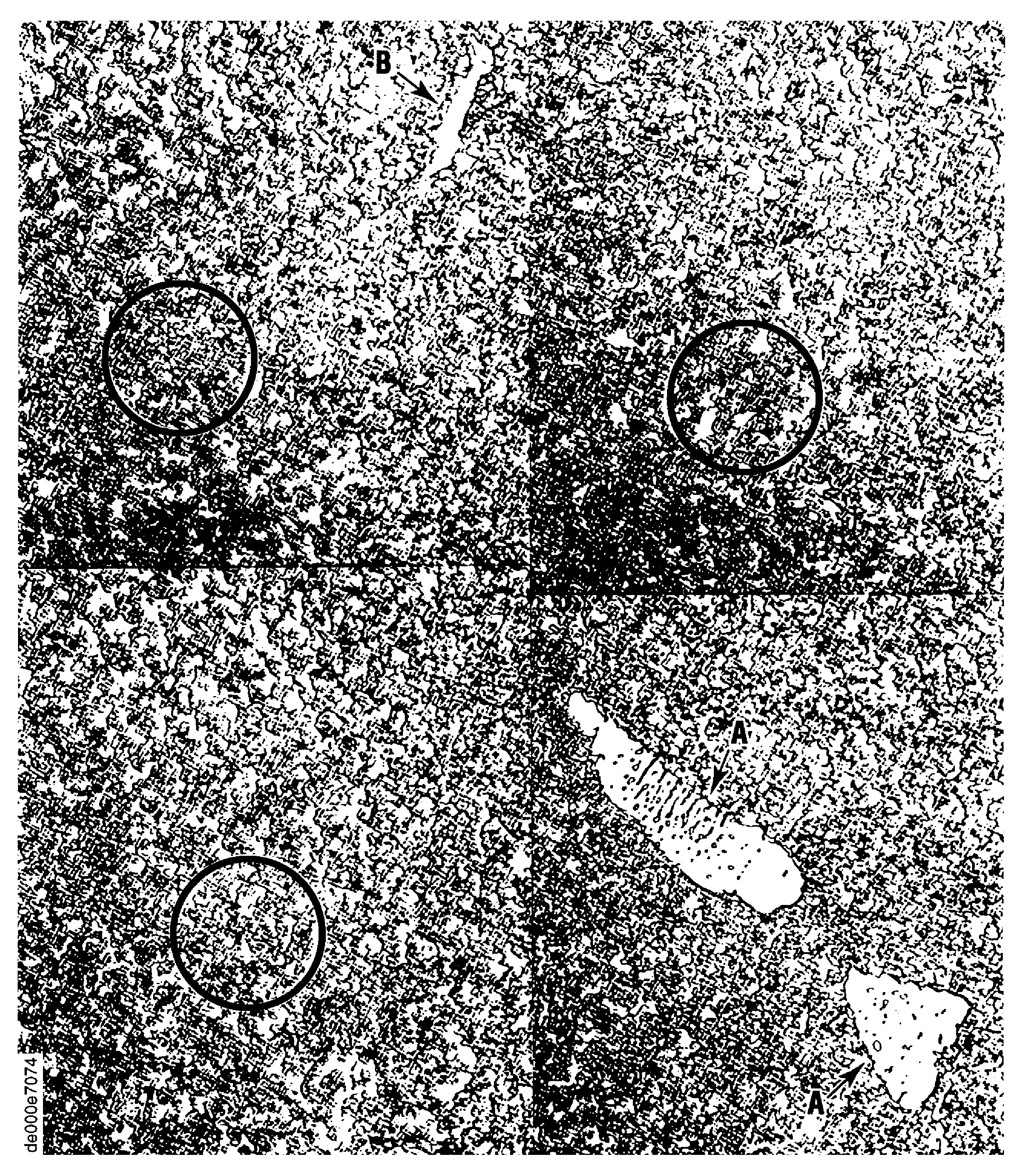
Figure:
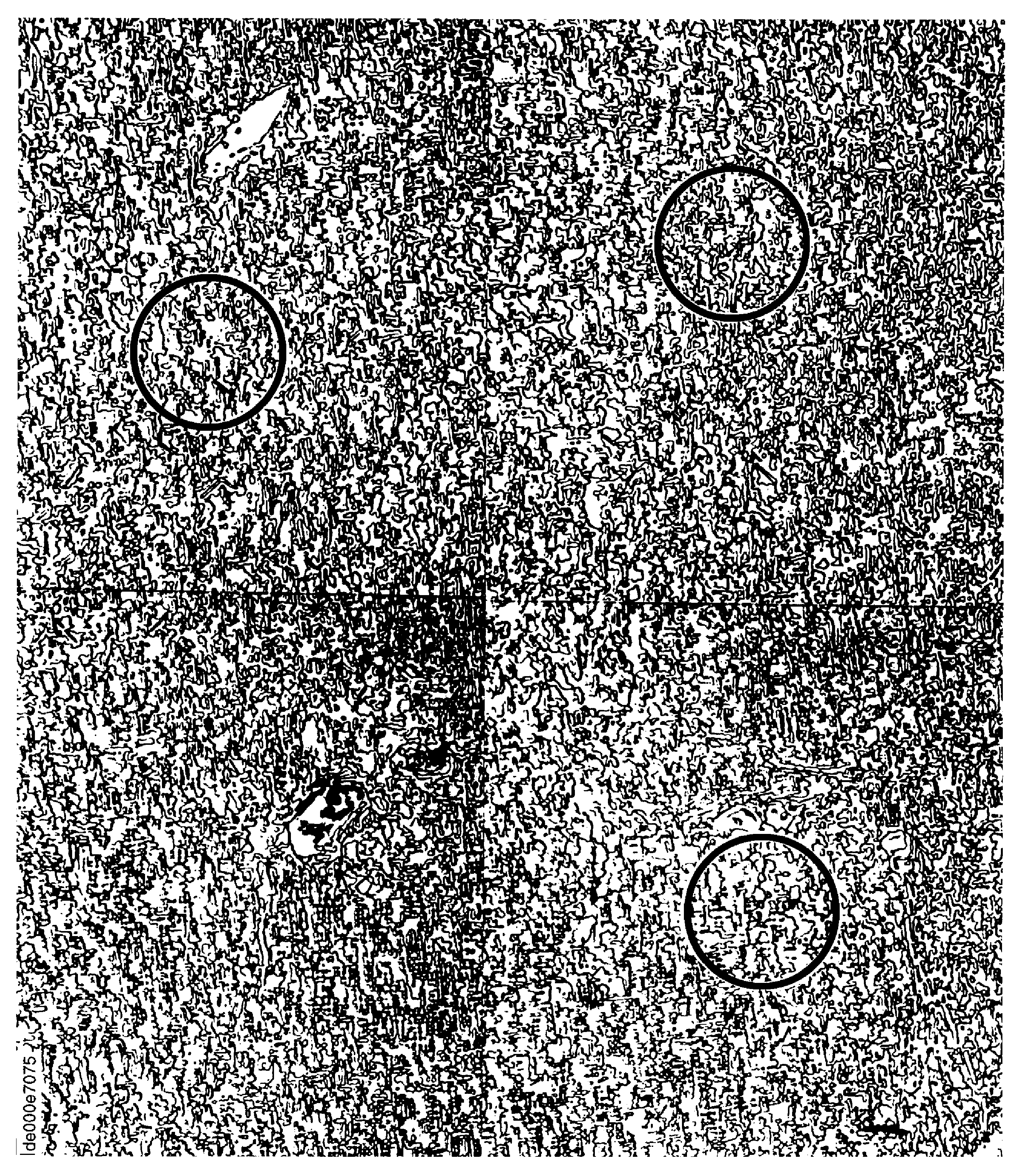
Figure:
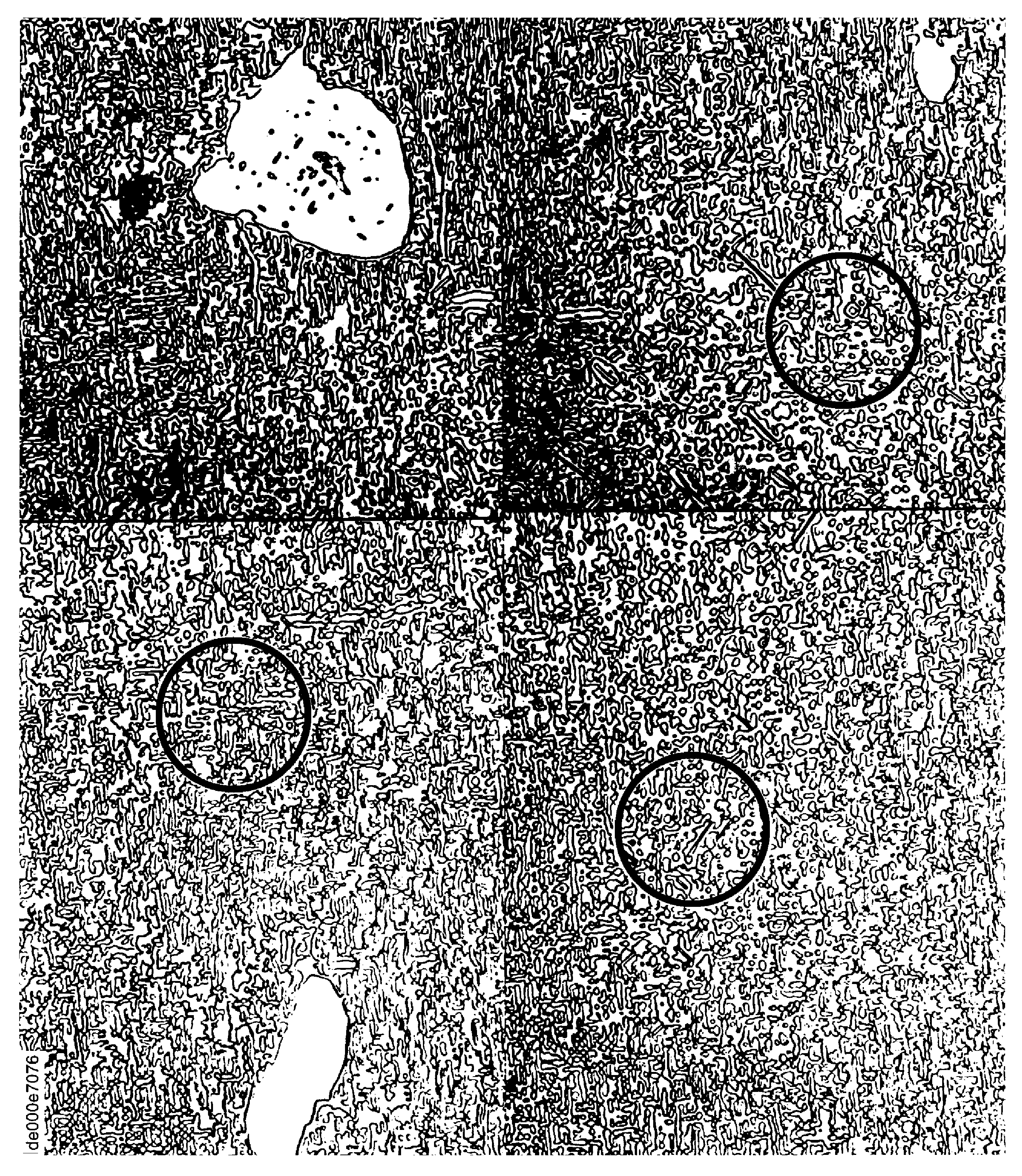
Figure:
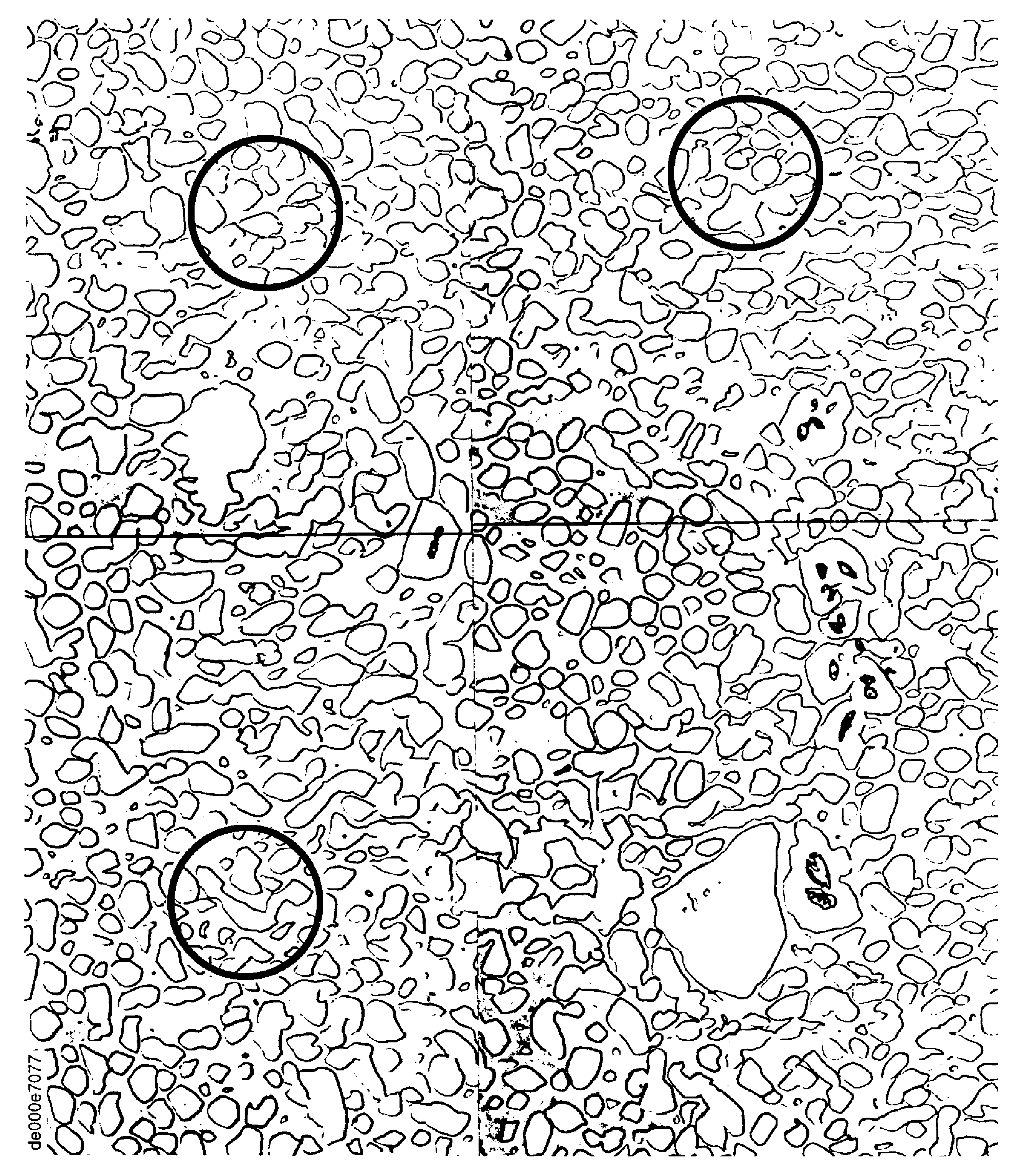
Figure: