
Export Control
EAR Export Classification: Not subject to the EAR per 15 C.F.R. Chapter 1, Part 734.3(b)(3), except for the following Service Bulletins which are currently published as EAR Export Classification 9E991: SBE70-0992, SBE72-0483, SBE72-0580, SBE72-0588, SBE72-0640, SBE73-0209, SBE80-0024 and SBE80-0025.Copyright
© IAE International Aero Engines AG (2001, 2014 - 2021) The information contained in this document is the property of © IAE International Aero Engines AG and may not be copied or used for any purpose other than that for which it is supplied without the express written authority of © IAE International Aero Engines AG. (This does not preclude use by engine and aircraft operators for normal instructional, maintenance or overhaul purposes.).Applicability
All
Common Information
TASK 72-00-31-300-004 LPC Fan Blade - Blend Repair, Repair-004 (VRS1050)
General
This repair gives the procedure to scallop the leading edge to remove the damage from the LP compressor rotor blade.
Deterioration of SFC and fan balance will occur when fan blades are dressed to this TASK.
The maximum number of dressed blades for a given LP compressor rotor blade set is the equivalent of three blades dressed to the maximum limit. Exceeding this could result in engine vibration of unacceptable limits.
This repair can only be used on the LP compressor (fan) module, with the fan blades still assembled in position.
Fan blades repaired to this scheme must be glass bead peened at the next shop visit. Glass bead peening instructions are specified in VRS1724.
Price and availability - none
A log book entry is necessary when you complete this repair.
The practices and processes referred to in the procedure by the TASK numbers are in the SPM.
NOTE
Preliminary Requirements
Pre-Conditions
NONESupport Equipment
| Name | Manufacturer | Part Number / Identification | Quantity | Remark |
|---|---|---|---|---|
| Portablegrinding equipment | LOCAL | Portable grinding equipment | ||
| Fluorescent Penetrant Inspection Equipment | LOCAL | Fluorescent Penetrant Inspection Equipment | ||
| Chemical Cleaning Equipment | LOCAL | Chemical Cleaning Equipment |
Consumables, Materials and Expendables
| Name | Manufacturer | Part Number / Identification | Quantity | Remark |
|---|---|---|---|---|
| CoMat 05-019 WATERPROOF SILICON CARBIDE | LOCAL | CoMat 05-019 | ||
| CoMat 05-020 WATERPROOF SILICON CARBIDE | LOCAL | CoMat 05-020 | ||
| CoMat 05-021 WATERPROOF SILICON CARBIDE | 44197 | CoMat 05-021 | ||
| CoMat 05-064 WATERPROOF SILICON CARBIDE | K6835 | CoMat 05-064 | ||
| CoMat 06-022 FLUORESCENT PENETRANT (POST-EMULSIFIED ULTRA HIGH SENSITIVITY) | LOCAL | CoMat 06-022 |
Spares
NONESafety Requirements

CAUTION
CAUTION
CAUTION
Procedure
CAUTION
YOU MUST USE SILICON CARBIDE TYPE ABRASIVE WHEELS, STONES AND PAPERS TO DRESS, BLEND AND POLISH THIS COMPONENT.CAUTION
IF THE MATERIAL SHOWS A CHANGE IN COLOR, TO DARKER THAN A LIGHT STRAW COLOR, THE COMPONENT IS TO BE REJECTED.CAUTION
DO NOT FORCE WITH MECHANICAL CUTTERS OR THE MATERIAL WILL BECOME TOO HOT.Remove the damage on the leading edge and the airfoil surface.
If the damage is evident in Zone AD, then you must blend parallel with the blade leading edge, to remove any material above the repaired area.
If you blend in Zone AD, then you can have one scallop in Zone AC. AA and AB may each feature a scallop, independently of the repair of Zone AD and AC.
Use CoMat 05-019 WATERPROOF SILICON CARBIDE to CoMat 05-021 WATERPROOF SILICON CARBIDE and/or CoMat 05-064 WATERPROOF SILICON CARBIDE.
Surface finish of the repair must be the same as the adjacent area.
NOTE
Make smooth and polish the repaired area.
SUBTASK 72-00-31-350-051 Remove the Damage from the LP Compressor Rotor Blade Assembly
Figure: Fan blade - scalloping limits
Fan blade - scalloping limits

Figure: Fan blade - blend details
Fan blade - blend details

Figure: Fan blade - surface dressing for pressure face and non-pressure face
Fan blade - surface dressing for pressure face and non-pressure face

Figure: Fault to avoid when blending the edge of the blades
Fault to avoid when blending the edge of the blades
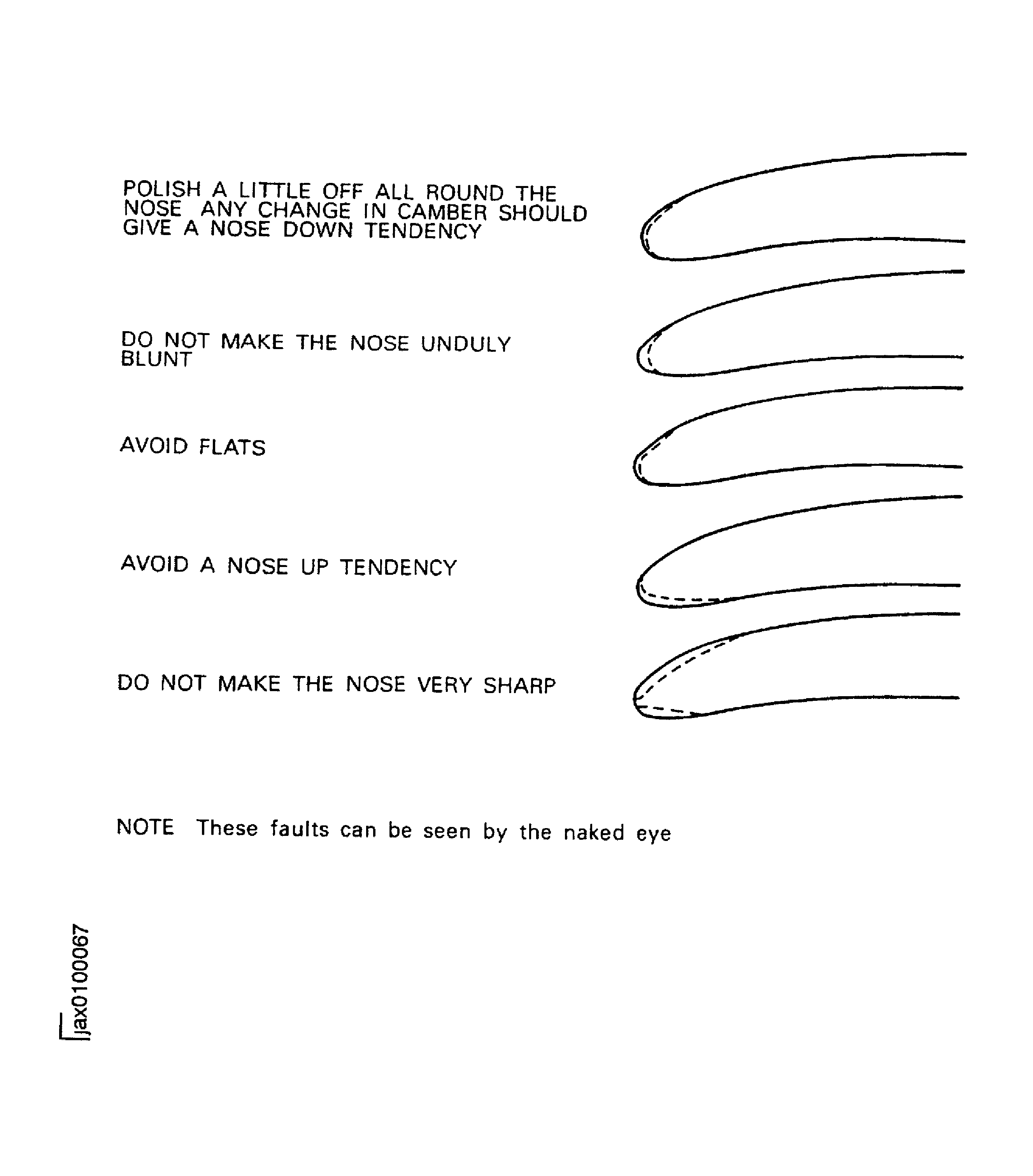
Figure: Typical example of damage before and after scalloping
Typical example of damage before and after scalloping

Figure: Fan blade - leading edge shape
Fan blade - leading edge shape

Figure: Fan blade - leading edge shape
Fan blade - leading edge shape

Figure: Fan blade - leading edge shape
Fan blade - leading edge shape
