
TASK 72-50-22-300-077 LPT Stage 4 Vane - Blend Repair, Repair-077 (VRS4372)

DMC:V2500-A0-72-50-2204-02A-649A-C|Issue No:002.00|Issue Date:2013-11-01

Export Control

EAR Export Classification: Not subject to the EAR per 15 C.F.R. Chapter 1, Part 734.3(b)(3), except for the following Service Bulletins which are currently published as EAR Export Classification 9E991: SBE70-0992, SBE72-0483, SBE72-0580, SBE72-0588, SBE72-0640, SBE73-0209, SBE80-0024 and SBE80-0025.

Copyright

© IAE International Aero Engines AG (2001, 2014 - 2021) The information contained in this document is the property of © IAE International Aero Engines AG and may not be copied or used for any purpose other than that for which it is supplied without the express written authority of © IAE International Aero Engines AG. (This does not preclude use by engine and aircraft operators for normal instructional, maintenance or overhaul purposes.).

Applicability

All

Common Information

TASK 72-50-22-300-077 LPT Stage 4 Vane - Blend Repair, Repair-077 (VRS4372)

Effectivity

FIG/ITEM

PART NO.

01-750

3A2417

01-550

3A2898

Material of component

PART IDENT

SYMBOL

MATERIAL

Stage 4 turbine vane

MTS1323B/M-247LC DS

General

Price and availability - none

The practices and processes referred to in the procedure by the TASK numbers are in the SPM.

NOTE

For more equipment and materials necessary to do this repair refer to the SPM TASK 70-23-05-230-501.

NOTE

Equivalent equipment can be used.

Preliminary Requirements

Pre-Conditions

NONE

Support Equipment

NameManufacturerPart Number / IdentificationQuantityRemark
Action swivel viseLOCALAction swivel vise
Radius gage setLOCALRadius gage set
Illuminated comparator magnifierLOCALIlluminated comparator magnifier
Dial caliperLOCALDial caliper
External dial caliperLOCALExternal dial caliper

0 - 0.787 in. (0 - 20.0 mm)

Consumables, Materials and Expendables

NONE

Spares

NONE

Safety Requirements

NONE

Procedure

    1. SUBTASK 72-50-22-350-128 General Instructions for the Blend Repair of the Stage 4 Turbine Vane

      1. Blend the nicks and pits of the stage 4 turbine vane.

      2. Do the blend repair with the stage 4 vane installed to action swivel vise.

        Use files, needle files and stones to blend the nicks and pits.

        Use illuminated comparator magnifier to examine the areas during blend repair.

      1. Polish the blended areas.

      2. Use fine stones to polish the blend repaired areas.

        After the blend repair the surface must be as smooth as the initial surface.

        Edges and corners are not permitted.

    1. SUBTASK 72-50-22-350-129 Blend Repair the Stage 3 Turbine Vane

      NOTE

      1. Refer to SUBTASK 72-50-22-350-128 before you do the blend repairs.

      2. Do not blend repair dents, but blend repair dents on leading and trailing edge.

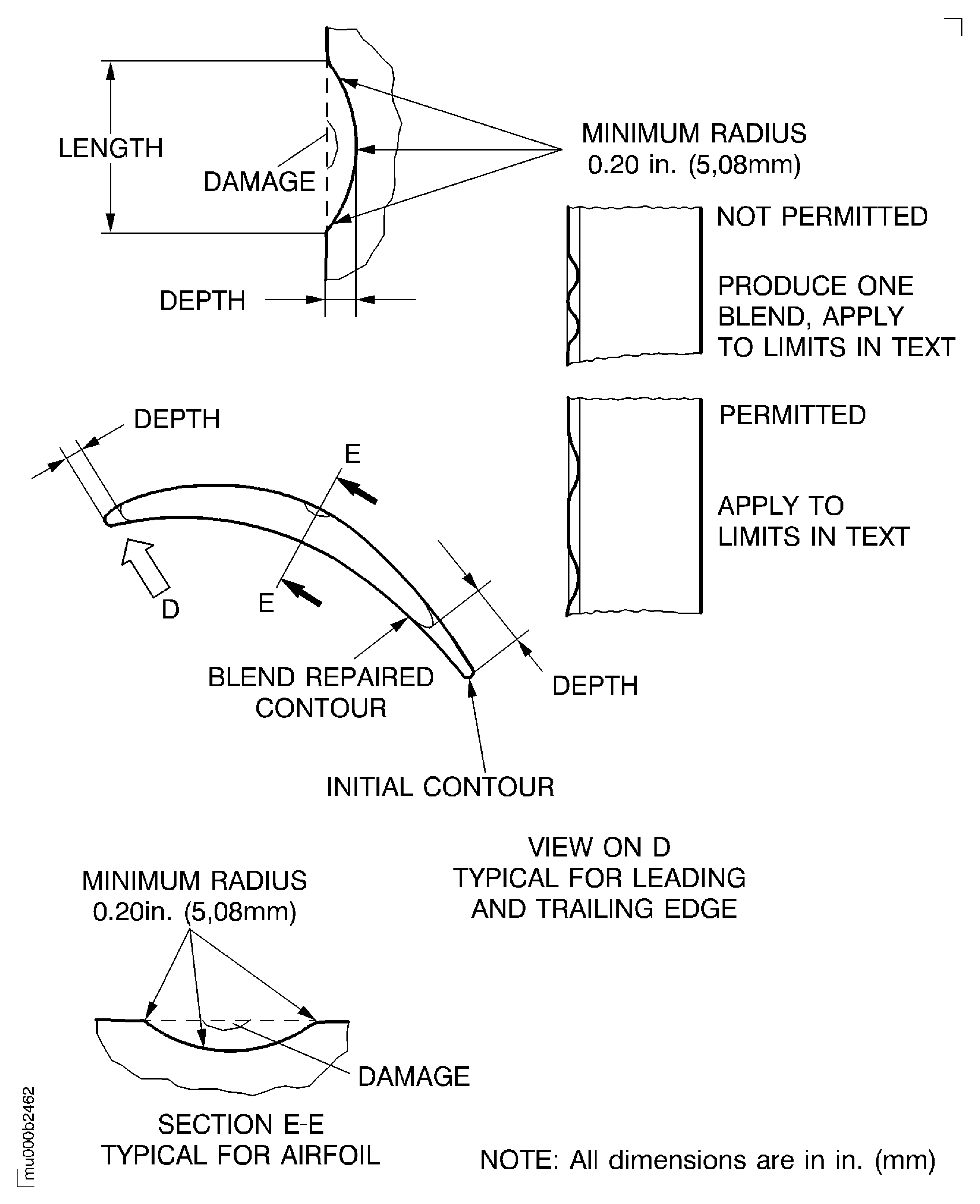
      3. The blend ratio, length to depth, must be a minimum of 5:1, refer to Figure.

      4. Keep the material removal to the minimum necessary to remove damage.

      5. The surface texture of all repaired surfaces must have the same or better quality to that of the adjacent not damaged area.

      6. Nicks within acceptable limits do not require blend repair. If there, remove raised material only.

      7. Repeated blending in one place is acceptable to the specified maximum depth, measured from the initial unblended surface.

      8. Area definition is identical with area definition at visual inspection.

    2. Refer to: Figure

      1. CAUTION

        THE MINIMUM DISTANCE BETWEEN BLENDS AT LEADING AND TRAILING EDGE IS 0.500 IN. (12.7 MM).

        Blend the surface in area A1.

      2. Blend depth from initial surface 0.010 in. (0.254 mm).

        The blended area must not be more than 10 per cent of area A1.

      1. Blend the surface in area A2.

      2. No blends permitted.

      1. Blend the surface in area A3.1.

      2. Blend depth from initial surface 0.020 in. (0.508 mm).

        The maximum permitted total depth of opposite blends on leading and trailing edge is 0.020 in. (0.508 mm).

        The total length of all blends on leading edge must not be more than 0.700 in. (17.78 mm).

      1. Blend the surface in area A3.2.

      2. Blend depth from initial surface 0.100 in. (2.54 mm).

        The maximum permitted total depth of opposite blends on leading and trailing edge is 0.100 in. (2.54 mm).

        The total length of all blends on leading edge must not be more than 0.700 in. (17.78 mm).

      1. Blend the surface in area A4.1.

      2. Blend depth from initial surface 0.020 in. (0.508 mm).

        The maximum permitted total depth of opposite blends on leading and trailing edge is 0.020 in. (0.508 mm).

        The total length of all blends on leading edge must not be more than 0.700 in. (17.78 mm).

      1. Blend the surface in area A4.2.

      2. Blend depth from initial surface 0.100 in. (2.54 mm).

        The maximum permitted total depth of opposite blends on leading and trailing edge is 0.100 in. (2.54 mm).

        The total length of all blends on trailing edge must not be more than 0.700 in. (17.78 mm).

      1. Blend the surface in area A5.

      2. Blend depth from initial surface 0.010 in. (0.254 mm).

        The blended area must not be more than 10 percent of area A5.

      1. Blend the surface in area A6.

      2. Blend depth from initial surface 0.010 in. (0.254 mm).

        The blended area must not be more than 10 percent of area A6.

      1. Blend the surface in area A7.

      2. No blends permitted.

      1. Blend the surface in area A8.

      2. Blend depth from initial surface 0.010 in. (0.254 mm).

        The blended area must not be more than 10 percent of area A8.

      1. Blend the surface in area A9.

      2. Blend depth from initial surface 0.010 in. (0.254 mm).

        Blend cracks only. Blending of nicks, dents and pits is not permitted. Remove the raised material.

    1. SUBTASK 72-50-22-230-120 Examine the Blend Repaired Areas for Cracks

      1. Do the test for cracks.

      2. Refer to the SPM TASK 70-23-05-230-501.

        Use ultra high sensitivity level.

        No cracks permitted.

    1. SUBTASK 72-50-22-220-272 Examine the Blend Repaired Area Visually and Dimensionally

      1. Examine the surface of the blended areas visually.

      2. Use illuminated comparator magnifier.

        The surface must be as smooth as the initial surface.

        Edges and corners are not permitted.

      1. Examine the blend repaired areas dimensionally.

      2. Measure the dimensions of the blended areas with dial caliper and external dial caliper.

        The limits are given in Step.

        Use radius gage set to examine the radius at each blend repaired area.

        Refer to Figure.

        Use the dial caliper to identify the extension of leading and trailing edge areas.

        Refer to Figure.

    1. SUBTASK 72-50-22-380-093 Replace the Coating of the Stage 4 Turbine Vane

      1. Replace the coating of the stage 4 turbine vane.

      2. Refer to Repair, VRS4368 TASK 72-50-22-300-092 (REPAIR-092) or Repair, VRS4370 TASK 72-50-22-300-075 (REPAIR-075).

  1. Figure: Repair Detaild and Dimensions

    Repair Detaild and Dimensions
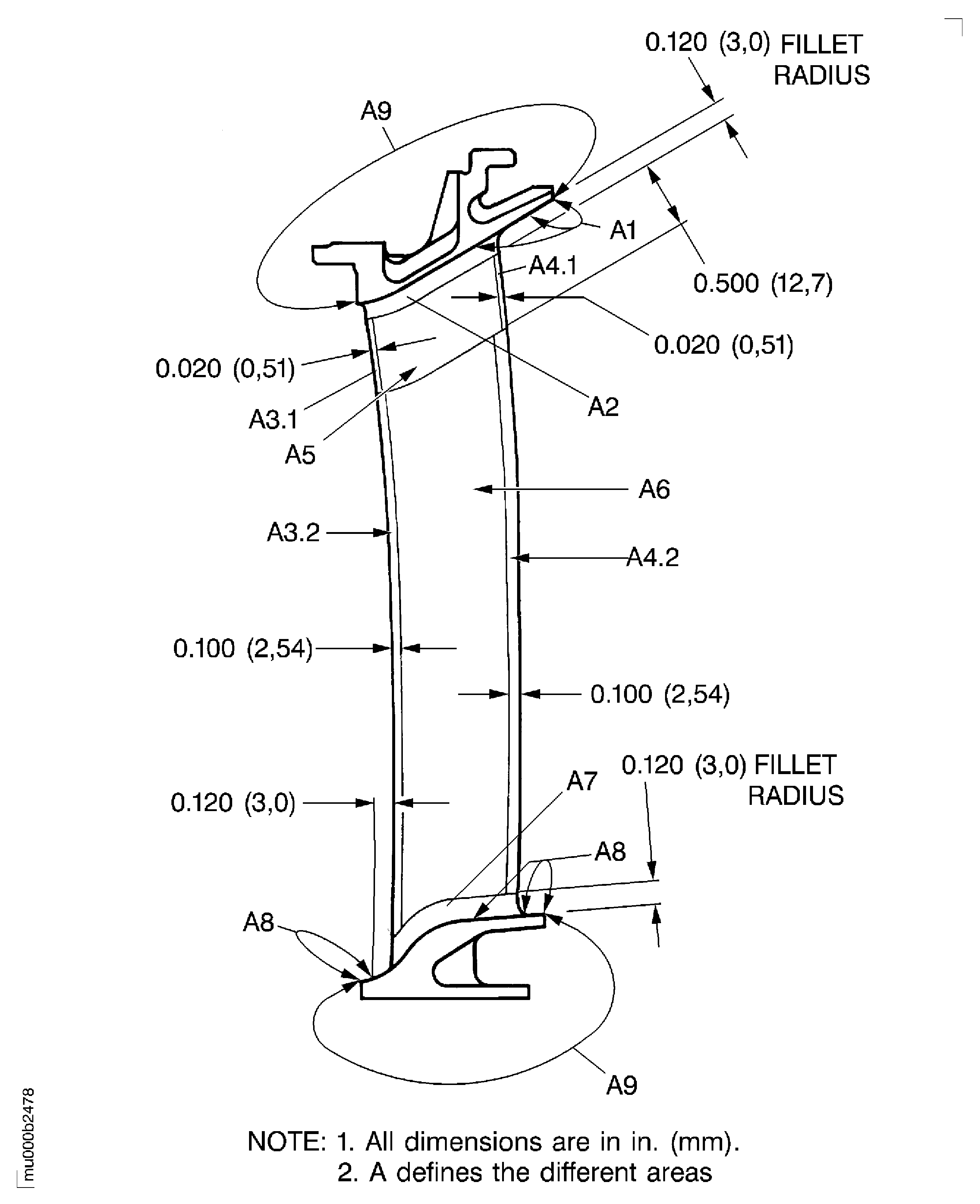
    Figure: Repair Details and Dimensions

    Repair Details and Dimensions
Requirements After Job Completion

Follow-On Conditions

NONE
Change Type:

Editorial correction due to conversion

Manufacturer Code:LOCAL
Enterprise Name:LOCALLY SUPPLIED
Manufacturer Code:LOCAL
Tool Number:Action swivel vise
Tool Name:Action swivel vise
Manufacturer Code:LOCAL
Tool Number:Dial caliper
Tool Name:Dial caliper
Manufacturer Code:LOCAL
Tool Number:External dial caliper
Tool Name:External dial caliper
Manufacturer Code:LOCAL
Tool Number:Illuminated comparator magnifier
Tool Name:Illuminated comparator magnifier
Manufacturer Code:LOCAL
Tool Number:Radius gage set
Tool Name:Radius gage set