Export Control
EAR Export Classification: Not subject to the EAR per 15 C.F.R. Chapter 1, Part 734.3(b)(3), except for the following Service Bulletins which are currently published as EAR Export Classification 9E991: SBE70-0992, SBE72-0483, SBE72-0580, SBE72-0588, SBE72-0640, SBE73-0209, SBE80-0024 and SBE80-0025.Copyright
© IAE International Aero Engines AG (2001, 2014 - 2021) The information contained in this document is the property of © IAE International Aero Engines AG and may not be copied or used for any purpose other than that for which it is supplied without the express written authority of © IAE International Aero Engines AG. (This does not preclude use by engine and aircraft operators for normal instructional, maintenance or overhaul purposes.).Applicability
All
Common Information
TASK 70-15-01-160-501 Strip Coatings By High Pressure Water Blasting
Preliminary Requirements
Pre-Conditions
NONESupport Equipment
NONEConsumables, Materials and Expendables
NONESpares
NONESafety Requirements

WARNING
Procedure
This process is not approved to remove antigallants, RTV or paint prior to fluorescent penetrant inspection. It is not to be used as a general cleaning process before fluorescent penetrant inspection. The high pressure water stripping may affect the sensitivity of the fluorescent penetrant inspection.
This process cannot be used on rotating parts, or blade/airfoil applications unless it is specifically called out in the engine manual.
Reference TASK 70-33-59-300-503 for coatings and base materials for which high pressure water stripping is approved.
It is approved to use TASK 70-15-01-160-501 to remove the materials in the subsequent list:
Chrome Plate.
Nickel Plate.
It is not approved to use TASK 70-15-01-160-501 Strip Coatings By High Pressure Water Blasting to remove the materials in the subsequent list:
See TASK 70-33-59-300-503 for coatings and base materials for which TASK 70-15-01-160-501 STRIP COATINGS BY HIGH PRESSURE WATER BLASTING is approved.
Some engine conditions can cause the complete removal of engine-run IAE 53-5 by TASK 70-15-01-160-501 STRIP COATINGS BY HIGH PRESSURE WATER BLASTING to be more difficult. Therefore, it is possible that it will be necessary to do TASK 70-33-90-300-503 to break down engine-run IAE 53-5 coating before you do TASK 70-15-01-160-501 STRIP COATINGS BY HIGH PRESSURE WATER BLASTING.
Some engine conditions can cause the complete removal of engine-run IAE 265 base coat by TASK 70-15-01-160-501 STRIP COATINGS BY HIGH PRESSURE WATER BLASTING to be more difficult.
All blade, airfoil and knife-edge seal applications require special approval. Refer to the applicable step below for the SPECIAL APPLICATION authorization procedure.
SUBTASK 70-15-01-160-001 General Data
The base metal removal must be less than 0.001 inch (0.025 mm).
This shall be demonstrated using a test piece of the same material as the component to be stripped. Adjacent masked and unmasked areas shall be exposed to the water blast and the material removal shall be assessed using metallurgical section.
The material removal should be uniform.
No grain plucking or pitting shall occur.
Base Metal Removal.
SUBTASK 70-15-01-160-002 Validation of the Process
GENERIC APPLICATION AUTHORIZATION. High pressure water stripping must not be used on rotating parts without the permission of IAE. Equipment manufacturers and equipment operators can get generic application authorization to do TASK 70-15-01-160-501 based on a GENERIC QUALIFICATION of their equipment and its operating parameters. Manufacturers with generic qualification may request from IAE the authority to self-qualify additional equipment. Operators Manufacturers and operators can use their equipment at parameters less aggressive than those evaluated in the generic qualification, and can do so without any further approval from IAE. Operators may contact IAE to determine which manufacturer has self-qualification authority. For generic application authorization, write to IAE at the address shown below. Manufacturers with generic approval are in the list that follows by source code. Refer to the Vendor List - Organizations Technical Information Repository source names/addresses identified by these numbers.
01EK9 Pratt & Whitney Automation, Inc.
26057 TAFA Inc.
27528 Progressive Surface.
7U188 Flow International.
Self-qualification authorization will include a program that demonstrates the manufacturer's testing capabilities. The manufacturer must agree to provide a summary of their self-qualified equipment to P&W on a regular basis.
Approved equipment suppliers are as follows:
All blade, airfoil, knife-edge seal, and some other applications require special application authorization from IAE.
For SPECIAL APPLICATION authorization of either an equipment supplier or user of the equipment to do TASK 70-15-01-160-501 Strip Coatings By High Pressure Water Blasting for applications not specified in the generic approval, or to use parameters that are more aggressive than those tested in the generic approval, write to IAE at the address shown below.
SUBTASK 70-15-01-160-003 Approval to Use High Pressure Water Stripping
Must be automated to assure continuous relative motion between the waterjet nozzle and the workpiece. Automation should control nozzle position and movement, part movement, and water pressure.
Typical stripping pressures are between 20,000 psi (137,895.1 kPa) and 55,000 psi (379,211.6 kPa) with water flow from 0.05 - 6 gal/minute (0.19 - 22.71 liters)/minute).
It is not necessary to use high pressures to remove soft materials, such as rubber. During the development of a procedure to remove rubber or other soft materials, start with the lowest pressure setting practicable, and then do tests of the procedure at intervals as you increase the pressure until you find the pressures that correctly remove the material.
SUBTASK 70-15-01-160-004 General Equipment Requirements and Capabilities
Make additional passes if permitted by the GENERIC QUALIFICATION OR SPECIAL APPLICATION authorization.
Strip the part by the usual stripping process that the Engine Manual or CIR Manual repair instructions specify for the part. The part must agree with all minimum wall thickness requirements and all other dimensional requirements after the removal of the remaining coating.
Do a visual inspection for total coating removal. If there is any remaining coating, do one of the steps that follow:
SUBTASK 70-15-01-160-005 High Pressure Water Blasting Procedure
WARNING
REFER TO THE MANUFACTURER'S MATERIAL SAFETY DATA SHEETS FOR CONSUMABLE MATERIAL'S INFORMATION SUCH AS: HAZARDOUS INGREDIENTS, PHYSICAL/CHEMICAL CHARACTERISTICS, FIRE, EXPLOSION, REACTIVITY, HEALTH HAZARD DATA, PRECAUTIONS FOR SAFE HANDLING, USE AND CONTROL MEASURES.No swirl patterns (shallow circular ridges caused by inadequate overlap of jet erosion patterns). See Figure.
No energy lines (visual linear indications which result when a rotating nozzle momentarily stops during stripping procedure causing nozzle jets to produce a linear indication until nozzle rotation resumes). See Figure.
Complete coating removal (no residual coating remains adhered to the substrate).
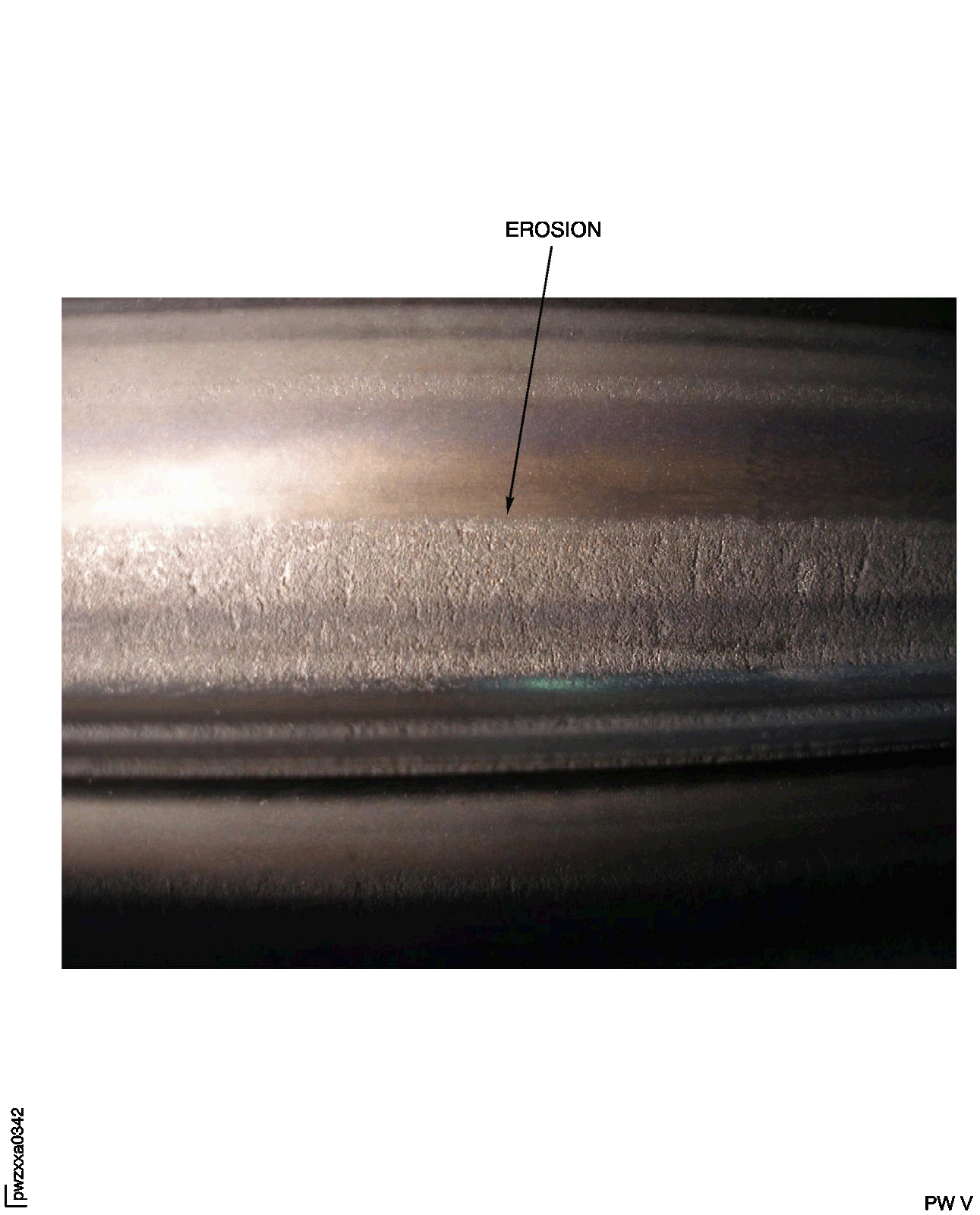
Stripped areas must not show base metal erosion. See Figure.
No increase in surface roughness (surface roughness of any area exposed to water jet stripping) beyond that allowed by controlling technical data.
If boundary is specified for stripped area, but no tolerance is given, stripping must be complete within boundary and may extend up to 0.125 inch (3.175 mm) outside boundary.
Surface texture must be uniform and matte in appearance.
Part geometry shall remain predominantly unchanged.
Visually inspect stripped production workpiece to ensure water jet stripping requirements listed below are met:
SUBTASK 70-15-01-200-001 Inspection
Figure: Example of Swirl Pattern
Example of Swirl Pattern
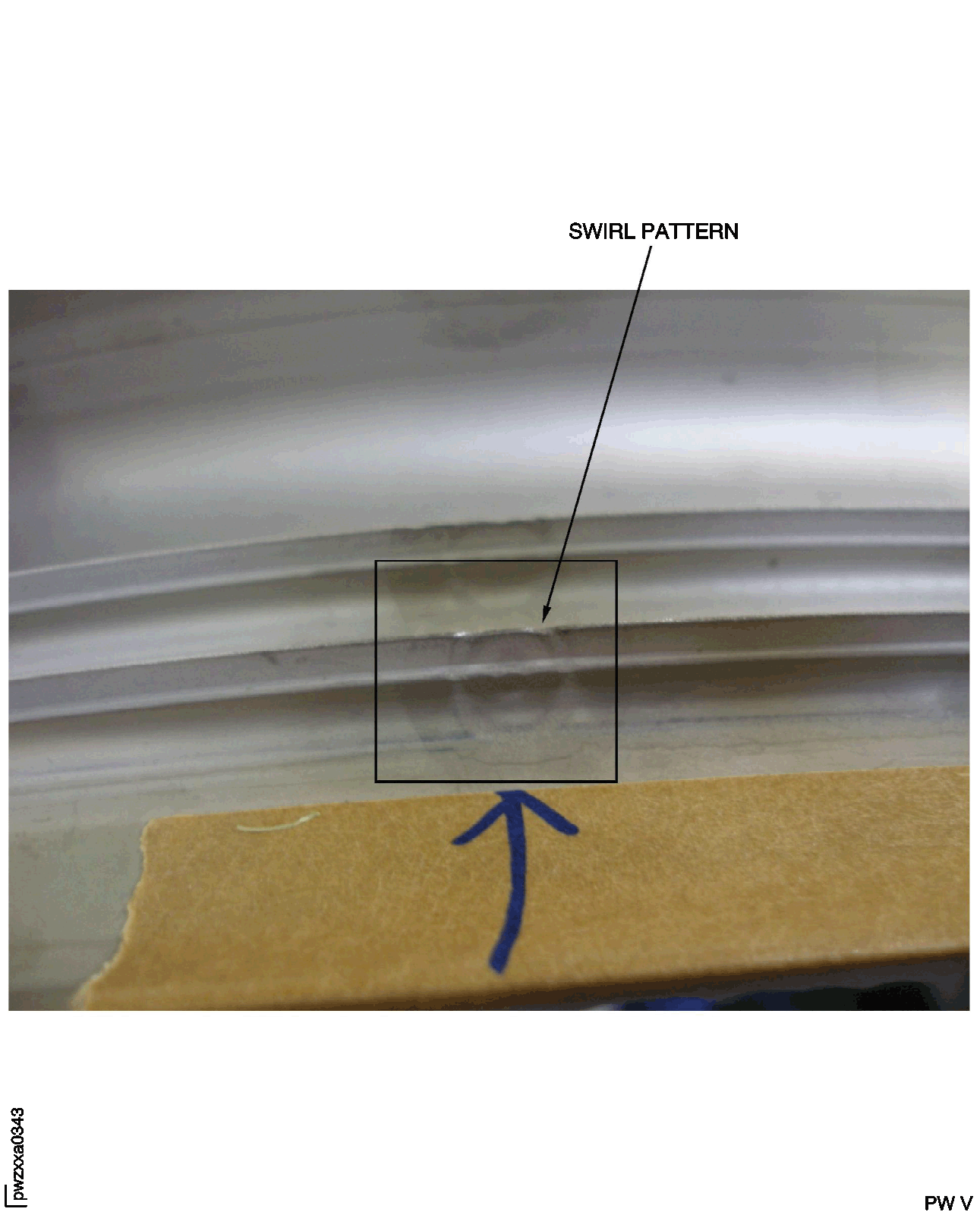
Figure: Example of Energy Lines
Example of Energy Lines
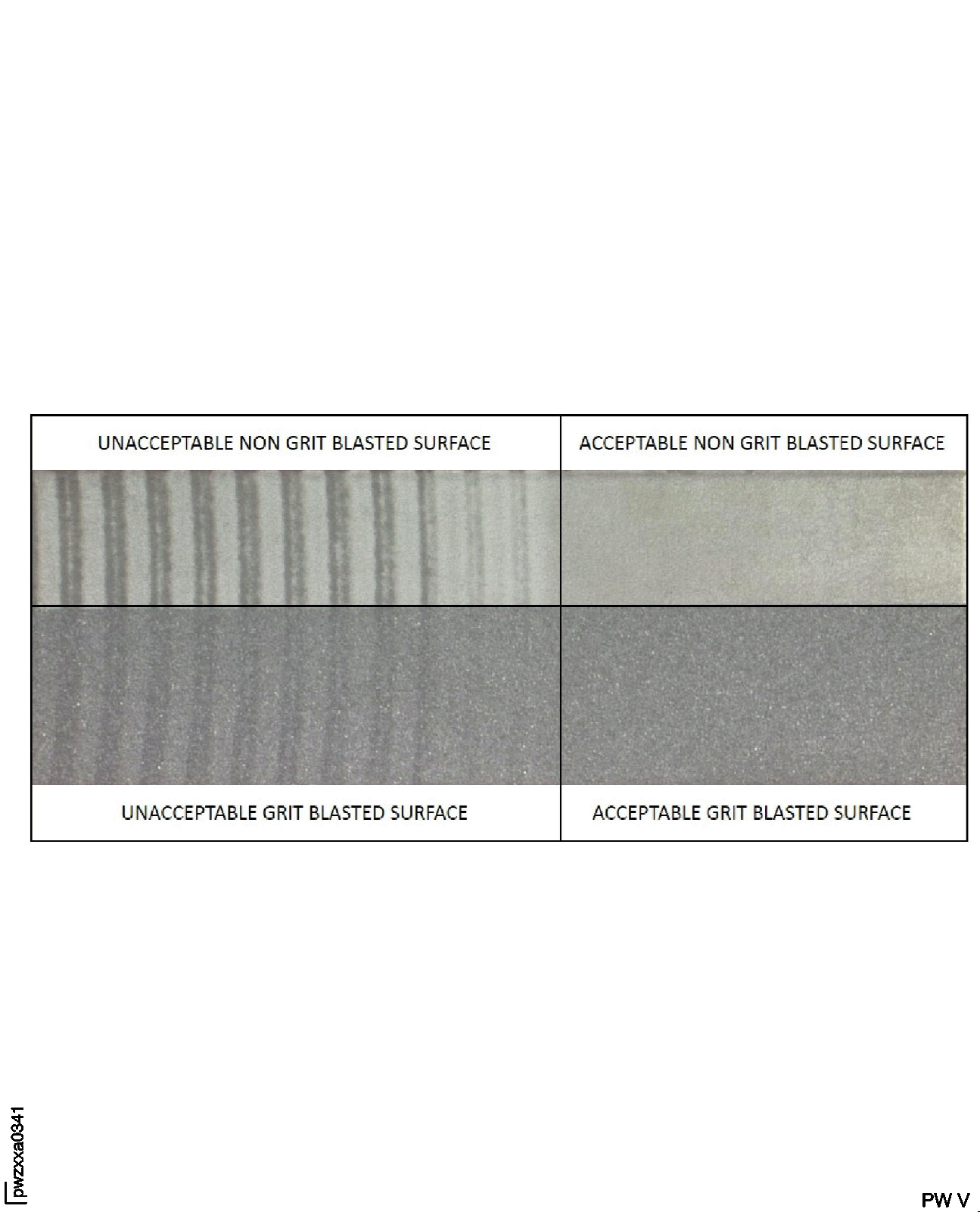
Figure: Example of Base Metal Erosion
Example of Base Metal Erosion