
TASK 72-00-45-220-002-D00 HPT Assembly - Examine The HPT Assembly Front Face At Interface M-45, Inspection-002 - SBE 72-0511

DMC:V2500-A5-72-00-4500-01D-300A-B|Issue No:005.00|Issue Date:2021-05-01

Export Control

EAR Export Classification: Not subject to the EAR per 15 C.F.R. Chapter 1, Part 734.3(b)(3), except for the following Service Bulletins which are currently published as EAR Export Classification 9E991: SBE70-0992, SBE72-0483, SBE72-0580, SBE72-0588, SBE72-0640, SBE73-0209, SBE80-0024 and SBE80-0025.

Copyright

© IAE International Aero Engines AG (2001, 2014 - 2021) The information contained in this document is the property of © IAE International Aero Engines AG and may not be copied or used for any purpose other than that for which it is supplied without the express written authority of © IAE International Aero Engines AG. (This does not preclude use by engine and aircraft operators for normal instructional, maintenance or overhaul purposes.).

Applicability

V2500-A5 and Post SBE 72-0511

Common Information

TASK 72-00-45-220-002-D00 HPT Assembly - Examine The HPT Assembly Front Face At Interface M-45, Inspection-002 - SBE 72-0511

General

The word "reject" is used after an interface inspection statement to show that a higher level inspection and possible repair to the damaged part is necessary.

Do the higher level inspection procedure as found in the applicable Chapter/Section/Subject of this manual on the damaged part(s). It is not necessary to do the higher level inspection on parts that are serviceable to the interface inspection standard.

Refer to TASK 72-00-00-200-000 (INSPECTION/CHECK-000) (examine the modular/non-modular interfaces) before you do this TASK.

The policy that is necessary for inspection is given in SPM TASK 70-20-01-200-001.

Decreased module run time will result if you install modules again that are near the maximum interface limits.

Erosion damage - Indications having a weathered, abraded, or corroded appearance

All parts must be visually examined for damage, corrosion and wear. All defects (distress, missing hardware etc.) that are not identified in the procedure must be documented and referred to IAE Technical Services.

Preliminary Requirements

Pre-Conditions

NONE

Support Equipment

NameManufacturerPart Number / IdentificationQuantityRemark
IAE 1P16046 Removal/Installation fixture0AM53IAE 1P160461
IAE 1P16543 Removal/Installation fixture0AM53IAE 1P165431

Consumables, Materials and Expendables

NONE

Spares

NONE

Safety Requirements

NONE

Procedure

    1. SUBTASK 72-00-45-220-225 Visually Examine the Bolt Holes of the Case Flange at Location 1

    2. Refer to Figure.

      1. Surface damage, dents, scratches, burrs and round-bottom nicks not more than 0.010 in. (0.25 mm) in depth with no sharp edges

      2. Accept

      1. Other than Step.

      2. Reject

      1. Sharp-bottom nicks

      2. Reject

      1. Cracks

      2. Reject

    1. SUBTASK 72-00-45-220-257 Examine the Bolt Holes of the Case Flange at Location 1

    2. Refer to Figure.

    3. Clean the bolt holes per SPM TASK 70-11-26-300-503 (PW equivalent SPOP 208).

    4. Perform local FPI per SPM TASK 70-23-05-230-501 (high sensitivity) (or equivalent PW SPOP 70).

    5. Examine the flange bolt holes carefully.

      1. If you find any indication.

      2. Reject.

    1. SUBTASK 72-00-45-220-226 Visually Examine the Case Flange at Location 2

    2. Refer to Figure.

      1. Surface damage, dents, scratches, burrs and round-bottom nicks not more than 0.010 in. (0.25 mm) in depth with no sharp edges

      2. Accept

      1. Other than Step.

      2. Reject

      1. Sharp-bottom nicks

      2. Reject

      1. Cracks

      2. Reject

    1. SUBTASK 72-00-45-220-227 Visually Examine the Surface of the Case at Location 3

    2. Refer to Figure.

      1. Surface damage, dents, scratches, burrs and round-bottom nicks not more than 0.010 in. (0.25 mm) in depth with no sharp edges

      2. Accept

      1. Other than Step.

      2. Reject

      1. Sharp-bottom nicks

      2. Reject

      1. Cracks

      2. Reject

    1. SUBTASK 72-00-45-220-228 Visually Examine the Hardface on the Outer Airseal Supports at Location 4

    2. Refer to Figure.

      1. Chipped or spalled on more than 10 percent of the hardface area

      2. Reject

    1. SUBTASK 72-00-45-220-229 Visually Examine the Diameter of the Case Flange at Location 5

    2. Refer to Figure.

      1. Round-bottom dents not more than 0.250 in. (6.35 mm) in diameter and 0.010 in. (0.25 mm) in depth

      2. Accept

      1. Wear not more than 25 percent of the contact surface

      2. Accept

      1. Other than Step or Step.

      2. Reject

    1. SUBTASK 72-00-45-220-230 Visually Examine the Stage 1 Ceramic Outer Airseals at Location 6

    2. Refer to Figure.

      1. There is metal from the blades on the airseals

      2. Accept

      1. Segments that have spalling or chipping down to the metal layer (dark color layer) for not more than:

        1. 50 percent of the ceramic

        2. Accept

      1. Cracks in the ceramic (white) layer of the coating

      2. Accept

      1. Other than Step, Step, or Step.

      2. Reject

    1. SUBTASK 72-00-45-220-231 Measure the Stage 1 Turbine Blade Tip Clearance at Location 7

    2. NOTE

      The IAE 1P16046 Removal/Installation fixture or IAE 1P16543 Removal/Installation fixture is installed when you remove the HP turbine rotor and stator assembly from the engine. Do not remove this fixture when you do the inspection.

      Refer to Figure.

      1. Measure at eight equally spaced locations in the axial center of the rub groove. Do not rotate the rotor.

        1. More than 0.077 in. (1.96 mm) (average of eight measurements)

        2. Reject

    1. SUBTASK 72-00-45-220-232 Visually Examine the Stage 1 Turbine Blades at Location 8

    2. Refer to Figure, Figure and Figure.

      1. Nicks and dents on the airfoil.

        1. If the nick or dent is in Area A or B and is larger than 0.200 in. (5.08 mm)

        2. Reject

      1. Erosion or burns on the airfoil or platforms.

        1. If the erosion or burn is on the leading edge and extends more than 20 percent of the airfoil radial length

        2. Reject

        1. If the erosion or burn on the leading edge has changed the shape of the airfoil

        2. Reject

        1. If the erosion or burn on the airfoil or the platform has gone through the coating. This does not include burns on the leading edge

        2. Reject

        1. If the erosion or burn on the airfoil trailing edge in the inner 50 percent of Area A is more than 0.050 in. (1.27 mm) axially

        2. Reject

        1. If the erosion or burn on the airfoil trailing edge in the outer 50 percent of Area A is longer than 0.070 in. (1.78 mm) axially except for the tip

        2. Reject

        1. If the erosion or burn on the blade tip is longer than 0.050 in. (1.27 mm) radially. (For reference, the top row of cooling holes on the concave side are 0.090 in. (2.29 mm) from the tip)

        2. Reject

      1. Cracks on the airfoil.

        1. If the crack is in Area A or B and is longer than 0.050 in. (1.27 mm)

        2. Reject

        1. If the crack in Area A or B extends from a burned area and the combination of the burn plus the crack is longer than 0.050 in. (1.27 mm)

        2. Reject

        1. If the crack is in Area C and is longer than 0.070 in. (1.78 mm)

        2. Reject

        1. If the crack in Area C extends from a burned area and the combination of the burn plus the crack is longer than 0.070 in. (1.78 mm)

        2. Reject

        1. If a radial crack on the airfoil which starts at the blade tip is longer than 0.120 in. (3.05 mm). The number of cracks is not important

        2. Reject

      1. Cracks on the platform.

        1. If there are cracks which are longer than 0.080 in. (2.03 mm)

        2. Reject

        1. If there is a crack which goes through the platform to the airfoil fillet radius. The number of cracks is not important

        2. Reject

      1. Discoloration or particles on the airfoil or platform

      2. Accept

    1. SUBTASK 72-00-45-220-233 Visually Examine the Outer Surface of the Outer Seal at Location 9

    2. Refer to Figure.

      1. Scored or grooves

      2. Reject

    1. SUBTASK 72-00-45-220-234 Visually Examine the Outer Seal Surface at Location 10

    2. Refer to Figure.

      1. Nicks or dents

      2. Reject

      1. Look for sign of soot and oil.

      2. If signs of soot and oil are found, inspect the High Pressure Turbine for possible oil ignition event. Refer to TASK 72-45-00-200-801.

      3. Report all findings to IAE Technical Services.

    1. SUBTASK 72-00-45-220-235 Visually Examine the Knife-Edges of the Outer Seal at Location 11

    2. Refer to Figure.

      1. Chips, cracks, nicks, bent or worn to the base metal

      2. Reject

    1. SUBTASK 72-00-45-220-236 Visually Examine the Knife-Edges of the Inner Seal Location 12

    2. Refer to Figure.

      1. Cracks

      2. Reject

      1. Nicks or bent

      2. Repair, VRS3199 TASK 72-45-13-300-001 (REPAIR-001)

    1. SUBTASK 72-00-45-220-237 Visually Examine the Disk Surface at Location 13

    2. Refer to Figure.

      1. Nicks or dents

      2. Reject

    1. SUBTASK 72-00-45-220-238 Visually Examine the Stage 2 Turbine Disk at the HPT Retaining Nut Mating Face at Location 14

    2. Refer to Figure.

      1. Scored or high metal

      2. Repair, VRS3238 TASK 72-45-31-300-001 (REPAIR-001)

    1. SUBTASK 72-00-45-220-239 Visually Examine the Stage 2 Disk at Location 16

    2. Refer to Figure.

      1. Scored or high metal

      2. Repair, VRS3238 TASK 72-45-31-300-001 (REPAIR-001)

    1. SUBTASK 72-00-45-220-240 Visually Examine the Stage 2 Disk Splines at Location 17

    2. Refer to Figure.

      1. Damage

      2. Reject

    1. SUBTASK 72-00-45-220-241 Visually Examine the Metering Plugs of the Stage 2 Disk at Location 15

    2. Refer to Figure.

      1. Metering plugs can be removed by hand (four places)

      2. Reject

    1. SUBTASK 72-00-45-220-242 Visually Examine the Stage 1 Disk Splines at Location 18

    2. Refer to Figure.

      1. Damage

      2. Reject

    1. SUBTASK 72-00-45-220-243 Visually Examine the Stage 1 Disk at Location 19

    2. Refer to Figure.

      1. Scored or high metal

      2. Repair, VRS3184 TASK 72-45-11-300-001 (REPAIR-001)

    1. SUBTASK 72-00-45-220-244 Visually Examine the Cooling Air Holes of the Inner Seal at Location 20

    2. Refer to Figure.

      1. Cracks

      2. Reject

      1. There are signs of soot and oil.

      2. If signs of soot and oil are found, inspect the High Pressure Turbine for possible oil ignition event. Refer to TASK 72-45-00-200-801.

      3. Report all findings to IAE Technical Services.

    1. SUBTASK 72-00-45-220-245 Visually Examine the TOBI Seal Inner Diameter at Location 21

    2. Refer to Figure.

      1. There is scored high material, damage, and/or erosion

      2. Reject. Examine the No.4 bearing rear carbon seal. Refer to TASK 72-43-20-200-002. Report all findings to IAE Technical Services

      1. There are signs of soot and oil.

      2. If signs of soot and oil are found, inspect the High Pressure Turbine for possible oil ignition event. Refer to TASK 72-45-00-200-801.

      3. Report all findings to IAE Technical Services.

    1. SUBTASK 72-00-45-220-249 Visually Inspect Area of HPT Stage 1 Hub between Inner and Outer Air Seal at Location 22

      1. There are signs of soot and oil.

      2. If signs of soot and oil are found, inspect the High Pressure Turbine for possible oil ignition event. Refer to TASK 72-45-00-200-801.

      3. Report all findings to IAE Technical Services.

    1. SUBTASK 72-00-45-220-266 Visually Examine the Outer Seal Area between the Knife-Edges at Location 23

    2. Refer to Figure.

      1. Chipped coating.

      2. Accept.

  1. Figure: Locations At Interface M-45

    Locations At Interface M-45
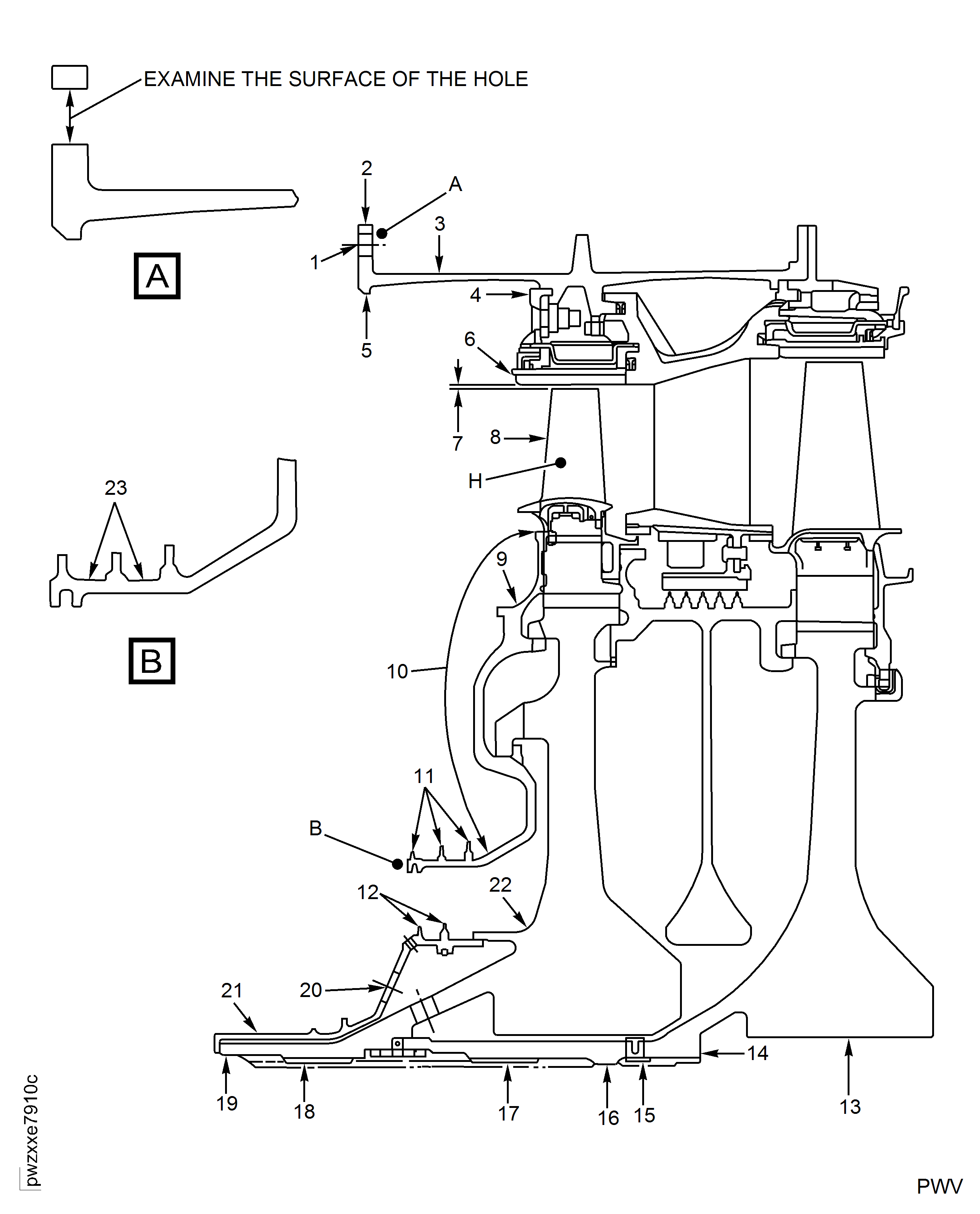
    Legend
    1

    Locations At Interface M-45

    Sheet 1

    Close

    Figure: Stage 1 HPT Blade Inspection Areas

    Sheet 2
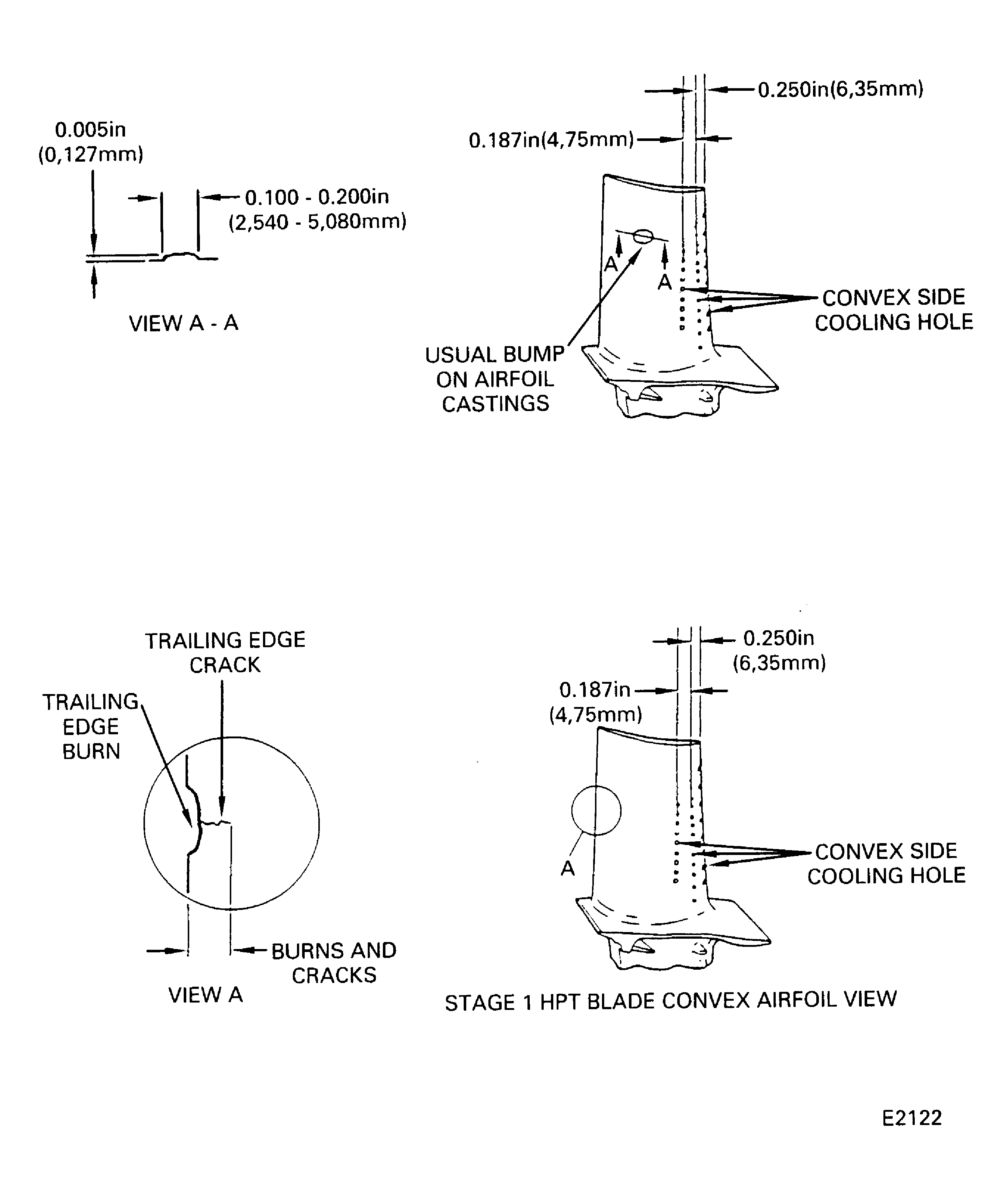
    Legend
    Stage 1 HPT Blade Inspection Areas

    Sheet 2

    Close

    Figure: Stage 1 HPT Blade Inspection Areas

    Sheet 3
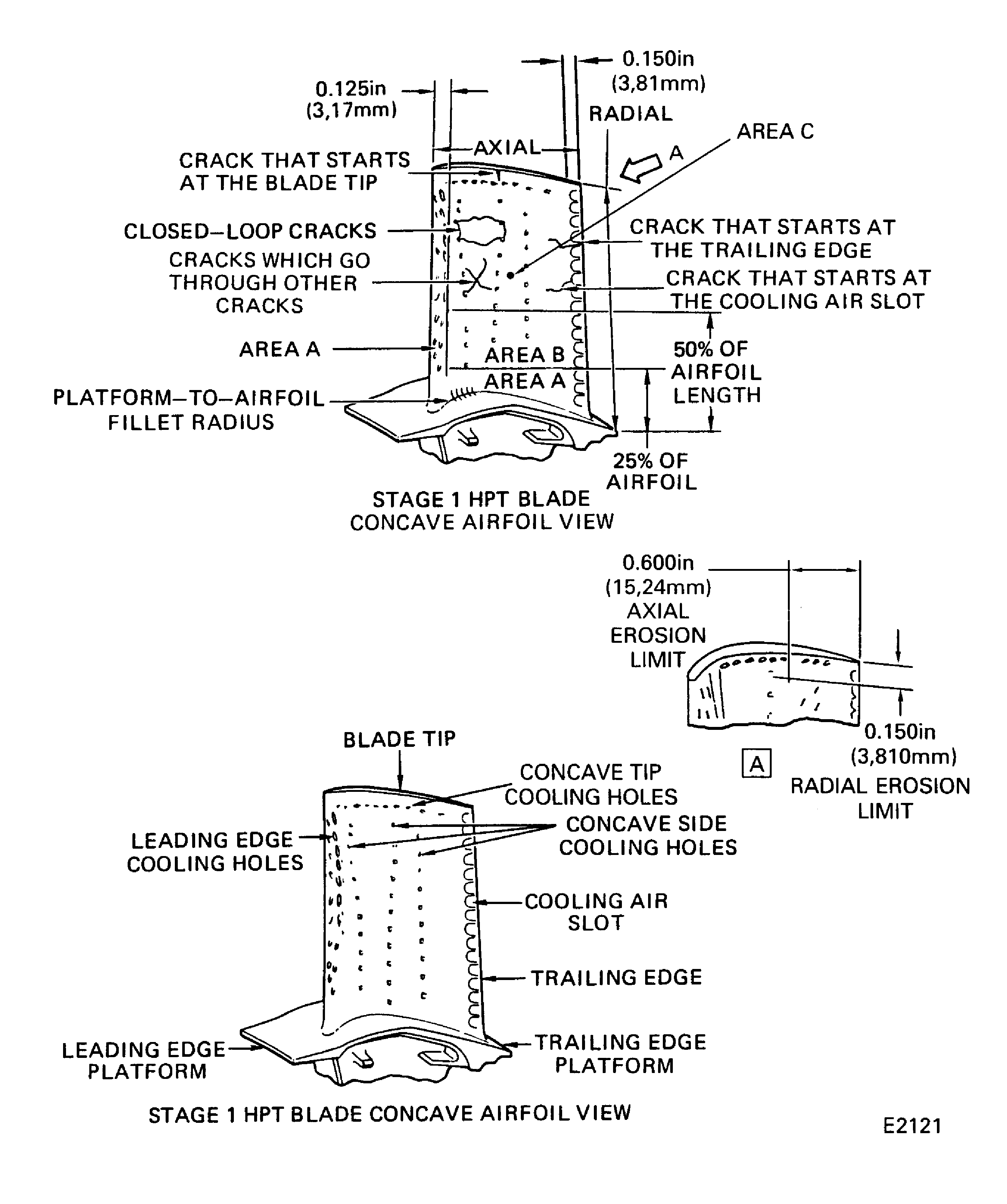
    Legend
    Stage 1 HPT Blade Inspection Areas

    Sheet 3

    Close

Requirements After Job Completion

Follow-On Conditions

NONE
Change Type:

Added new subtask and revised figure. (20VC456)

Manufacturer Code:0AM53
Enterprise Name:IAE INTERNATIONAL AERO ENGINES AG
BU Name:NULL
Building:SUITE 400
Street:628 HEBRON AVENUE
City:GLASTONBURY
State:CT
Zip Code:06033
Country:USA
Manufacturer Code:0AM53
Tool Number:IAE 1P16046
Tool Name:IAE 1P16046 Removal/Installation fixture
Manufacturer Code:0AM53
Tool Number:IAE 1P16543
Tool Name:IAE 1P16543 Removal/Installation fixture