
TASK 70-34-03-340-501 Thermal Spray Coating Application - General Data

DMC:V2500-00-70-34-03-00A-609A-D|Issue No:003.00|Issue Date:2020-05-01

Export Control

EAR Export Classification: Not subject to the EAR per 15 C.F.R. Chapter 1, Part 734.3(b)(3), except for the following Service Bulletins which are currently published as EAR Export Classification 9E991: SBE70-0992, SBE72-0483, SBE72-0580, SBE72-0588, SBE72-0640, SBE73-0209, SBE80-0024 and SBE80-0025.

Copyright

© IAE International Aero Engines AG (2001, 2014 - 2021) The information contained in this document is the property of © IAE International Aero Engines AG and may not be copied or used for any purpose other than that for which it is supplied without the express written authority of © IAE International Aero Engines AG. (This does not preclude use by engine and aircraft operators for normal instructional, maintenance or overhaul purposes.).

Applicability

All

Common Information

TASK 70-34-03-340-501 Thermal Spray Coating Application - General Data

Table 1.

Introduction

Health Precautions

Methods Used to Apply Plasma Spray Coatings

General

Standard Equipment

Prepare the Surface of the Parts for Plasma and Other Thermal Spray Coatings (Titanium and Non-Titanium Parts)

Relocated to the SPM TASK 70-34-18-380-501,

SUBTASK 70-34-18-340-001

Selection of the Coating

Comparative Standards for Analysis of Coating Microstructures

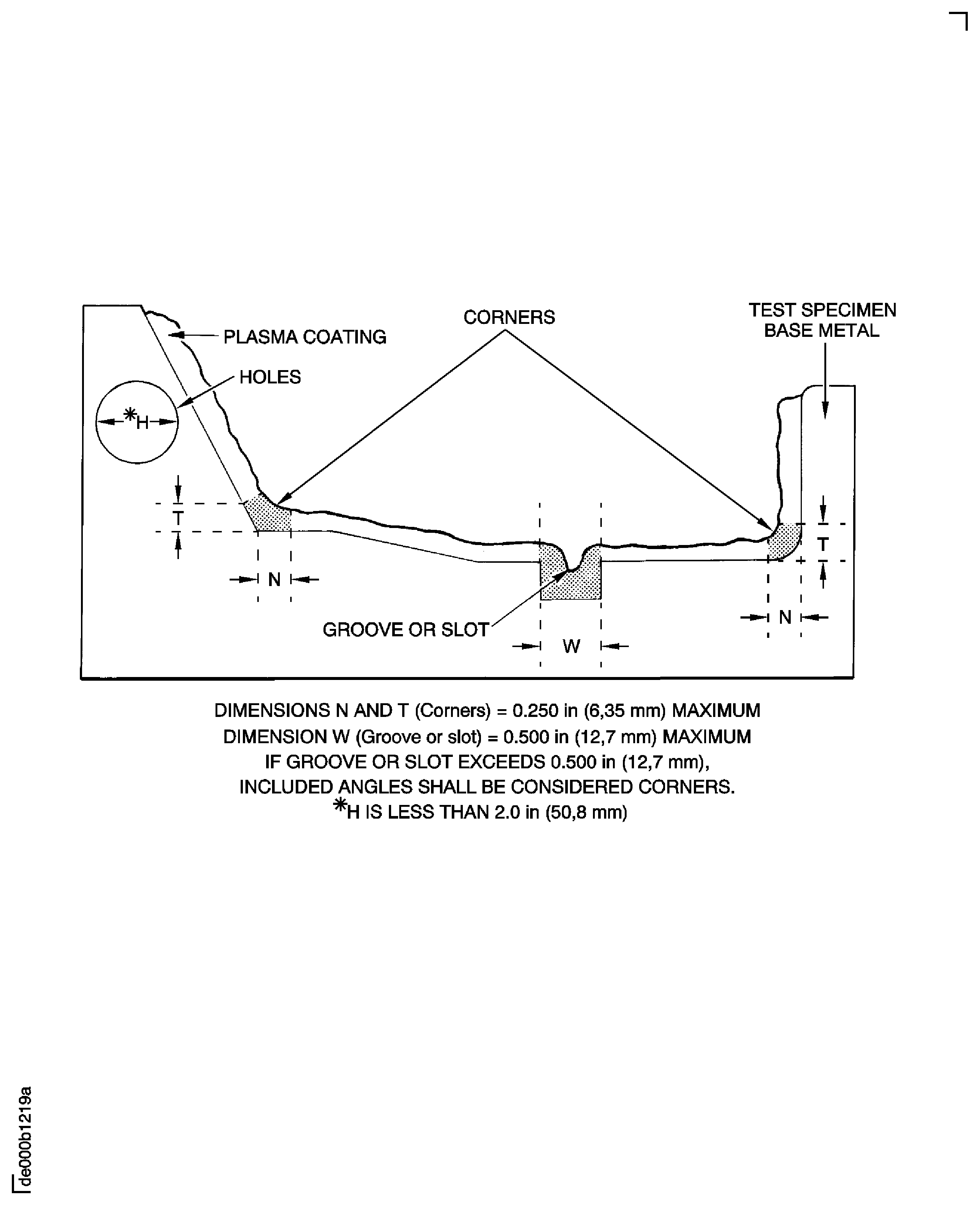
Corners, Grooves, or Slots Where Higher Amounts of Porosity or Oxides Are Permitted

Apply IAE 53-XX Plasma Coating

Apply IAE 271-XX Dual Wire Electric Arc Coating

Apply IAE 36206-XX HVOF Coating

Removal of Masking Tape

Finish the Surface of the Parts

Microplasma Spray Chip Repair

Evaluation of Ground and Lapped Plasma and Flame Deposited Coatings

Introduction

This procedure give details of the method and control of thermal spray coatings. Step gives a description of the different application methods.

IAE 53 suffix numbers refer to coatings applied by plasma spray.

IAE 271 suffix numbers refer to coatings applied by the dual wire arc process.

IAE 36206 Suffix numbers refers to coatings applied by HVOF spray process.

Preliminary Requirements

Pre-Conditions

NONE

Support Equipment

NONE

Consumables, Materials and Expendables

NameManufacturerPart Number / IdentificationQuantityRemark
CoMat 03-037 METAL SPRAYING POWDER,Ni Al08662CoMat 03-037
CoMat 03-064 PLASMA SPRAY POWDERDK026CoMat 03-064
CoMat 03-065 PLASMA SPRAY POWDERLOCALCoMat 03-065
CoMat 03-066 METAL SPRAYING POWDER, 75 CHROMIUM CARBIDE/25 (80 NICKEL - 20 CHROMIUM ALLOY), FINEDK026CoMat 03-066
CoMat 03-067 PLASMA SPRAY POWDERLOCALCoMat 03-067
CoMat 03-068 PLASMA SPRAY POWDERIE426CoMat 03-068
CoMat 03-069 PLASMA SPRAY POWDER08662CoMat 03-069
CoMat 03-074 PLASMA SPRAY POWDERLOCALCoMat 03-074
CoMat 03-076 PLASMA SPRAY POWDER0AM53CoMat 03-076
CoMat 03-077 METAL SPRAYING POWDERNI-CR ALLOYIE426CoMat 03-077
CoMat 03-078 METAL SPRAYING POWDER,Co-BASE ALLOYIE426CoMat 03-078
CoMat 03-079 PLASMA SPRAY POWDERIE426CoMat 03-079
CoMat 03-080 METAL SPRAYING POWDER,Co BASE ALLOYIE426CoMat 03-080
CoMat 03-081PLASMA SPRAY POWDER33870CoMat 03-081
CoMat 03-083 PLASMA SPRAY POWDER39918CoMat 03-083
CoMat 03-084 PLASMA SPRAY POWDER06565CoMat 03-084
CoMat 03-086 PLASMA SPRAY POWDER67027CoMat 03-086
CoMat 03-089 METAL SPRAYING POWDER Ni/Al (95/5)33870CoMat 03-089
CoMat 03-091 PLASMA SPRAY POWDER60097CoMat 03-091
CoMat 03-096 PLASMA SPRAY POWDERLOCALCoMat 03-096
CoMat 03-100 PLASMA SPRAY POWDER33870CoMat 03-100
CoMat 03-101 PLASMA SPRAY NICKEL ALUMINIUMALLOY72271CoMat 03-101
CoMat 03-124 FLAME SPRAY NICKEL-ALUMINUM(78 Ni-22 Al)39918CoMat 03-124
CoMat 03-340 PLASMA SPRAY POWDER33870CoMat 03-340
CoMat 03-396 PLASMA/FLAME SPRAY POWDER0FGH2CoMat 03-396
CoMat 03-478 WIRE, DUAL ELECTRIC ARC, MOLYBDENUM26057CoMat 03-478
CoMat 03-479 WIRE, DUAL ELECTRIC ARC, NICKEL ALLOY26057CoMat 03-479
CoMat 03-480 WIRE, DUAL ELECTRIC ARC, ALUMINUM ALLOY26057CoMat 03-480
CoMat 03-481 WIRE, DUAL ELECTRIC ARC, NICKEL-CHROMIUM/ ALUMINUM ALLOY26057CoMat 03-481
CoMat 03-482 WIRE, DUAL ELECTRIC ARC, NICKEL ALLOY39918CoMat 03-482
CoMat 03-486 POWDER, HIGH VELOCITYOXY-FUEL (HVOF)01FK3CoMat 03-486
CoMat 03-487 POWDER, HIGH VELOCITYOXY-FUEL (HVOF)01FK3CoMat 03-487
CoMat 03-488 POWDER, HIGH VELOCITYOXY-FUEL (HVOF)01FK3CoMat 03-488
CoMat 03-489 POWDER, HIGH VELOCITYOXY-FUEL (HVOF)01FK3CoMat 03-489
CoMat 03-490 POWDER, HIGH VELOCITYOXY-FUEL (HVOF)01FK3CoMat 03-490

Spares

NONE

Safety Requirements

WARNING

IT IS THE RESPONSIBILITY OF THE OPERATOR TO OBTAIN AND OBSERVE THE MANUFACTURER'S MATERIAL SAFETY DATA SHEETS FOR CONSUMABLE MATERIALS INFORMATION SUCH AS, HAZARDOUS INGREDIENTS, PHYSICAL/CHEMICAL CHARACTERISTICS, FIRE, EXPLOSION, REACTIVITY, HEALTH HAZARD DATA, PRECAUTIONS FOR SAFE HANDLING, USE AND CONTROL MEASURES AND ALSO TO TAKE LOCAL REGULATIONS INTO CONSIDERATION.

Procedure

    1. SUBTASK 70-34-03-860-001 Health Precautions

      1. Ear protection.

        1. The noise from a plasma gun in operation is sufficiently high to be considered dangerous to the operator and other personnel in the area. Noise is given off in frequencies which can and cannot be heard. Sample decibel measurements are 119 dB at the gun and 95 to 105 dB in the area up to 30 ft. (10 m) from the gun. Correct sound-proofing of the spray area, use of portable baffles at the booth entrance, and ear protection for both operator and other personnel in the area are recommended.

        2. Sound absorbing insulation - Fiberglass batts (or equivalent) - is available from supplier code 45255 (refer to the Supplier List in the PCI); however, other suppliers can be used.

        3. Perforated acoustical panels (or equivalent) are available from supplier code 3A4D4 (refer to the Supplier List in the PCI); however, other suppliers can be used.

          NOTE

          When this process is being used, earmuffs are recommended for all personnel within the process area.
        4. Earmuffs, such as Model 1200 Hear-Guard Hearing Protector (or equivalent), are available from supplier code 02622 (refer to the Supplier List in the PCI); however, other suppliers can be used.

      1. Eye and skin protection.

      2. In general, the light produced in plasma spray operations is higher in ultraviolet content than light given off in the usual electric arc welding.

      3. This light is also less intense than an electric arc because the arc is contained far inside the gun.

      4. It is not necessary for the operator to look directly in the arc to see his/her work.

        1. The intensity and ultraviolet content of light in the plasma gun operation changes with several factors, especially with the power level that is used to apply the coating. Exposure of the equipment to this light changes with:

        2. The amount of fixturing.

        3. The nature and shape of the workpiece.

        4. The number of checks the operator must do during the process.

      5. The plasma operator must have the same maximum degree or extent of eye and skin protection that is necessary for an arc welder.

      6. During the initial "learning phase" period of plasma application, the use of the usual arc welder's helmet with a No. 8 or No. 9 glass is recommended. With experience, the operator can change the shade of the lens, as necessary.

      1. Respiration protection.

      2. The need to use respirators will depend on the degree of air pollution control that you get from the exhaust ventilation, water-wash curtain, plus the general air circulation in the spray booth or work area. Good ventilation and the circulation of air away from the operator will minimize the need for respirators.

      3. It is important to know that air pollution can have different effects on different people. Some people have a very bad reaction to air contamination.

      4. Be sure to monitor the effects (if any) of new plasma coating materials that you use in the future as they can add new and different amounts and types of air contamination.

    1. SUBTASK 70-34-03-860-002 Methods Used to Apply Thermal Spray Coatings

      1. The type of heat used and the process and the equipment used are the clear differences between the groups. There are six basic groups of thermal spray coatings:

      2. Gaseous fuel and oxygen flame.

      3. Detonation.

      4. Plasma spray.

      5. Dual wire electric arc.

      6. HVOF Spray.

      7. Microplasma.

    2. Gaseous fuel and oxygen flame.

      Terms such as flame spray, powder spray, and wire spray, generally refer to a procedure which uses gaseous fuel and oxygen flame to melt and propel molten metal on to the surface of parts. The metal can be supplied to the gun in wire or powder form. There are different types of this equipment but the basic principle is the same and the heat available is the limiting factor. Metals with relatively low melting points can be applied in this manner. The gun can be held by hand or supported in position. This type of equipment is relatively inexpensive but is not able to apply coatings that require heat greater than 5000 deg F (2760 deg C).

    3. Detonation.

      This process is known as Praxair's D-Gun Process. The process uses a cannon-like device inside a concrete room with an outside control area. An explosive mixture of gas and oxygen is ignited in the combustion chamber which erupts from the open barrel end. As the gases pass out of the barrel, the metallic powder is melted by a shock wave and propelled by the pressure wave which follows. This process is used to apply hard coatings with relatively high density which is obtained by the very high speed at impact. This is a proprietary process which requires shipment of parts outside the overhaul shop.

    4. Plasma spray.

      Plasma coatings use a high intensity electric arc which heats an inert (or relatively inert) gas or gaseous mixture to an ionized state. This causes expansion of the gas which results in a high velocity. Powdered metal is injected in to the hot flame, melted, and propelled on to the surface of the part. The advantage of plasma is the higher temperatures which can be used, up to 20,000 to 30,000 deg F (11.093 to 16.649 deg C) and the inert atmosphere which permits control of oxides in the coating. Plasma equipment is easily available at reasonable cost, and the work area can be located in an overhaul shop. It gives a selection of coatings and only an average level of skill is necessary.

    5. Dual wire arc.

      The dual wire arc process creates an electric arc between two feed stock wires. The arc causes the wires to melt and high pressure gas propels the molten metal to the substrate.

    6. HVOF Spray.

      The High - Velocity-Oxy-Fuel (HVOF) process uses an oxygen-fuel (propylene,propane,hydrogen,natural gas or kerosene) mixture, high kenetic energy, and combustion thermal output to propel axially or radially-fed powder feed stock. High inlet process gas pressures and system and gun components designs cause high particle velocities. These coatings usually have low residual internal stresses, low oxide levels, and high bond strengths and densities. Thus, the operator can usually spray HVOF coatings to higher thicknesses than other thermally sprayed coatings.

    7. Microplasma.

      The Compact Plasma Spray (CPS or Microplasma) process is technically the same as the standard plasma spray process but the gun and its components cause a much narrower spray pattern. CPS coatings are applied either manually or with automated equipment. The CPS process makes it easier to apply the coating to a small area and to repair local coating chips with only minimal masking necessary.

      NOTE

      All of the coatings are mechanically bonded to the surface and should not be confused with fusion weld type hardfacing. The temperature of the part can usually be kept below 400 deg F (204 deg C) to keep distortion to a minimum. Each coating mixture has distinct characteristics which are used on different parts to best advantage. Plasma coatings are used regularly for the repair of jet engine parts to return them to a serviceable condition.
    1. SUBTASK 70-34-03-860-003 General

      1. Thermal spray coating repairs are usually the last to be completed on a part. All acid and alkali cleaning, inspection (except dimensional), anodizing, peening, welding, and electro-plating repairs, must be completed and accepted before plasma coating, unless:

      2. The part is sufficiently masked, or.

      3. IAE Materials Engineering gives approval.

    2. Data and illustrations related to the removal of old coatings, surface conditioning, plasma coating, and finishing of plasma coating, where necessary, will be included in the Engine Manual Repair Section with other repairs to the part, or in Service Bulletins.

      1. It is necessary to get IAE Repair Source Approval before application of IAE 53-XX coatings on any knife-edge seals, brush seals, seal plates, bearing seal faces, or blade tips. Prospective sources must request qualification through IAE Engineering. Plasma spray repairs on disks, hubs, rotor shafts, and rotor spacers are not recommended except where permitted in the applicable engine repair instructions. Conditions to be observed at these repairs are as follows:

        1. Unless specified differently, thermal spray coating, or impingement, is not permitted on mating diameters or fillet radii. Prevent coating and overspray on to these areas with correct masking.

        2. Removal of such coating on parts that were peened will make necessary the removal of all coating from the mating diameter. It will also be necessary to do peening again before you apply the new coating.

      2. Parts must be shotpeened before the grit blast preparation for plasma spraying. The necessary data will be given in the repair instructions.

      3. For each mating diameter repair on a disk, hub or rotor shaft, the fillet radius of the undercut made in the preparation for the coating must not be smaller than the initial mating diameter fillet radius, and neither the undercut or its fillet radius can extend in to the adjacent face surface.

    3. Dual wire electric arc spray coatings (that is, the IAE 271-XX coatings) can be used in place of IAE 53-XX coatings in many applications. They can usually be applied to greater thicknesses than equivalent composition plasma spray coatings. Refer to Step.

    1. SUBTASK 70-34-03-860-004 Standard Equipment

    2. Sufficient work area and many items of support equipment are necessary for the plasma coating procedure. The correct equipment, space, and lay-out for the plasma coating procedure will help with the quality of the coating and make shorter the time necessary to get and keep the sufficient level of plasma coating skills.

    3. A suggestion for a typical set of plasma spray equipment is contained in the Facilities Equipment Manual (FEM) under section 12.

      The main items are:

      RT 001 Acoustic Room, Modularized.

      RT 002 Power Supply.

      RT 004 Turntable.

      RT 005 Control Assembly, Turntable.

      RT 006 Transverse Unit, Horizontal and Vertical.

      RT 007 Control Assembly, Transverse Unit.

      RT 008 Collector, Airborne Particle.

      RT 010 Heat exchanger.

      RT 012 Gun, Plasma Spray.

      RT 018 Computer, Control Unit.

      RT 019 Distribution Unit.

      RT 020 Powder Feed Unit.

      RT 021 Main Unit.

      Equivalent equipment which leads to achievement of process requirements can be used also.

      1. Give special attention to:

        1. Plasma gun.

          1. The data which follows is given as a guideline only.

          2. Power - 20 to 40 Kw.

            NOTE

            Nitrogen or a nitrogen/hydrogen blend can be used when IAE 53-10, -12 and -33 coatings are used.
          3. Arc Gas - Equipment which can use argon, helium, argon/helium blend, argon/25% maximum hydrogen blend, helium/25% maximum hydrogen blend, or argon/helium/25% maximum hydrogen blend must be used.

          4. Powder feed - Use a system which has been shown to give constant and satisfactory performance.

        1. Arc gas.

        2. The plasma coating acceptance standards given in the SPM TASK 70-34-03-340-501-001 were developed with argon or helium gas or mixtures of argon and helium gas with up to a maximum of 25% hydrogen gas by volume.

      1. Fixtures/Supports.

        1. Fixtures must be available to support the workpieces and (if necessary) spray gun in such a way that the gun-to-workpiece distance and angle can be controlled and repeated. Fixtures and supports are the responsibility of the operator.

        2. For large engine parts, such as cases, a variable speed turntable, which can have its angle changed, is necessary. Locally made adapters to hold the workpiece to the turntable are also necessary. For a supplier of turntables, refer to supplier code 95226 in the PCI Supplier List; however, other suppliers can be used, if equally competent, to make the necessary item.

        3. For smaller engine parts, different sized lathes or locally made or purchased turntables and adapters will be sufficient to support workpieces.

      1. Degreasing Equipment.

      2. Parts must be clean and free of any oil or contamination. Degreasing equipment used in the SPM TASK 70-11-03-300-503 is recommended. The same degreasing equipment used in the usual cleaning of parts in the engine overhaul can be used for parts which are to be plasma coated.

      1. Grit blasting.

        1. Grit blasting equipment used for the preparation of parts for plasma coatings must not be used for any other purpose.

        2. For the plasma spray coat to bond to the base metal satisfactorily, you must have a fully clean prepared surface.

        3. The grit used for general cleaning of parts contains unwanted particles that will cause contamination of the surface of the parts. If this general cleaning grit is used, failure of the plasma coating can occur in-service.

        4. Frequent changes to the grit will not remove contamination by unwanted particles if you use a blasting cabinet used for purposes other than to prepare parts for plasma coating.

        5. Thus, it is necessary to install blasting equipment that is to be specifically used for plasma coating preparation.

      2. Air supplied to the grit blasting equipment must be clean, oil-free, and dry.

      1. Plasma spray booth.

      2. CAUTION

        AIR WITH OIL VAPOR, GRINDING DUST, OR OTHER CONTAMINATION MUST NOT GET PULLED INTO THE BOOTH BECAUSE IT COULD CAUSE AN UNSATISFACTORY BOND IF IT TOUCHES THE PART DURING THE PLASMA COATING PROCEDURE.

        To permit large and heavy workpieces, such as engine cases, to be handled in the spray booth, a walk-in type is recommended. A satisfactory booth can be made by the conversion of a walk-in size spray-painting booth, with a water-washed rear wall and the addition of the necessary sound-proof material. For the address of a supplier of spray booths, refer to supplier code 3GX14 in the Supplier List in the PCI; however, other suppliers can be used.

    1. SUBTASK 70-34-03-380-001 Prepare the Surface of the Parts for Thermal Spray Coatings (Titanium and Non-Titanium Parts) (Deleted)

    2. This subtask has been relocated to the SPM TASK 70-34-18-380-501, SUBTASK 70-34-18-380-001.

    1. SUBTASK 70-34-03-340-001 Selection of the Coating

      1. The coatings which are used regularly are identified by an IAE code number. The coatings are identified as one of the IAE 53-XX group or the IAE 36206-XX group. The CoMat numbers which can be used for the different coatings are given in the Tables as follows:

      2. IAE 53-XX group.

        Table 2. Table 1

        Coating Process/ Powder Item Number

        Powder Composition and Maximum Service Temperature

        Recommended Thickness

        Use

        IAE 53-1/

        Plasma spray powder

        88 WC - 12 Co (Fine)

        1000 deg F (538 deg C)

        0.003 to 0.008 inch (0.08 to 0.203 mm) (See Note 1);

        0.002 to 0.008 inch (0.051 to 0.203 mm) (See Note 2)

        Hardcoat

        IAE 53-2/

        Plasma spray powder

        88 WC - 12 Co

        1000 deg F (538 deg C)

        0.003 to 0.010 inch (0.08 to 0.254 mm) (See Note 1);

        0.003 to 0.013 inch (0.08 to 0.330 mm) (See Note 2)

        Hardcoat

        IAE 53-5/

        Plasma spray powder

        75 CrC + 25(80 Ni - 20 Cr alloy) (Fine)

        1600 deg F (871 deg C)

        0.003 to 0.008 inch (0.08 to 0.203 mm) (See Note 1);

        0.002 to 0.006 inch (0.051 to 0.152 mm) (See Note 2)

        Hardcoat

        IAE 53-7/

        Plasma spray powder

        75 CrC + 25(80 Ni - 20 Cr alloy)

        1500 deg F (816 deg C)

        0.003 to 0.010 inch (0.08 to 0.254 mm) (See Note 1);

        0.003 to 0.008 inch (0.08 to 0.203 mm) (See Note 2)

        Hardcoat

        IAE 53-10/

        Plasma spray powder

        Aluminum oxide

        2000 deg F (1093 deg C)

        0.003 to 0.010 inch (0.08 to 0.254 mm)

        Hardcoat

        IAE 53-11/

        Plasma spray powder

        93 Aluminum oxide - 3 Titanium oxide

        1300 deg F (704 deg C)

        0.003 to 0.011 inch (0.008 to 0.28 mm) See Notes 1 and 11)

        Hardcoat

        IAE 53-12/

        Plasma spray powder

        Zirconium oxide (See Note 4)

        2000 deg F (1093 deg C)

        0.003 to 0.020 inch (0.08 to 0.51 mm) (See Note 4)

        Thermal barrier

        IAE 53-13/

        Plasma spray powder

        Molybdenum commercially pure

        800 deg F (427 deg C)

        0.003 to 0.020 inch (0.08 to 0.51 mm) (See Note 3)

        Build-up and undercoat

        IAE53-14/

        Plasma spray powder

        Cobalt alloy - 28 Cr - 19.5 W - 5 Ni - 1 V

        1600 deg F (871 deg C)

        0.003 to 0.008 inch (0.08 to 0.203 mm) (See Note 2)

        Hardcoat

        IAE 53-15/

        Plasma spray powder

        80 Ni - 20 Cr alloy

        1500 deg F (816 deg C)

        0.003 to 0.020 inch (0.08 to 0.51 mm) (See Note 3).

        Build-up

        0.002 to 0.005 inch (0.051 to 0.127 mm).

        Undercoat

        IAE 53-16

        (See Note 10)/

        Plasma spray powder

        Cobalt alloy - 25.5 Cr - 10.5 Ni - 7.5 W (Fine)

        1800 deg F (982 deg C)

        0.003 to 0.006 inch (0.08 to 0.152 mm) (See Note 1);

        0.002 to 0.006 inch (0.051 to 0.152 mm) (See Note 2).

        Hardcoat

        IAE 53-17/

        Plasma spray powder

        80 Ni - 20 Cr alloy (Fine)

        1500 deg F (816 deg C)

        0.003 to 0.010 inch (0.08 to 0.254 mm).

        Build-up

        0.003 to 0.005 inch (0.08 to 0.127 mm)

        Undercoat

        IAE53-18/

        Plasma spray powder

        Cobalt alloy - 25.5 Cr - 10.5 Ni - 7.5 W

        1800 deg F (982 deg C)

        0.003 to 0.030 inch (0.08 to 0.762 mm) (See Note 1);

        0.003 to 0.028 inch (0.08 to 0.711 mm) (See Note 2).

        Hardcoat

        0.003 to 0.030 inch (0.08 to 0.76 mm) (See Note 3)

        Build-up

        IAE 53-20/

        Plasma spray powder

        Aluminum, commercially pure

        500 deg F (260 deg C)

        0.003 to 0.020 inch (0.08 to 0.51 mm)

        Rub strip and build-up

        IAE 53-21

        (See Note 8)/

        Metal spraying powder

        80 Ni - 20 Al (Nickel coated aluminum particles)

        1600 deg F (871 deg C)

        0.003 to 0.015 inch (0.08 to 0.38 mm) (See Note 3).

        Build-up

        0.002 to 0.005 inch (0.051 to 0.127 mm)

        Undercoat

        IAE 53-22/

        Plasma spray powder

        50 (80 WC - 12 Co) + 35 (70 Ni - 16.5 Cr - 4 Fe - 4 Si - 3.8 B) + 15 (80 Ni - 20 Al)

        800 deg F (427 deg C)

        0.003 to 0.010 inch (0.08 to 0.254 mm) (See Note 2)

        Hardcoat

        IAE 53-33/

        Plasma spray powder

        Magnesium Zirconate (See Note 5)

        2000 deg F (1093 deg C)

        0.003 to 0.020 inch (0.08 to 0.51 mm) (See Note 5)

        Thermal barrier

        IAE 53-35/

        Plasma spray powder

        Aluminum - 12 silicon alloy (See Note 6)

        500 deg F (260 deg C)

        0.003 to 0.025 inch (0.08 to 0.64 mm) (See Note 6)

        Build-up

        IAE 53-37

        (See Note 9)/

        Plasma spray powder

        95 Ni - 5 Al (Nickel-aluminum composite particles)

        1300 deg F (704 deg C)

        0.003 to 0.025 inch (0.08 to 0.64 mm) (See Note 3).

        Build-up

        0.002 to 0.007 inch (0.051 to 0.177 mm) (See Note 13)

        Undercoat

        IAE 53-38/

        Plasma spray powder

        Molybdenum, commercially pure (Fine)

        800 deg F (427 deg C)

        0.003 to 0.020 inch (0.08 to 0.51 mm) (See Note 3)

        Build-up

        IAE 53-47/

        Plasma spray powder

        94 (69.5 Ni + 18.5 Cr) - 6 Al (Nickel-chromium/aluminum composite particles)

        1600 deg F (871 deg C)

        0.003 to 0.025 inch (0.08 to 0.64 mm) (See Note 3).

        Build-up

        0.002 to 0.015 inch (0.051 to 0.38 mm)

        Undercoat

        IAE 53-69/

        Plasma spray powder

        62 Cu - 38 Ni alloy

        1000 deg F (538 deg C)

        As necessary

        Blade root antigallant

        IAE 53-78/

        Plasma/Flame spray powder

        90 Cu - 10 Al

        1200 deg F (649 deg C)

        As necessary

        Provides fretting and wear resistance

        IAE 53-80

        (See Note 9)/

        Plasma spray nickel aluminum alloy

        95 Ni - 5 Al

        1300 deg F (704 deg C)

        As necessary

        Build-up

        Recommended thickness range without grinding.

        Recommended thickness range with grinding.

        Recommended thickness should be generally limited to 0.015 inch (0.381 mm) maximum on the mating diameter of major parts which turn (rotate). IAE 271 is recommended for applications where coating greater than 0.015 inch (0.381 mm) is necessary.

        An undercoat of 0.002 to 0.005 inch (0.051 to 0.127 mm) of IAE 53-15 is necessary.

        An undercoat of 0.001 to 0.005 inch (0.026 to 0.127 mm) ofCoMat 03-124 FLAME SPRAY NICKEL-ALUMINUM(78 Ni-22 Al) Flame spray nickel-aluminum, or 0.003 to 0.005 inch (0.08 to 0.127 mm) of IAE 53-17, or IAE 53-37 is necessary. (Refer to Note 8).

        An undercoat of 0.002 to 0.005 inch (0.051 to 0.127 mm) of IAE 53-37 is necessary when used on aluminum.

        Repair instructions will specify the middle coat thickness.

        IAE 53-37 is almost the same as IAE 53-21, and is recommended in place of IAE 53-21.

        When IAE 53-37 is specified, IAE 53-80 (Plasma spray nickel aluminum alloy) can be used as an alternative. The same quality standards apply to IAE 53-80 as apply to IAE 53-37.

        When IAE 53-16 is specified, you can use IAE 53-18 as an alternative.

        Must have an undercoat of 0.002 to 0.004 inch (0.051 to 0.101 mm) of IAE 53-37; but can be increased to 0.003 to 0.007 inch (0.077 to 0.177 mm) to increase the total two-layer coating thickness.

        Bond coat limited.

        Recommended thickness for aluminum substrates; for greater thickness, use IAE 53-35 with IAE 53-37 as a bond coat, 0.002 to 0.005 inch (0.051 to 0.127 mm) thick.

      3. IAE 271-XX Group.

        Coating Process/ Wire Item Number (See Note 1)

        Wire Composition (See Note 2) and Maximum Service Temperature

        Recommended Thickness (See Note 4)

        Use

        IAE 271-13/

        Wire

        Molybdenum, commercially pure

        800 deg F (427 deg C)

        0.003 to 0.035 inch (0.08 to 0.89 mm)

        Build-up

        IAE 271-35/

        Wire

        Aluminum - 12 Si alloy

        500 deg F (260 deg C)

        0.003 to 0.040 inch (0.08 to 1.02 mm)

        (See Note 3)

        IAE 271-37/

        Wire

        95 Ni - 5 Al

        1300 deg F (704 deg C)

        0.003 to 0.040 inch (0.08 to 1.02 mm).

        (See Note 5)

        Build-up

        0.003 to 0.005 inch (0.08 to 0.13 mm)

        Undercoat

        IAE 271-47/

        Wire

        94 (69.5 Ni - 18.5 Cr) - 6 Al

        1500 deg F (815 deg C)

        0.003 to 0.050 inch (0.08 to 1.27 mm).

        Build-up

        0.003 to 0.005 inch (0.08 to 0.13 mm)

        Undercoat

        IAE 271-48/

        Wire

        Nickel - 25 Fe - 15 Cr - 1.1 Si

        1300 deg F (704 deg C)

        0.003 to 0.030 inch (0.08 to 0.76 mm)

        Build-up

        When no IAE 271 suffix is specified, use IAE 271-37.

        Nominal analysis in percent by weight is shown for information only; coating material must agree with the wire specifications listed.

        Must have a 0.003 to 0.005 inch (0.077 to 0.127 mm) undercoat of IAE 271-37 when used on aluminum.

        Recommended thicknesses are for static, non-rotating parts only. Refer to Step on Rotating Components for rotating part coating thickness information.

        Over 0.040 inch (1.02mm) build-ups must get IAE Engineering approval.

      4. IAE 36206-XX Group-.

        Coating Process/Powder Item Number

        Powder Composition and Maximum Service Temperature

        Recommended Thickness

        Use

        Powder-High Velocity Oxy-Fuel (HVOF), Nickel Aluminium

        0.008 to 0.010 inch (0.204 to 0.254 mm)

        Hardcoat

        Powder-High Velocity Oxy -Fuel (HVOF), Nickel-Chromium- Iron (Inconel 718)

        0.008 to 0.010 inch (0.204 to 0.254 mm)

        Hardcoat

        Powder- High Velocity Oxy -Fuel (HVOF) (Inconel 625)

        0.008 to 0.010 inch (0.204 to 0.254 mm)

        Hardcoat

        Powder- High Velocity Oxy - Fuel (HVOF), Cobalt-Molybdenum- Chromium ( Triballoy T-400)

        0.008 to 0.010 inch (0.204 to 0.254 mm)

        Hardcoat

        Powder- High Velocity Oxy-Fuel (HVOF), Cobalt-Molybdenum- Chromium (Triballoy T-800)

        0.008 to 0.010 inch (0.204 to 0.254 mm)

        Hardcoat

      1. Engine parts will be coated with material specified by the instructions for each part. Use no other material unless an option is permitted; this information will be included in instructions in the Engine Manual Repair section. Permitted options are as follows:

        NOTE

        IAE 53-13 is usually used on surface finishes of 64AA or rougher.
        IAE 53-38 is usually used on surface finishes of 32AA or finer.
      2. IAE 53-13 can be used as an option to IAE 53-18.

      3. IAE 53-18 can be used as an option to IAE 53-16.

      4. IAE 53-37 or IAE 53-80 can be used as an option to IAE 53-21.

      5. It is permitted to use IAE 271-37 as an alternative to IAE 53-80.

    1. SUBTASK 70-34-03-860-006 Comparative Standards for Analysis of Coating Microstructures

    2. Interface Contamination.

      For examples of interface contamination, see Figure thru Figure.

      10 and 20 percent

      25 and 30 percent

      35 percent

    3. Porosity.

      For examples of porosity, see Figure thru Figure.

      1 and 3 percent, Pore size 10 micron

      5 and 8 percent, Pore size 10 micron

      2 and 5 percent, Pore size 20 micron

      7.5 and 10 percent, Pore size 20 micron

      12.5 and 15 percent, Pore size 20 micron

      20 and 25 percent, Pore size 20 micron

    4. Unmelted Particles.

      For examples of unmelted particles, see Figure thru Figure.

      3 and 5 percent

      8 and 10 percent

      15 percent

    1. SUBTASK 70-34-03-860-007 Corners, Grooves, or Slots Where Higher Amounts of Porosity or Oxides Are Permitted

      1. General.

      2. For an illustration of typical corners, grooves, or slots where greater amounts of porosity or oxides are permitted, see Figure.

    1. SUBTASK 70-34-03-340-002 Apply the IAE 53-XX Plasma Coating

    2. Refer to: Figure

      1. Before application of plasma coating.

        1. Each spray schedule must be initially qualified by metallography, bond strength, and hardness (where applicable). Refer to the SPM TASK 70-34-03-340-501-001, Step.

        2. CAUTION

          EACH EQUIPMENT SET-UP MUST BE QUALIFIED BY METALLOGRAPHIC EXAMINATION.

          Any spray schedule changes must be fully evaluated.

        3. A schedule supplied by IAE would be, at best, only a start; thus, IAE will not supply these schedules.

        4. Users of plasma coating equipment must contact the equipment manufacturer for help when the equipment is initially used.

        5. After some knowledge and experience, operators of plasma coating equipment can develop their own schedules.

      2. Disks, hubs, blades, rotor shafts, rotor spacers, drum rotors or knife-edge seals, brush seals, seal plates, and bearing seal faces must be held in a fixture, and mechanized equipment must be used in such a manner that the gun-to-work distance and spray angle stay fixed during grit blast preparation and coating. Mechanized or manual equipment can be used to prepare and plasma spray all other parts.

      1. During the application of a plasma coating.

      2. CAUTION

        DO NOT EXCEED THE APPROVED LIMITS (PARAMETER RANGES) BECAUSE THIS COULD HAVE A HARMFUL EFFECT ON THE COATING QUALITY. DETERMINE THE CAUSE OF THE OUT-OF-LIMITS CONDITION (OR, PARAMETER DRIFT) AND CORRECT THE CONDITION.

        Continuously monitor equipment settings and adjust to make allowance for drift caused by erosion of the gun electrode and nozzle.

      3. Tolerances used in manufacture make it very unlikely that any two guns will operate the same.

      4. Atmospheric conditions have an effect on the plasma gun operation.

      5. Different control settings are necessary for different makes of equipment.

        NOTE

        The thickness requirement specified is the thickness of the magnesium zirconate layer plus the nickel aluminide undercoat.
    3. Parts to be coated with IAE 53-33 must have the surface prepared after grit blasting and before the IAE 53-33 plasma coating is applied. These parts must be coated with CoMat 03-124 FLAME SPRAY NICKEL-ALUMINUM(78 Ni-22 Al) to a thickness of 0.001 to 0.005 inch (0.026 to 0.127 mm) applied by an oxy-acetylene flame spray torch, or a 0.003 to 0.005 inch (0.077 to 0.127 mm) thick of IAE 53-17 or 53-37 undercoat must be applied. Uncoated areas are not permitted.

    4. Surfaces to be coated must be heated to remove moisture and, when necessary, to control thermal expansion of the part in relation to the coating. The part can be heated by control of the torch dwell time immediately before spraying. The temperature of the part when heating and spraying must be kept sufficiently low to stop discoloration, oxidation, distortion, and other conditions which can have a bad effect on the coating or base metal.

    5. Parts must not be permitted to become too hot during plasma spraying. Average temperatures of parts during spraying must be kept less than 400 deg F (204 deg C) for aluminum alloys, and less than 500 deg F (260 deg C) for other alloys.

    6. The coating material must be put on to the necessary surfaces to the thickness specified, or to a thickness to permit the coating to be machined to the correct dimensions.

      NOTE

      When possible, adjacent areas, which are not necessary to coat, should be specified as optional coating areas.
    7. Unless specified differently, a tolerance of -0 and +0.125 inch (3.175 mm) will be permitted on the edges of areas to be coated. Optional coating areas, if coated, must be prepared, handled, and coated the same as the other areas.

    8. When repair illustrations or instructions specify one or more IAE 53 coatings to be applied one after the other, they must be applied as soon as possible. If possible, the coatings should be applied within two hours of completion of the coating applied before. The surfaces must not be prepared between each coating.

    9. Aluminum parts with surfaces or edges that are bare from when the surface was prepared before spraying or when it was finished after spraying, must have these areas protected as given in the SPM TASK 70-38-02-300-503 before assembly.

    10. As plasma coating equipment is used, IAE recommends that you record the settings to minimize the set-up time necessary to copy a specific coating on to a part. Figure shows a plasma coating process operation sheet. Such records will help when setting up equipment.

    1. SUBTASK 70-34-03-340-003 Apply the IAE 271-XX Dual Wire Electric Arc Coating

    2. The sequence of repair operations, masking, surface preparation and application is the same as that for IAE 53-XX plasma spray coatings. Refer to TASK 70-34-03-380-001 and TASK 70-34-03-340-002. Intentional heating of the part being coated is not permitted.

    3. In the IAE 271 dual wire electric arc coating, the coating material is specified by various suffixes. Refer to Step, TABLE 2.

      1. Non-Rotating Components.

        NOTE

        It is permitted to use IAE 271-37 as an alternative to IAE 53-80.
      2. For non-rotating components, the IAE 271-XX coatings can be used as alternatives to the equivalent suffix IAE 53-XX plasma spray coatings.

        Example:

        If a repair of a part specifies IAE 53-47, it is permitted to use IAE 271-47.

      1. Rotating Components.

        NOTE

        If a specific repair permits IAE 53-XX plasma spray of a rotating component to a thickness greater than 0.020 inch (0.508 mm), the equivalent suffix IAE 271-XX dual wire electric arc coating can also be used to that thickness.
      2. For rotating components, the IAE 271-XX coatings can be used as alternatives to the equivalent suffix IAE 53-XX plasma spray coatings ONLY UP TO A RECOMMENDED MAXIMUM THICKNESS of 0.020 inch (0.508 mm) (see NOTE below).

        Example:

        IAE 271-37 can be used as an alternative to IAE 53-37, on a rotating part up to a maximum recommended thickness of 0.020 inch (0.508 mm).

        1. All requirements associated with plasma spray of rotating parts are also applicable to dual wire electric arc coatings. Some of these requirements are:

        2. Impingement is not permitted on mating diameter fillet radii.

        3. Shotpeening must be done before grit blasting.

        4. Mechanized equipment must be used for spraying all rotating components (such as disks, hubs, blades, rotor shafts, rotor seals, rotor spacers, drum rotors, and bearing seal faces). Gun-to-work distance and spray angle must stay fixed during grit blast preparation and coating.

          1. Each spray schedule must be initially qualified by metallography, bond strength, and hardness (where applicable). Refer to the SPM TASK 70-34-03-340-501-001.

          2. Each equipment set-up must be qualified by metallographic examination.

          3. Any spray schedule changes must be fully evaluated again.

      1. CAUTION

        DO NOT USE IAE 271-37 COATING TO REPAIR AREAS THAT TOUCH OIL OR FUEL THAT IS UNDER PRESSURE.

        Aluminum Parts.

        NOTE

        1. Tests show that IAE 271-37 has satisfactory bond strength up to 0.025 inch (0.635 mm) when applied to aluminum.

      2. For the repair of aluminum parts, it is permitted to use IAE 271-37 dual wire electric arc coating. See Fig. 70-34-03-990-019 and for applicable corrosion treatment of finished machined areas, refer to the Engine Manual.

    1. SUBTASK 70-34-03-340-004 Apply the IAE 36206-XX HVOF Coating

    2. Refer to: Figure

    3. Before application of HVOF Coating.

      1. CAUTION

        EACH EQUIPMENT SET-UP MUST BE QUALIFIED BY METALLOGRAPHIC EXAMINATION.

        1. Each spray schedule must be initially qualified by metallography, bond strength, and hardness (where applicable).

          Refer to the SPM TASK 70-34-03-340-501-001, Step.

        2. Any spray schedule changes must be fully evaluated.

        3. A schedule supplied by IAE would be,at best,only a start; thus IAE will not supply these schedules.

        4. Users of HVOF coating equipment must contact the equipment manufacturer for help when the equipment is initially used.

        5. After some knowledge and experience, operators of HVOF coating equipment can develop their own schedules.

      2. All parts must be held in a fixture, and mechanized equipment must be used in such a manner that the gun -to-work distance and spray angle stay fixed during grit blast preparation and coating.

      1. CAUTION

        DO NOT EXCEED THE APPROVED LIMITS (PARAMETER RANGES) BECAUSE THIS COULD HAVE HARMFUL EFFECT ON THE COATING QUALITY. DETERMINE THE CAUSE OF THE OUT-OF-LIMITS CONDITION (OR, PARAMETER DRIFT) AND CORRECT CONDITION.

        During the application of a HVOF Coating.

      2. Continuously monitor equipment settings and adjust to make allowance for drift.

      3. Tolerances used in manufacture make it very unlikely that any two guns will operate the same.

      4. Atmospheric conditions have an effect on the HVOF gun operation.

      5. Different control settings are necessary for different makes of equipment.

    4. Surfaces to be coated may be heated to remove moisture and, when necessary, to control thermal expansion of the part in relation to the coating. The part can be heated by control of the torch dwell time immediately before spraying. The temperature of the part when heating and spraying must be kept sufficiently low to stop discolouration, oxidation distortion, and other conditions which can have a bad effect on the coating or base metal.

    5. Parts must not be permitted to become too hot during spraying. Average temperature of parts during spraying must be kept less than 400 deg F (204 deg C) for aluminium alloys, and less than 500 deg F ( 260 deg C) for other alloys.

    6. The coating material must be put on to the necessary surfaces, to the thickness specified, or to a thickness to permit the coating to be machined to the correct dimensions.

    7. Unless specified differently, tolerance of -0 and + 0.125 inch ( 3.175 mm) will be permitted on the edges of areas to be coated. Optional coating areas, if coated, must be prepared, handled and coated the same as the other areas.

      NOTE

      When possible, adjacent areas, which are not necessary to coat, should be specified as optional coating areas.
    8. As HVOF coating equipment is used, IAE recommends that you record the settings to minimize the set -up time necessary to apply a specific coating on to a part.

    1. SUBTASK 70-34-03-110-001 Removal of Masking Tape

      NOTE

      When machining or finishing is necessary, it is permitted to remove masking after these operations.
    2. After you plasma coat and decrease the temperature of the part, remove all masking materials and wipe clean all remaining masking adhesive from the part. Refer to the SPM TASK 70-11-26-300-503.

    1. SUBTASK 70-34-03-350-001 Finish the Surface of the Parts

    2. When specified, some coatings can be used in the as-sprayed condition.

    3. On some parts it will be necessary to finish the coating, either because of part fit or surface finish requirements. For harder coatings, it will be necessary to grind excess material to the finished dimensions. Single point machining and grinding are effective mechanical methods (procedures) for the removal or finishing of thermal spray coatings. Refer to the SPM TASK 70-32-07-100-501, SUBTASK 70-32-07-320-001.

      1. Wire brushing.

        1. Wire brushing plasma coatings reduces the roughness of the as-coated condition and thus reduces the wear on mating parts.

        2. The surface roughness of coated areas to be wire brushed will be specified in the applicable repair.

        3. When wire brushing of IAE 53-2, -7 and -18 coatings is specified, each coating must be brushed or polished to a constant surface finish. Wire brushes must have bristles of austenitic stainless steel.

      1. Grinding.

        NOTE

        When grinding coatings, soft wheels do a better job than hard wheels. If problems, like cracking or burnishing, occur during the grinding operation, it is recommended that you try a softer wheel. Softer wheels break down faster and the result is sharp, fresh, new grit.
        1. IAE 53-1, -2, -5 and -7 coatings.

        2. Finish grinding of these plasma spray coatings can be done with diamond wheels used with the usual precision grinding equipment.

        3. Use a resinoid bonded wheel 100 concentration diamond grit which has a hardness of L or N. Grit size will be between 100 to 400 grit. The grit size used will be different for the different surface finishes which are necessary.

        4. Dress and true each grinding wheel with a brake dresser to zero runout and balance on a wheel balancer until the wheel does not turn. If each grinding wheel has its own wheel mount, it should not be necessary to true the wheel again unless it becomes glazed or clogged. Regular dressing with a clean silicon carbide (37C400-HV) stick will keep it clean and satisfactorily cutting. Unless a diamond wheel is abused or misused, it is not necessary to retrue unless it becomes glazed or loaded.

        5. Grooves and other irregular-shaped surfaces (such as, radii and spherical surfaces) can be more economically finished with silicon carbide wheels (such as Jowitt and Rodgers X80J, or equivalent), which are dressed to the shape of the surface. This will stop the need for dressing an expensive diamond wheel.

        6. Use Solution Code 177 as the coolant. Refer to SPM TASK 70-32-08-320-501. Spray the mist of the coolant on to the grinding wheel.

        7. CAUTION

          DO NOT TRY TO GET A BETTER FINISH ON THE PART THAN THE GRIT SIZE OF THE WHEEL IS MANUFACTURED TO GIVE. A DULL OR GLAZED WHEEL CAN GIVE A SHINY, SMOOTH SURFACE COMPARED WITH A CLEAN FREE-CUTTING WHEEL. THE SURFACE, HOWEVER, WILL BE SMEARED AND UNWANTED HEAT CRACKS WILL APPEAR UNDER HIGH MAGNIFICATION. THIS IS NOT PERMITTED.

          Finishes of approximately 20 microinches can be had with size 100 grit, approximately 10 microinches with 220 grit, and approximately 6 microinches with 400 grit when a diamond wheel is used.

        8. Use a grinding wheel speed, at the outside diameter, of approximately 4800 to 5000 ft./minute (1463 to 1524 m/minute).

        9. For internal and external grinding, an infeed on cylindrical surfaces must not be more than a maximum of 0.0003 inch (0.0076 mm) for 100 grit, 0.0002 inch (0.0051 mm) for 220 grit, or 0.0001 inch (0.0025 mm) for 400 grit for each pass. The traverse feed must be at the slowest available setting on the machine.

        10. For surface or flat grinding, the down feed must not be more than a maximum of 0.0003 inch (0.0076 mm) for 100 grit, 0.0002 inch (0.0051 mm) for 220 grit, or 0.0001 inch (0.0025 mm) for 400 grit for each pass. Cross feed must be between 0.040 to 0.080 inch (1.02 to 2.03 mm)/pass. Traverse speed will be determined by the size of the part.

          NOTE

          The difference in different coatings will have an effect on the cutting rate. Thus, infeeds, cross feeds, work speed, and grinding speeds will be different as experience shows in order to get the best results.
        11. During grinding, internal diameter or external diameter surfaces must have a speed of 18 to 20 feet/minute (approximately 230 inches/minute) (5.842 mm/minute) or as slow as possible so the work is kept cool, cutting action is kept free, and a smooth surface finish is given.

        12. The finished thickness for IAE 53-5 must be 0.003 to 0.006 inch (0.077 to 0.152 mm).

          NOTE

          The data given below is applicable for finish grinding the IAE 53-10 coating applied on the internal diameter of carbon seals.
        1. IAE 53-10 coating.

        2. Wheel speed - 4800 surface feet (1462m)/minute.

        3. Work speed - 180 surface feet (55 m)/minute.

        4. Feed rate - 0.0001 inch (0.0025 mm)/stroke.

        5. Traverse rate.

          - 0.200 inch (5.08 mm)/revolution (rough).

          - 0.100 inch (2.54 mm)/revolution (finish).

        6. Surface finish - 10 microinches.

        7. Wheel specification - 280 grit diamond with 100 concentration in resinoid bond, standard hardness. A typical wheel is Norton SD280 - N100B56 1/8.

        8. Grinding fluid - Solution Code 177. Refer to SPM TASK 70-32-08-320-501. Spray the mist of the coolant on to the grinding wheel.

        1. IAE 53-13, -16 and -18 coatings.

        2. Wheel speed - 5500 to 6500 surface feet (1676 to 1987 m)/minute.

        3. Work speed - 180 to 200 surface feet (55 to 61 m)/minute.

        4. Infeed - 0.0002 to 0.0003 inch (0.0051 to 0.0076 mm), 0.0005 inch (0.0127 mm) maximum/revolution of work.

        5. Traverse speed.

          - 20 feet (6.1 m)/minute (rough).

          - 10 feet (3.05 m)/minute (finish).

        6. Wheel specification - 60 grit aluminum oxide medium hardness, vitreous bond. A typical wheel is Norton 32A60 - I8VBE.

        7. Grinding fluid - Solution Code 177. Refer to SPM TASK 70-32-08-320-501.

        1. IAE 53-21, -35, -37, and -80 coatings.

          These coatings should usually be finished by conventional milling procedures. But, if grinding is used to get a better surface finish, the subsequent data must be used.

        2. Wheel speed - 5500 surface feet (1676 m)/minute.

        3. Work speed - 180 to 200 surface feet (55 to 61 m)/minute.

        4. Infeed - 0.002 inch (0.051 mm) rough (maximum), 0.0005 inch (0.0127 mm) finish.

        5. Traverse speed - 20 feet (6.1 m)/minute.

        6. Wheel specification - 80 grit Silicon carbide, medium hardness, vitreous bond. A typical wheel is Norton 37C80-I8V.

        7. Grinding fluid - Solution Code 177. Refer to SPM TASK 70-32-08-320-501.

        1. IAE 271-37 coating.

        2. Equipment - 0.015 to 0.025 inch (0.38 to 0.64 mm) radius carbide-type tool with a single-point.

        3. Infeed - 0.002 to 0.004 inch (0.051 to 0.101 mm)/revolution of work to prevent bulk removal and pullout of coating surfaces.

        4. Work speed - 400 to 500 surface feet (122 to 152m)/minute.

        5. Traverse speed - as necessary to prevent spiralling.

        6. Cutting fluid - Solution Code 177. Refer to SPM TASK 70-32-08-320-501.

        1. IAE 271-13, -35, -47 and -48 coatings.

        2. Refer to the spray equipment and/or alloy wire suppliers for the recommended finishing procedures.

    1. SUBTASK 70-34-03-860-008 Microplasma Spray Chip Repair

      1. General.

        1. If the chipped coating (IAE 53-37 IAE 271-37, IAE 53-47 or IAE 271-47) only was not in engine service, you can repair it with the microplasma spray equipment available from Supplier Code 01FK3. Refer to the supplier List in the PCI. Be sure to obey these requirements:

        2. No more than two percent of the total surface area of the plasma sprayed surface can be repaired by this repair method. Chip size limit is 0.500 inch (12.700 mm) by 0.300 inch (7.620 mm).

        3. This repair is only permitted on to edge chips on non-rotating hardware.

        4. Equipment and operator qualification is necessary before you do this repair. Refer to the SPM TASK 70-34-03-340-501-001.

        5. Put all powder through a 100 mesh screen before you fill the hopper.

      1. Procedure.

        1. Examine the chipped coating for the subsequent conditions:

          NOTE

          DO NOT BLEND INTO THE BASE METAL.
        2. Raised and sharp edges.

        3. Abrupt step changes.

        4. Loose material.

      2. If necessary, manual blend the chipped coating to get a smooth transition from the bottom of the chip to the surface of the coating. Use one or more of these items:

        Abrasive stones: Abrasive paper: Abrasive pads: Files: Emery Cloth, Crocus Cloth.

        1. Prepare the repair area for plasma spray by one of these methods:

          NOTE

          All metallographic requirements applicable to IAE 53-37 and IAE 53-47 must be met, except up to 20 percent lack of bond is permitted for PWA 53-47, applied with Compact Plasma Spray equipment only.
          1. For area(s) with no coating at the interface.

          2. Clean the repair area(s). Refer to the SPM TASK 70-11-26-300-503.

          3. Mask the repair area(s). Refer to the SPM TASK 70-34-18-380-501.

          4. Grit blast the repair area(s). Refer to the SPM TASK 70-34-18-380-501.

          1. For area(s) with coating at the interface.

          2. Clean the repair area(s). Refer to the SPM TASK 70-11-26-300-503.

          3. Mask the repair area(s). Refer to the SPM TASK 70-34-18-380-501.

          1. Apply IAE 53-37 or IAE 53-47 plasma coating.

          2. Use only compact plasma spray equipment.

        2. Blend the microplasma coating to adjacent surfaces of the chipped coating. Be sure to obey all dimensional requirements.

        3. Clean the part. Refer to the SPM TASK 70-11-03-300-503.

        4. Be sure to obey all other requirements given in IAE 53-37.IAE 53-47 and the applicable Engine Manual.

      3. Apply IAE 53-57 plasma coating. Use CoMat 03-089 METAL SPRAYING POWDER Ni/Al (95/5) powder and only microplasma spray equipment.

      4. Machine or blend plasma to adjacent surfaces. Be sure to obey all dimensional requirements.

      5. Clean the part. Refer to the SPM TASK 70-11-26-300-503.

      6. Be sure to obey all other requirements specified in this TASK and the applicable Engine Manual.

    1. SUBTASK 70-34-03-220-001 Evaluation of Ground and Lapped Thermal Spray Coatings

    2. Apparatus - Low power binocular microscope.

    3. Clean areas to be examined by the SPM TASK 70-11-26-300-503. Be sure to remove all oil and other unwanted materials before you examine the cleaned areas.

      1. Examine the coating without magnification.

      2. The coating must have a good bond with the base metal.

      3. The surface of the coating must be continuous and equal in thickness.

        NOTE

        For IAE 53-37 or IAE 271-37 coating only, refer to Step micro plasma spray chip repair.
      4. There must be no spalling, chipping, flaking, or other imperfections unless permitted by the repair in the engine manual.

      5. If the surface is irregular, examine the surface with 20X magnification and oblique light.

      6. If indications are found, use 20X magnification to examine the area and approximately 10 percent of the remaining surface.

      1. Examine the finished surfaces with 20X magnification and oblique lighting.

      2. Ground surfaces must give off only a small quantity of light reflection and must have parallel grinding lines. See Figure, inset 1 and 2, and Figure, inset 3.

      3. Lapped surfaces must show only a small quantity of scratches on a highly polished surface. See Figure, inset 4.

        1. Possible defects should be specified by the subsequent terms. See Figure.

        2. Burnishing - highly polished surface which has no usual grinding lines.

        3. Heat checks - fine line defects in a network pattern.

        4. Heat cracks - heat-checks which have opened up.

        5. Scoring - scratches, gouges, or grinding marks which can be seen clearly in the surface finish.

          NOTE

          Porosity in the coating must not be confused with pullouts. A porous coating shows that corrective action is necessary for satisfactory results.
        6. Severe pullout - heat-checked areas which have pulled out.

        1. Analyze the indications.

        2. Parts which have scoring, pullout, heat checks, or heat cracks which extend in to the base material must have a new coating or surface applied.

          1. Parts which have scoring, pullout or burnishing, which does not extend in to the base material, are satisfactory if the subsequent steps apply:

          2. Area of indication does not exceed 10 percent of the total coated area.

          3. The indications do not extend over 50 percent of the coated surface width at any point.

    4. Deleted Figures.

      Fig. 70-34-03-990-001-001: IAE 53 Coating Data.

      Fig. 70-34-03-990-001-002: IAE 53 Coating Data.

      Fig. 70-34-03-990-001-003: IAE 53 Coating Data.

      Fig. 70-34-03-990-001-004: IAE 53 Coating Data.

      Fig. 70-34-03-990-001-005: IAE 271 Dual wire electric arc coating data.

  1. Figure: Example of a plasma coating schedule form
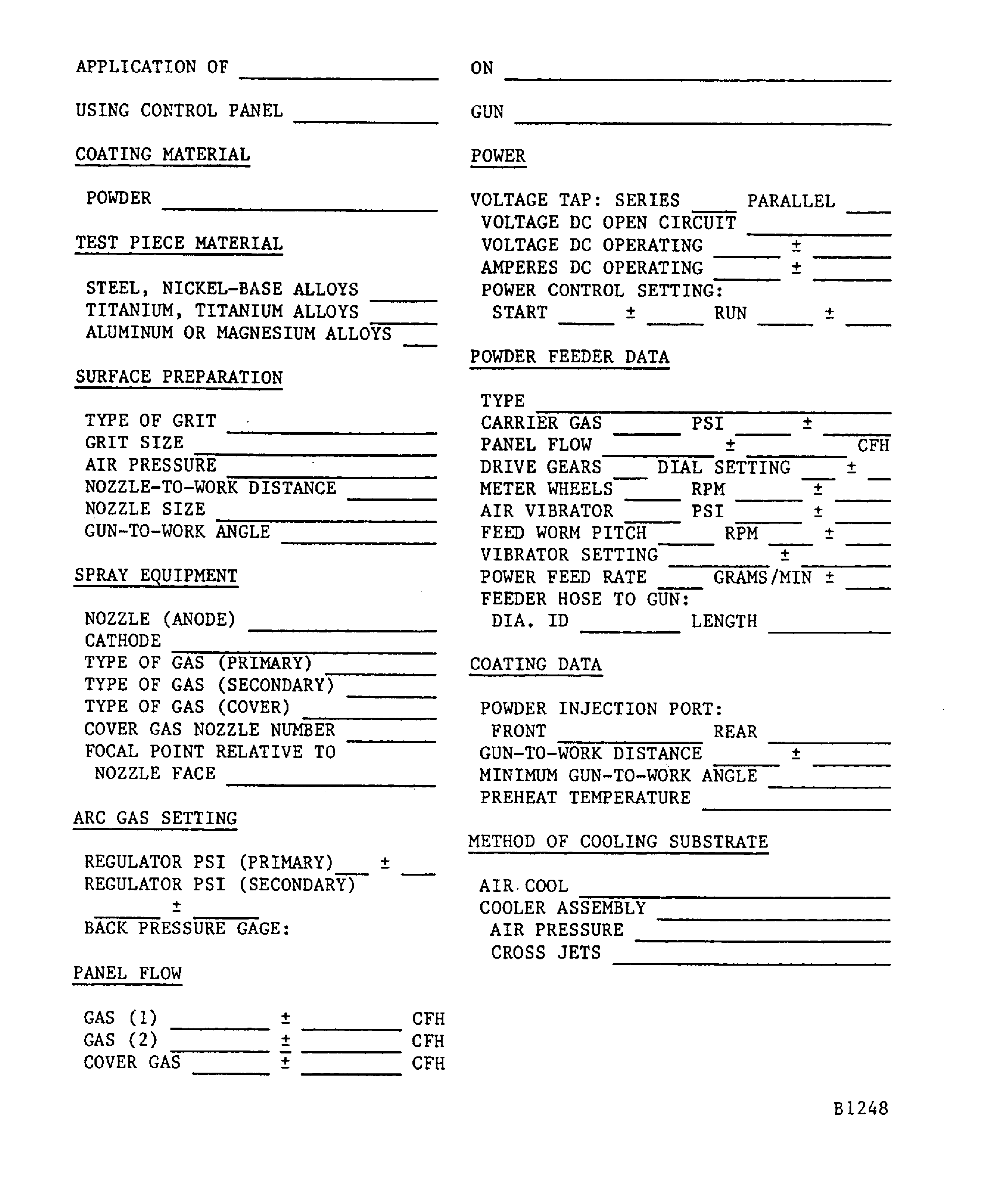
    Example of a plasma coating schedule form

    Figure: Example of permitted machine marks

    Example of permitted machine marks
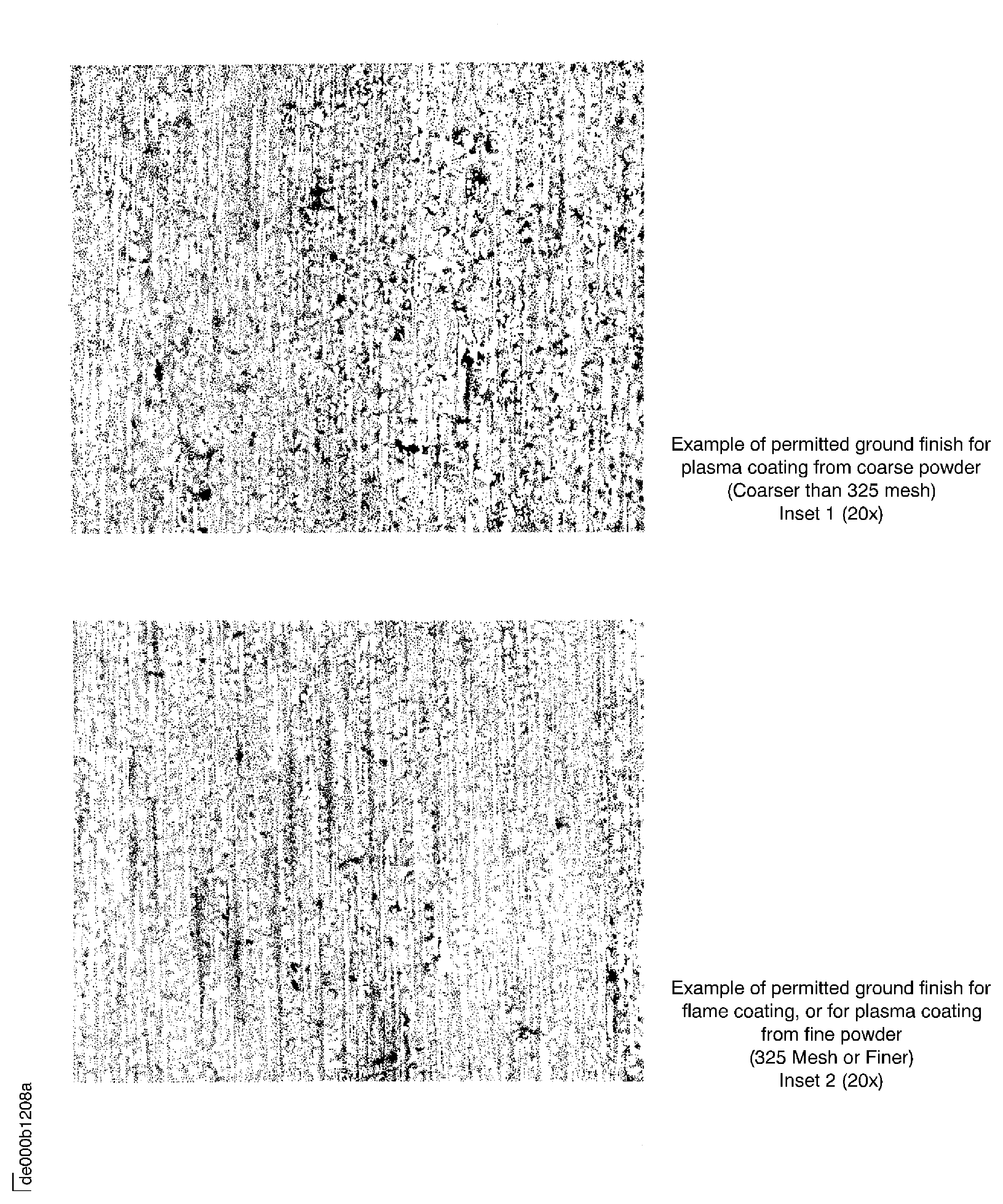
    Figure: Example of permitted machine marks

    Example of permitted machine marks
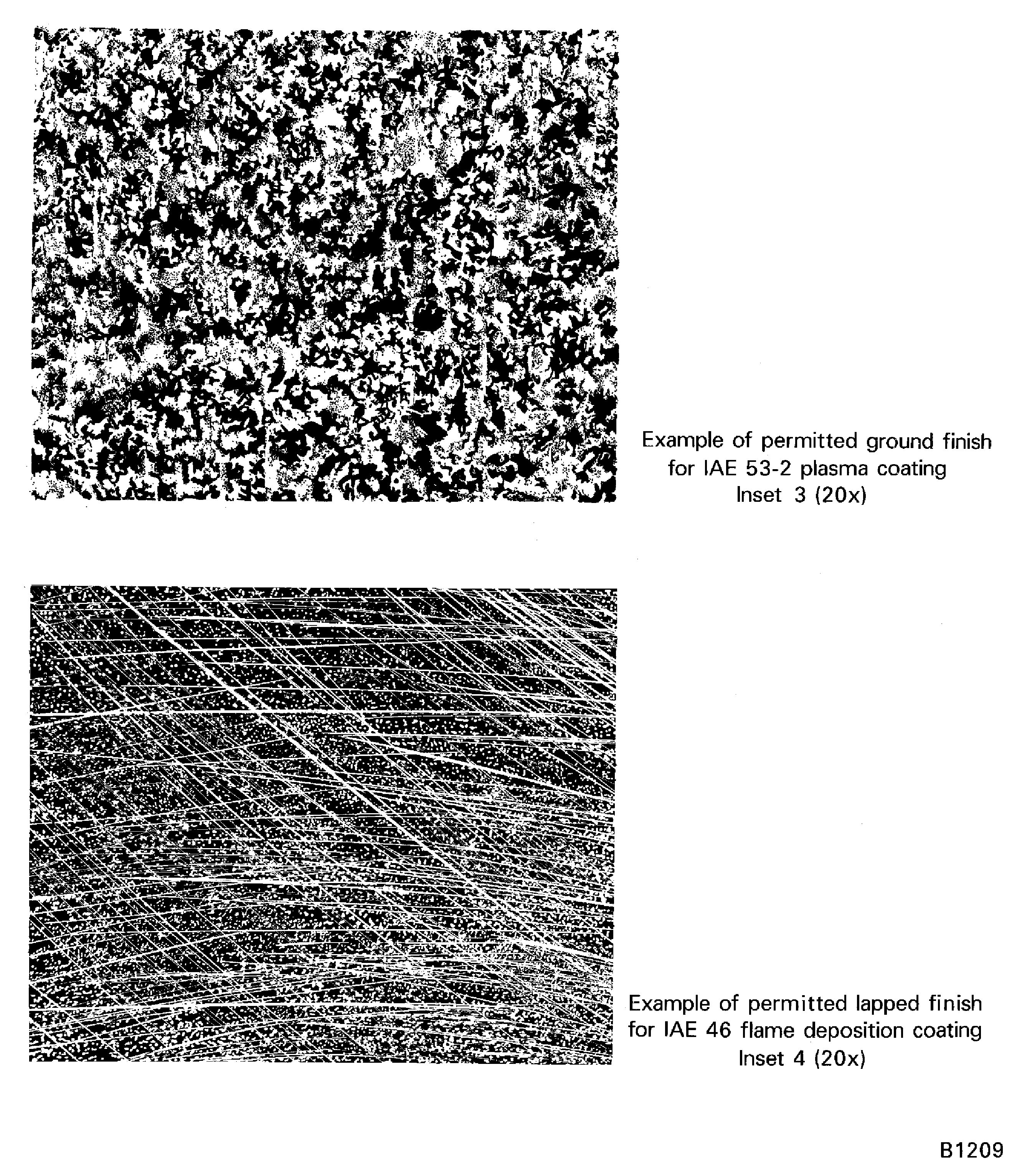
    Figure: Example of usual grinding defects

    Example of usual grinding defects
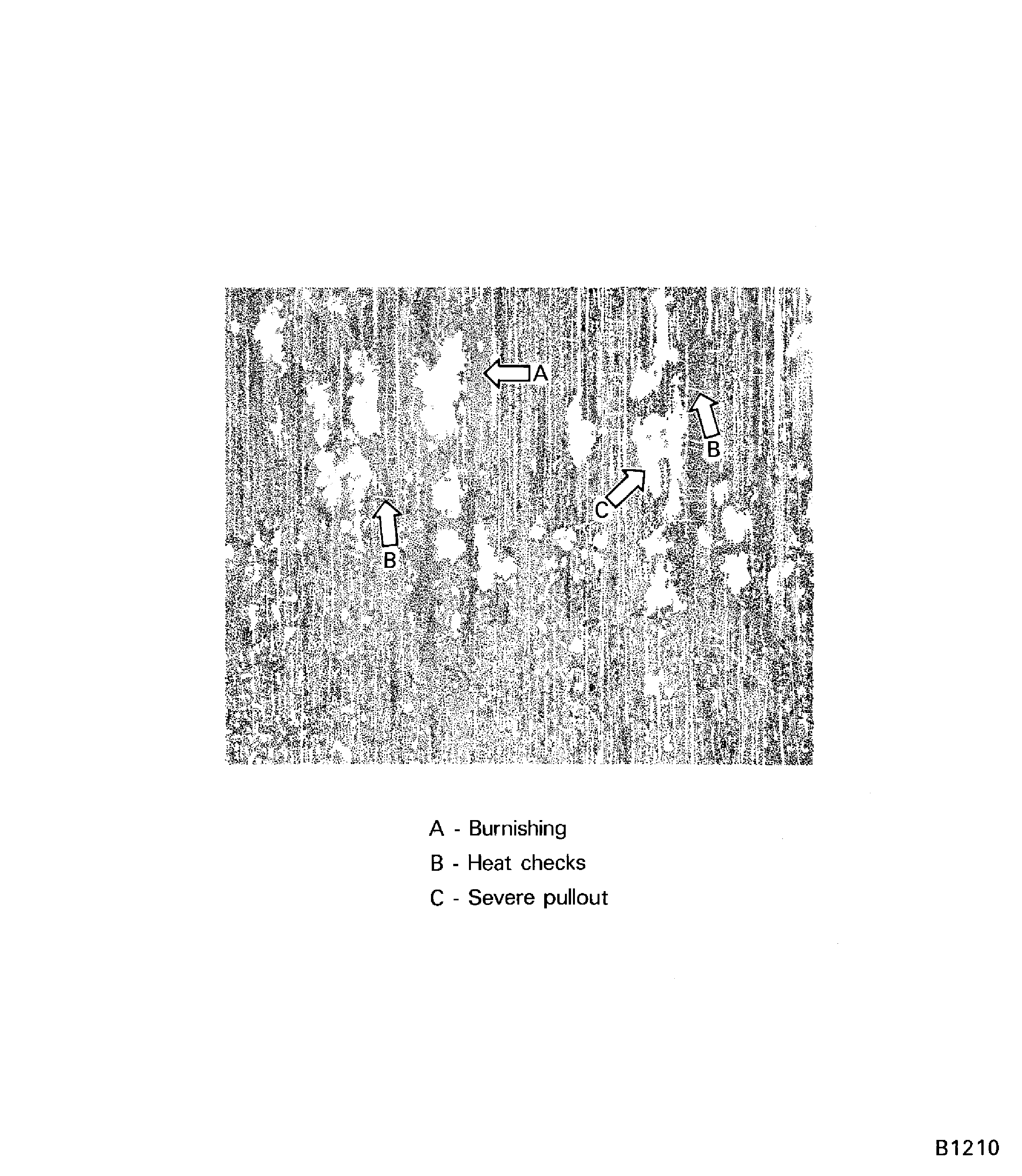
    Figure: Examples of interface contamination: The amount of contamination in the top picture is 10 percent and in the bottom picture 20 percent.
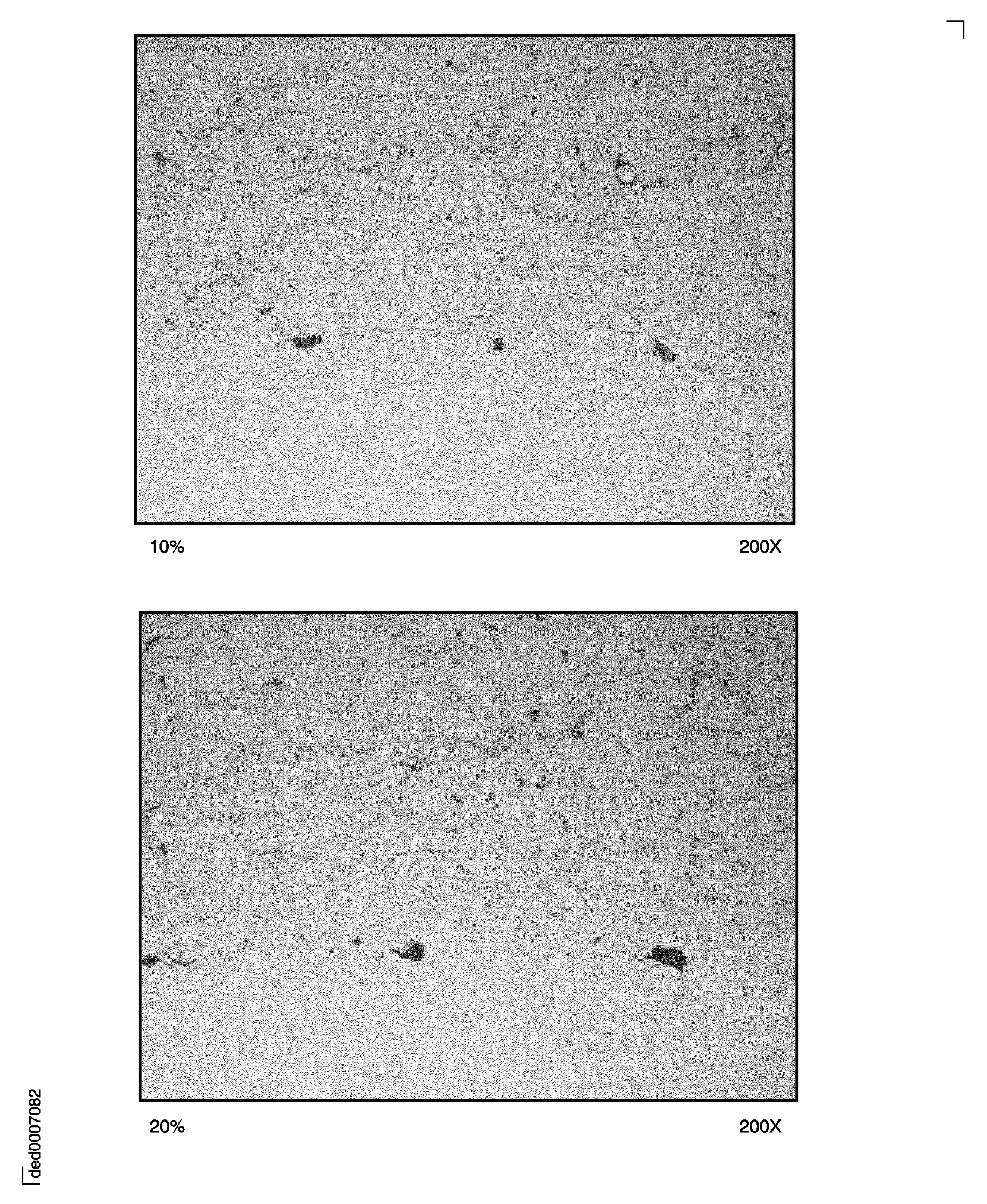
    Examples of interface contamination: The amount of contamination in the top picture is 10 percent and in the bottom picture 20 percent.

    Figure: Examples of interface contamination: The amount of contamination in the top picture is 25 percent and in the bottom picture 30 percent.
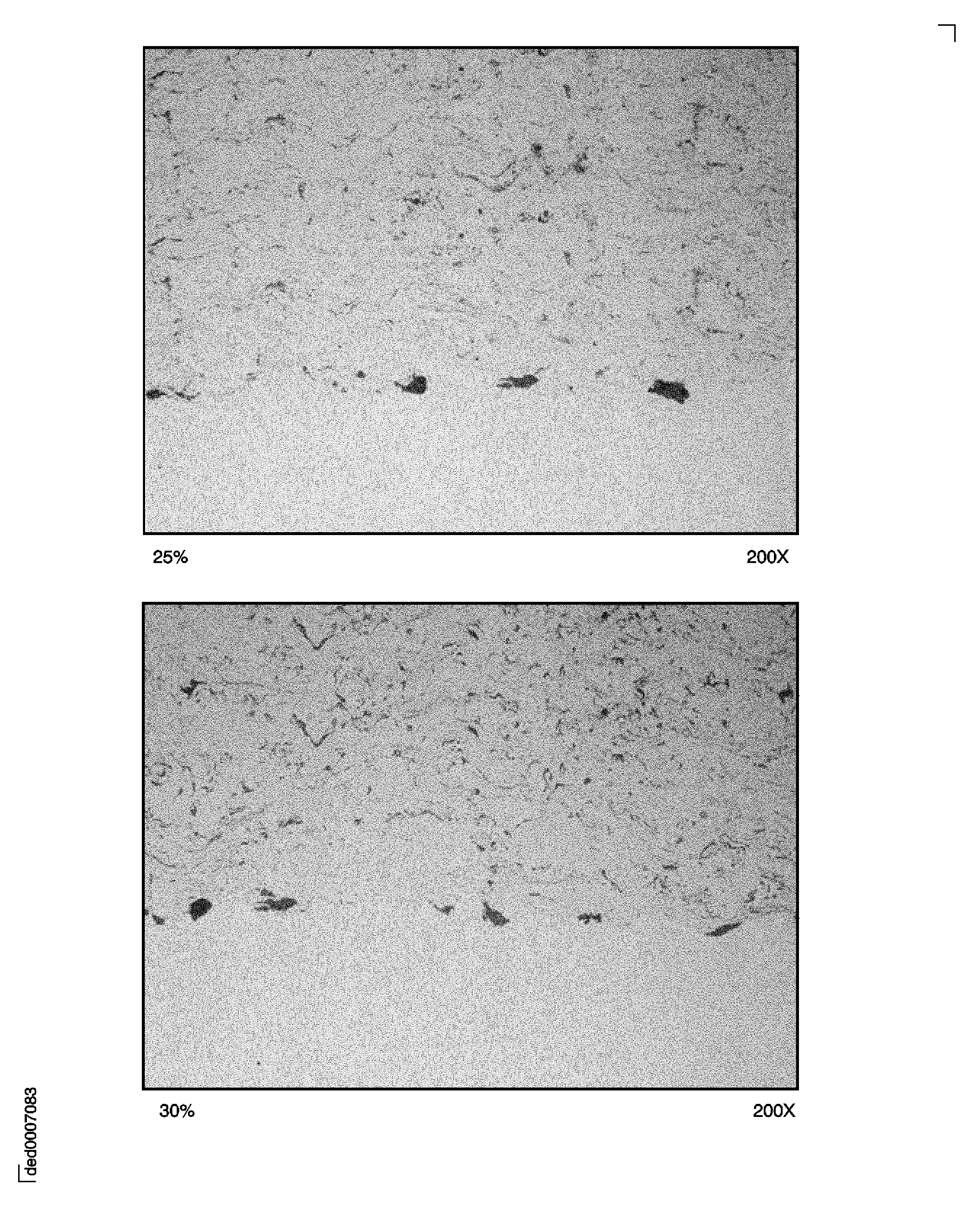
    Examples of interface contamination: The amount of contamination in the top picture is 25 percent and in the bottom picture 30 percent.

    Figure: Examples of interface contamination: The amount of contamination is 35 percent.

    Examples of interface contamination: The amount of contamination is 35 percent.
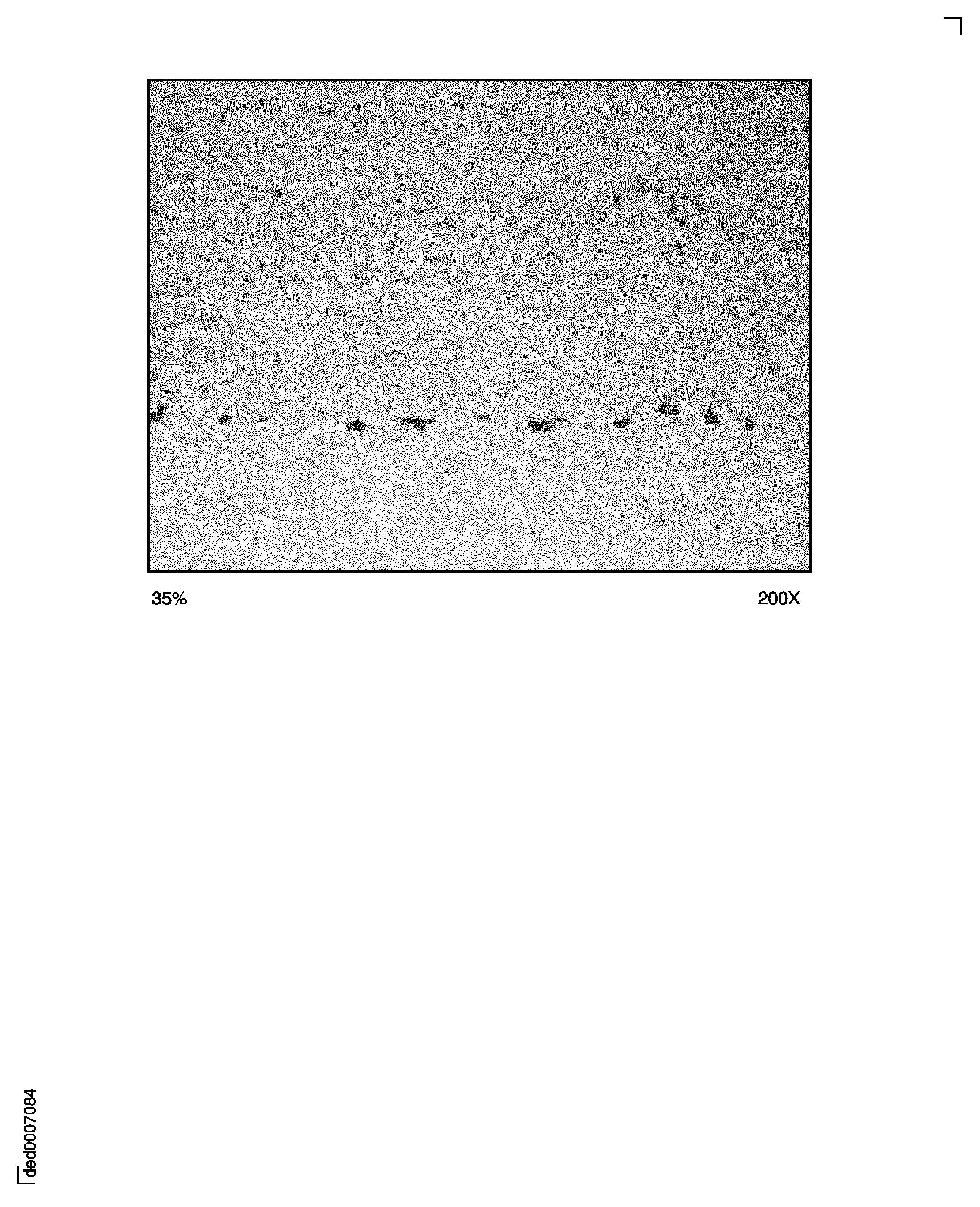
    Figure: Porosity: Pore size 10 micron; the amount of porosity in the top picture is 1 percent and in the bottom picture 3 percent.
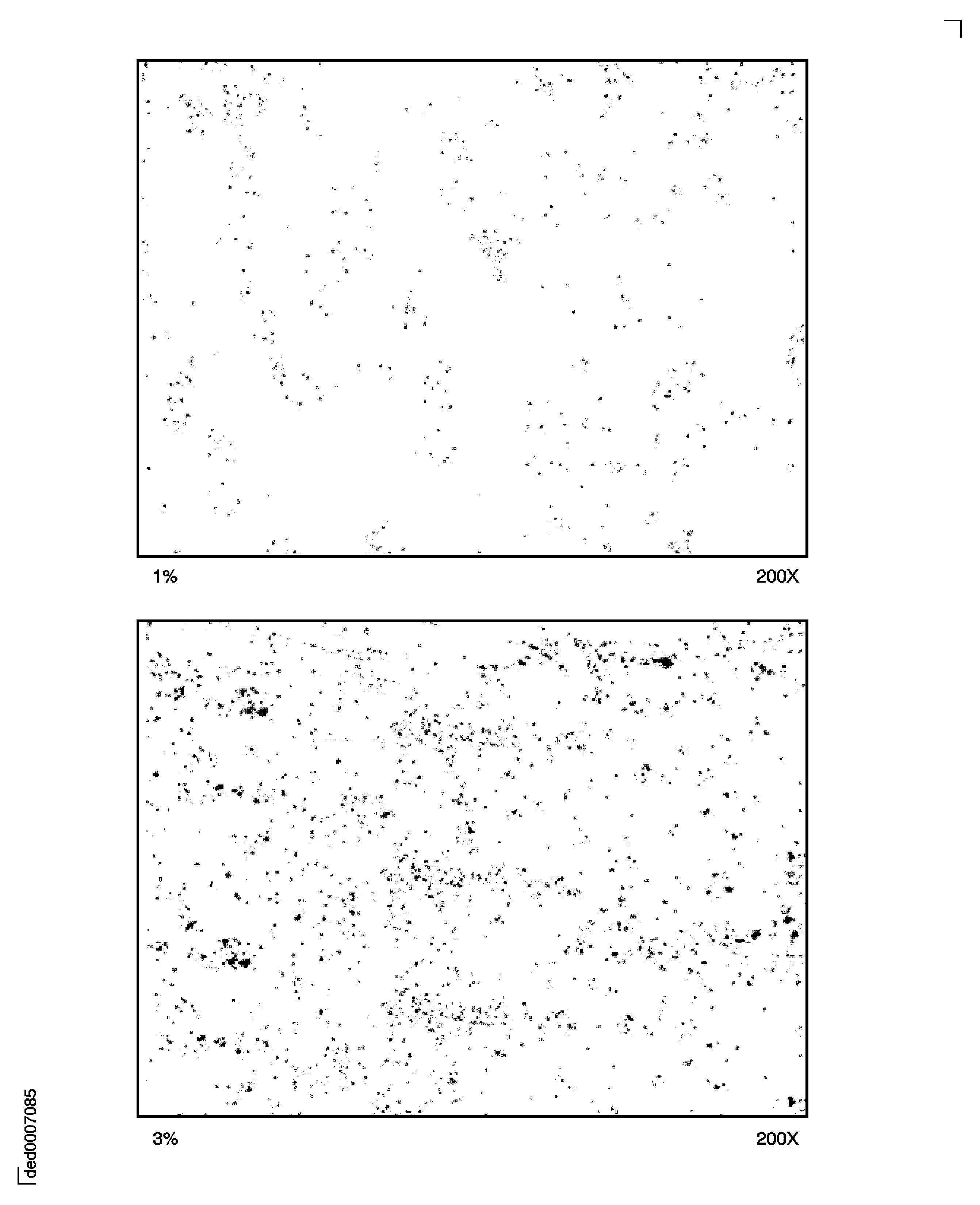
    Porosity: Pore size 10 micron; the amount of porosity in the top picture is 1 percent and in the bottom picture 3 percent.

    Figure: Porosity: Pore size 10 microns; the amount of porosity in the top picture is 5 percent and in the bottom picture 8 percent.
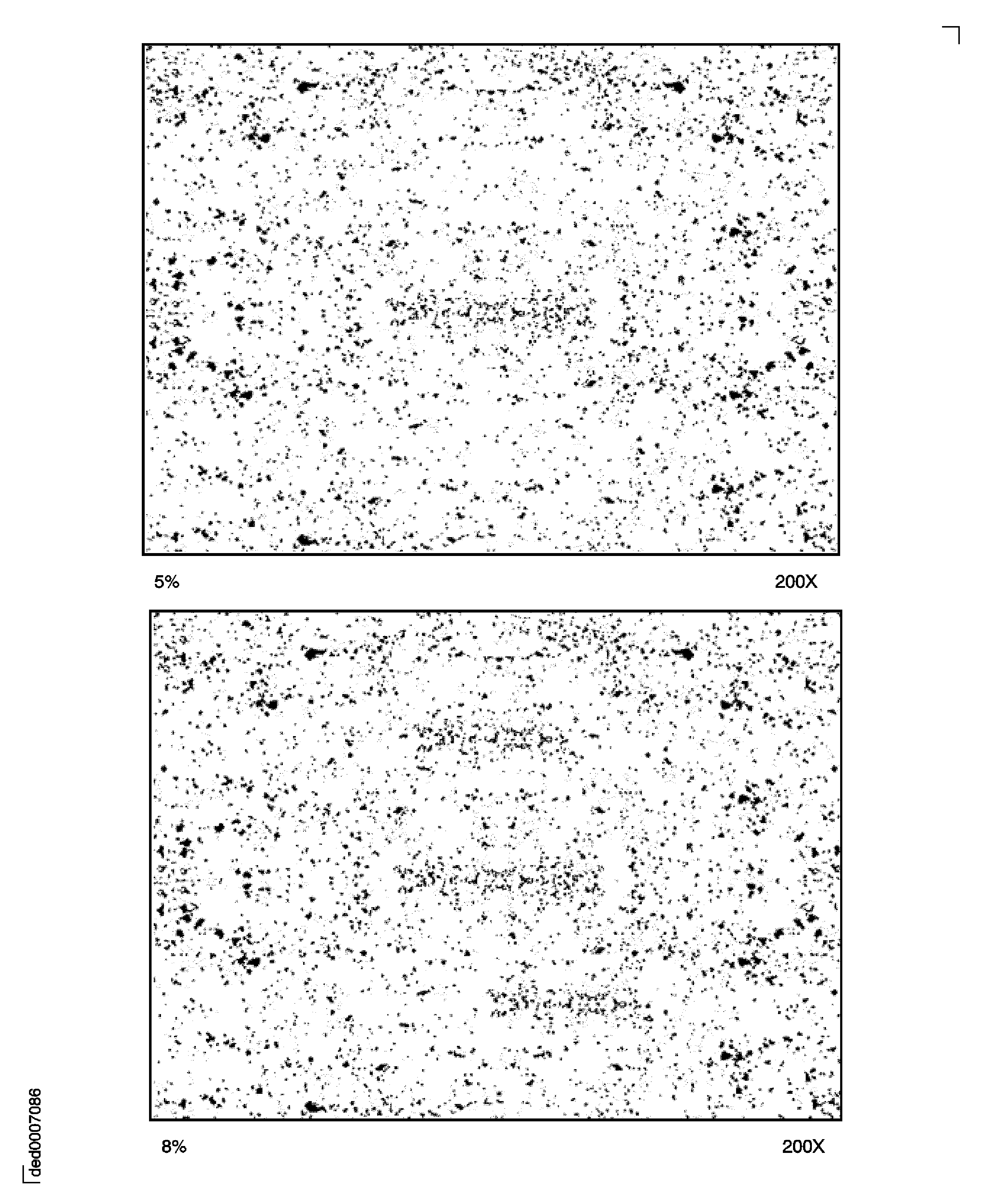
    Porosity: Pore size 10 microns; the amount of porosity in the top picture is 5 percent and in the bottom picture 8 percent.

    Figure: Porosity: Pore size 20 microns; the amount of porosity in the top picture is 2 percent and in the bottom picture 5 percent.
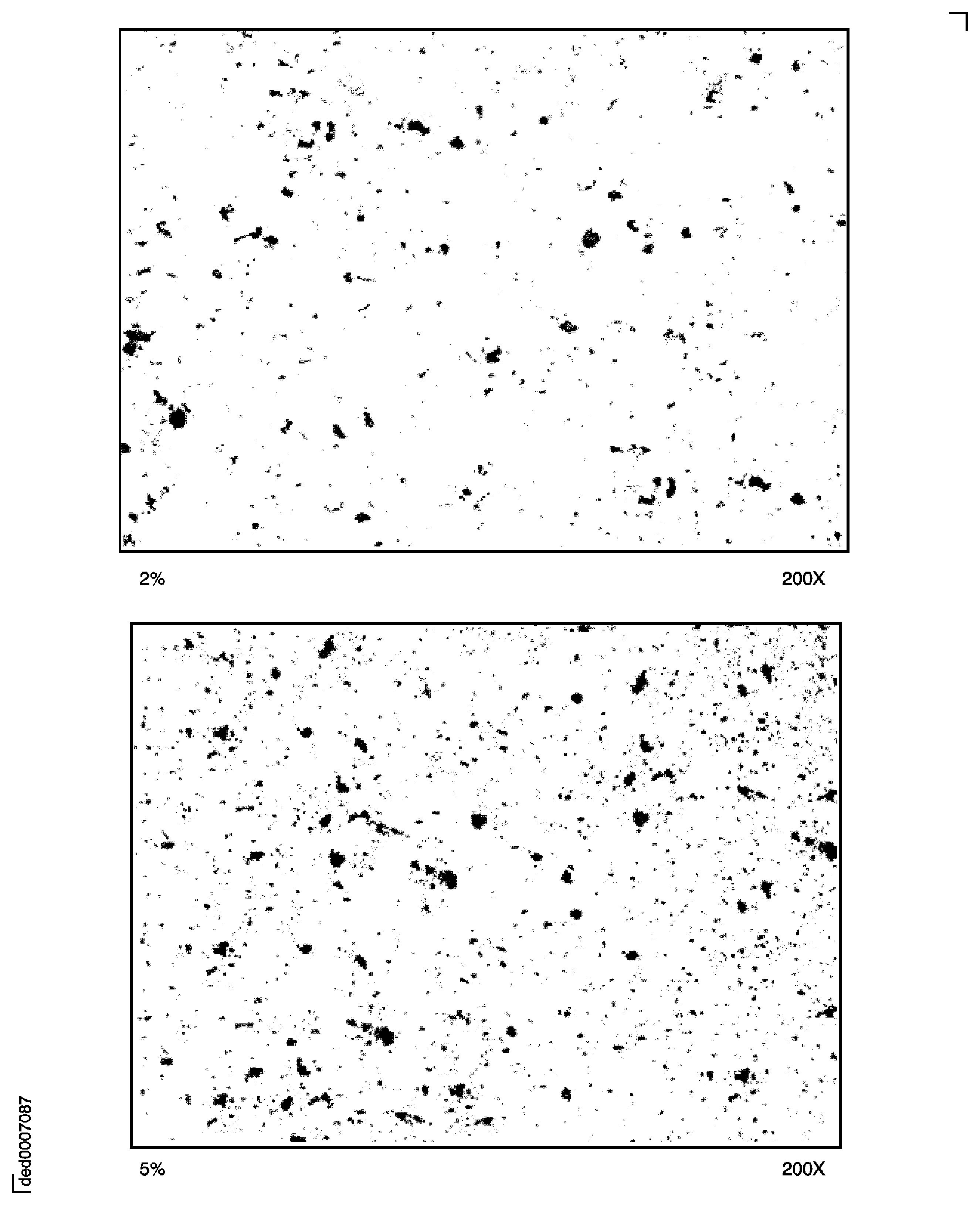
    Porosity: Pore size 20 microns; the amount of porosity in the top picture is 2 percent and in the bottom picture 5 percent.

    Figure: Porosity: Pore size 20 microns; the amount of porosity in the top picture is 7.5 percent and in the bottom picture 10 percent.
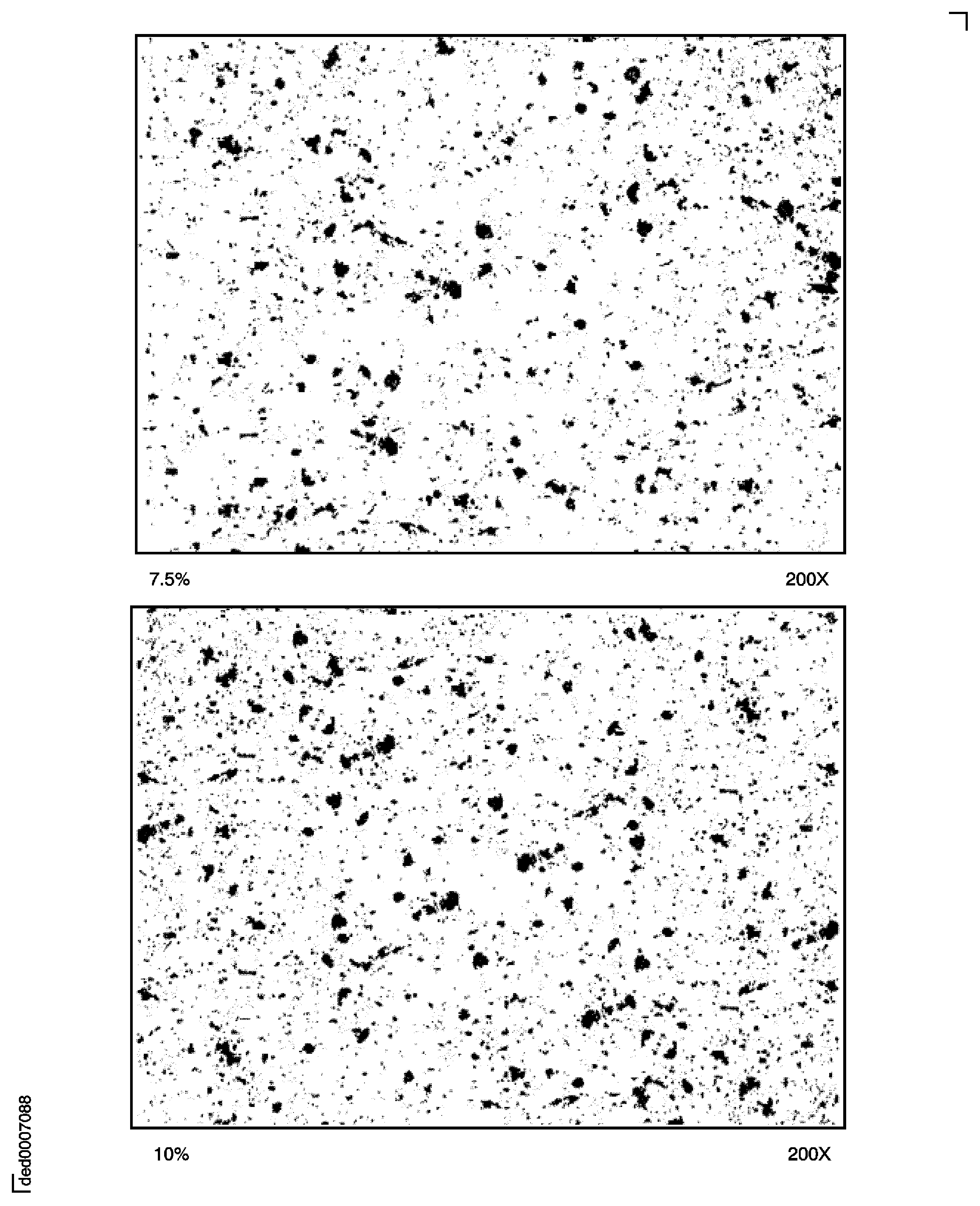
    Porosity: Pore size 20 microns; the amount of porosity in the top picture is 7.5 percent and in the bottom picture 10 percent.

    Figure: Porosity: Pore size 20 microns; the amount of porosity in the top picture is 12.5 percent and in the bottom picture 15 percent.
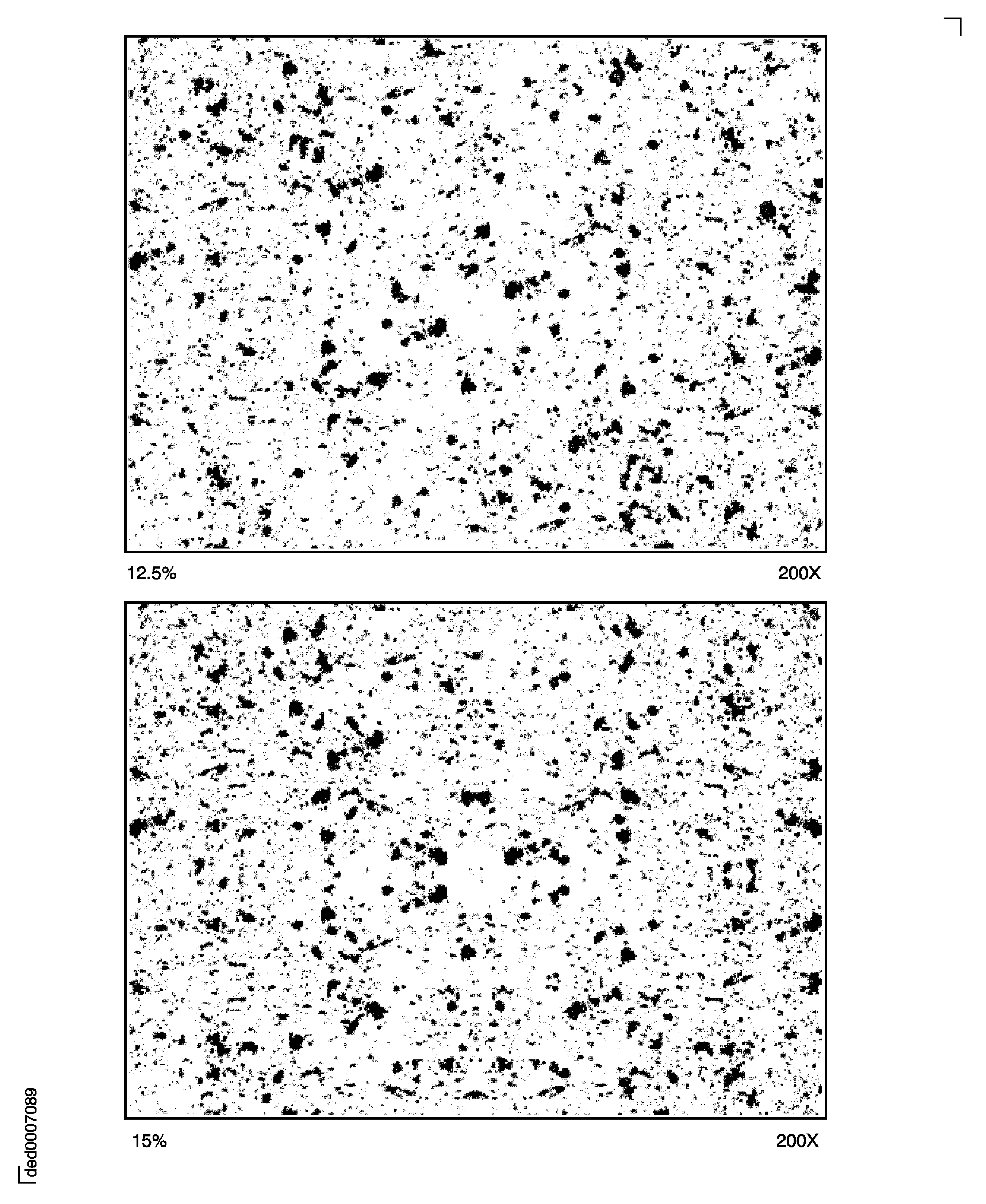
    Porosity: Pore size 20 microns; the amount of porosity in the top picture is 12.5 percent and in the bottom picture 15 percent.

    Figure: Porosity: Pore size 20 microns; the amount of porosity in the top picture is 20 percent and in the bottom picture 25 percent.
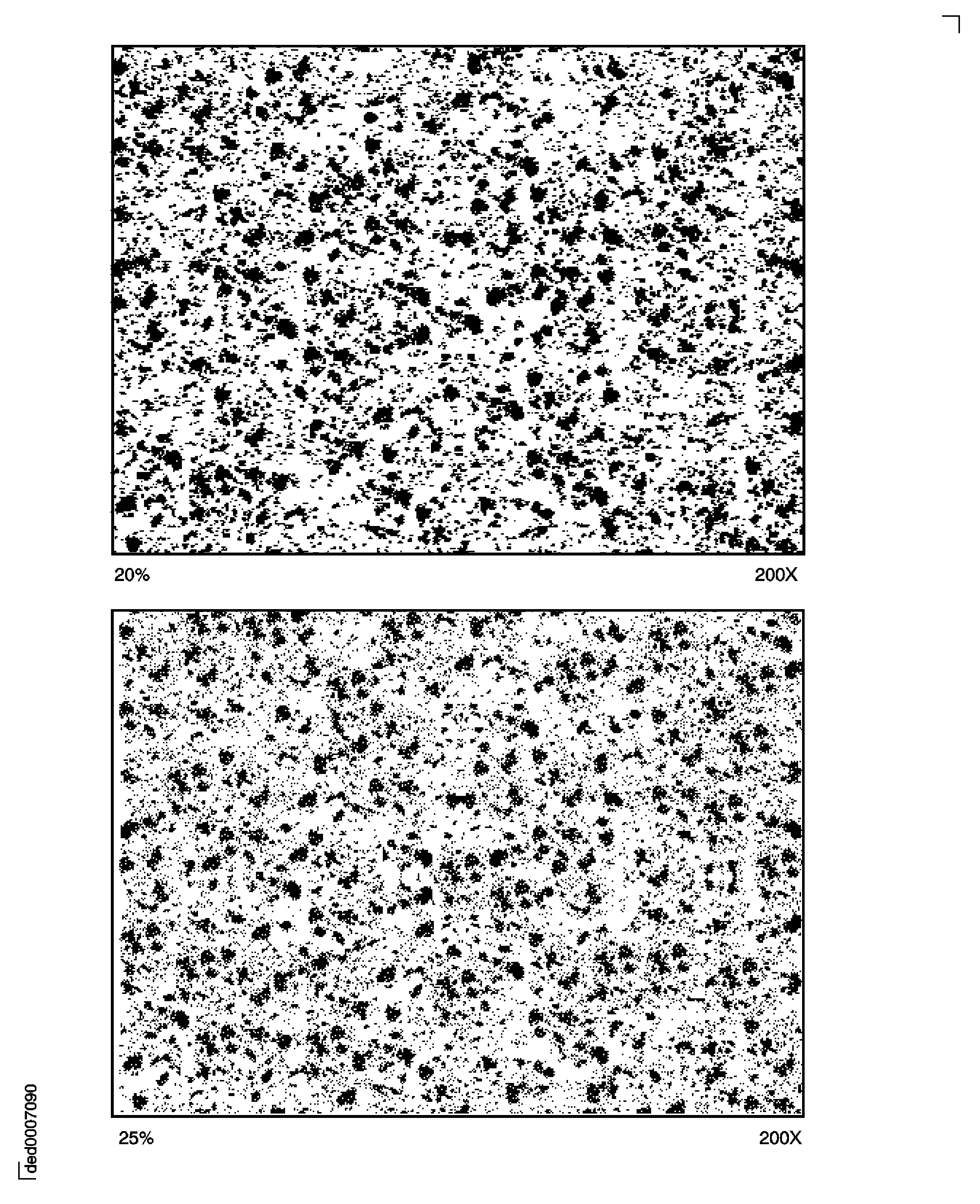
    Porosity: Pore size 20 microns; the amount of porosity in the top picture is 20 percent and in the bottom picture 25 percent.

    Figure: Example of unmelted particles: the amount of unmelted particles in the top picture is 3 percent and in the bottom picture 5 percent.
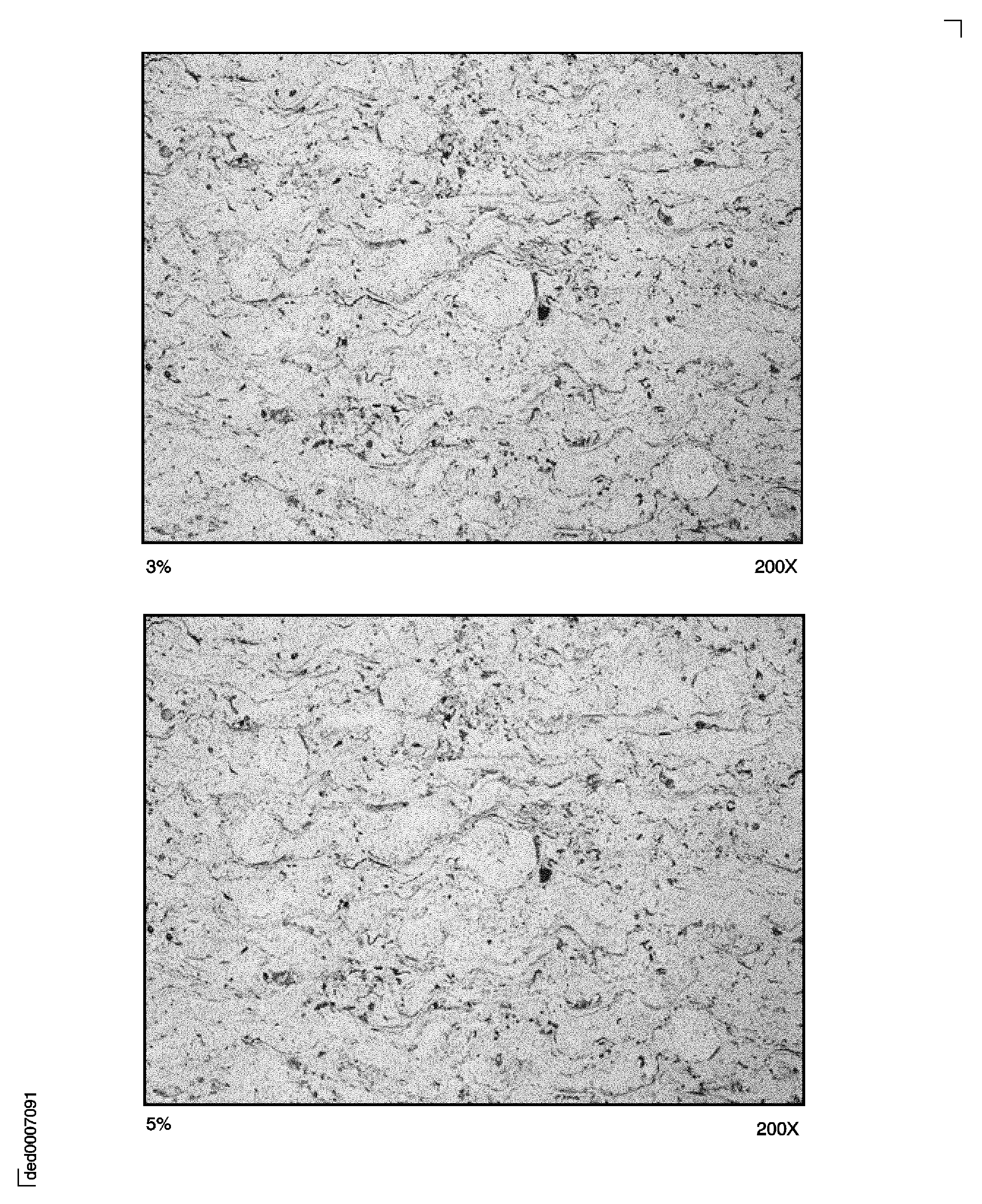
    Example of unmelted particles: the amount of unmelted particles in the top picture is 3 percent and in the bottom picture 5 percent.

    Figure: Example of unmelted particles: the amount of unmelted particles in the top picture is 8 percent and in the bottom picture 10 percent.
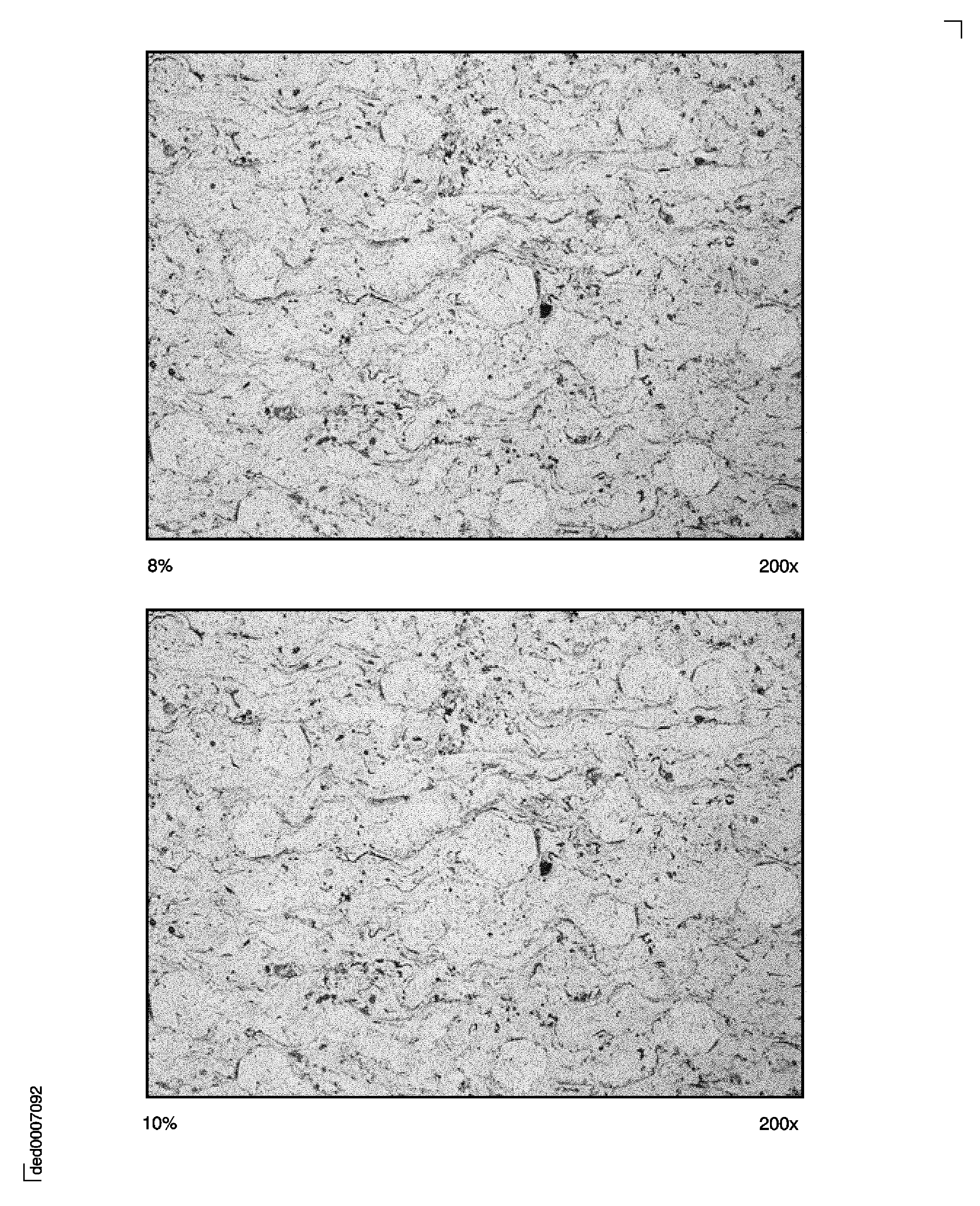
    Example of unmelted particles: the amount of unmelted particles in the top picture is 8 percent and in the bottom picture 10 percent.

    Figure: Example of unmelted particles: the amount of unmelted particles is 15 percent.

    Example of unmelted particles: the amount of unmelted particles is 15 percent.
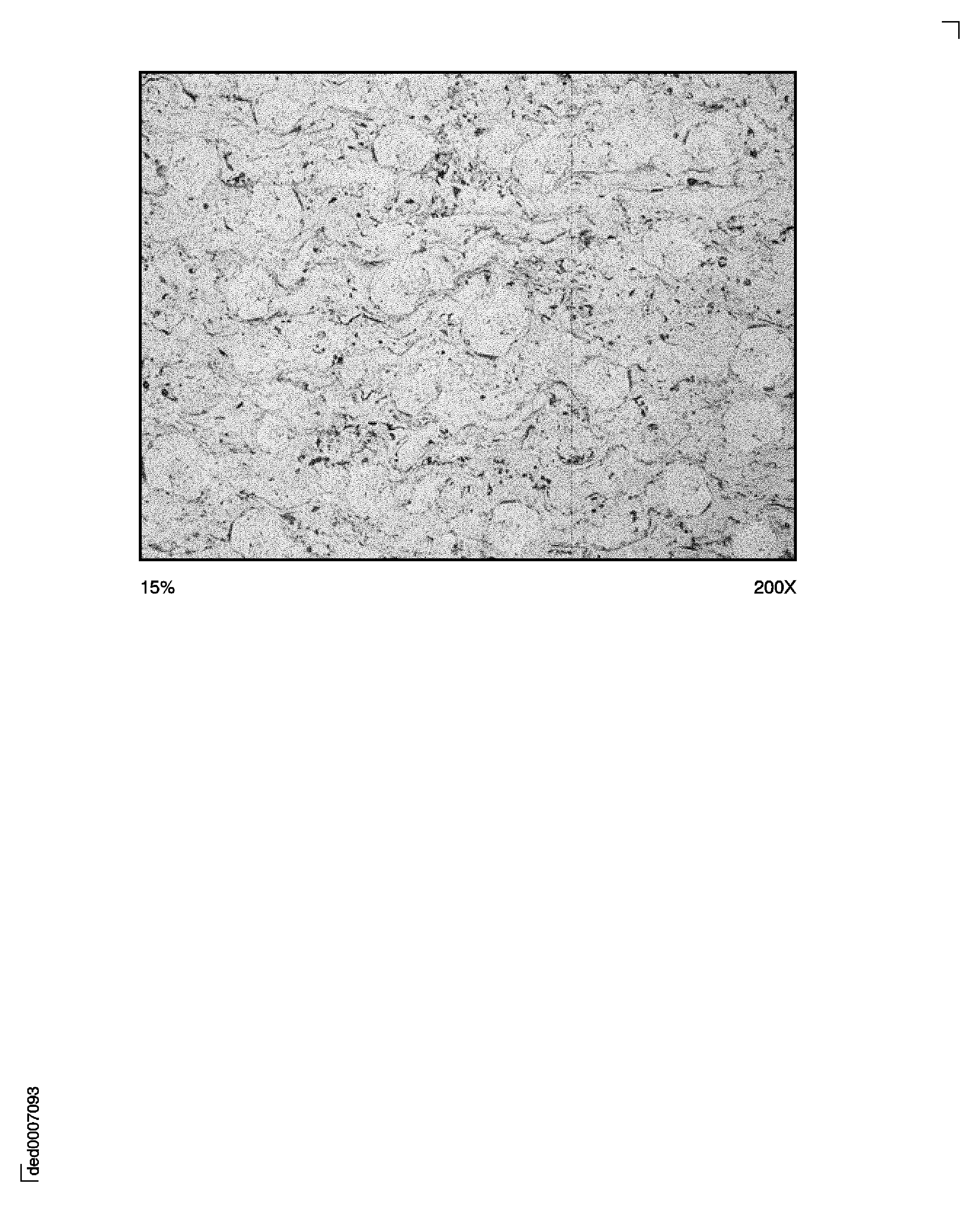
    Figure: Typical corners, grooves, or slots where greater amounts of porosity or oxides are permitted.

    Typical corners, grooves, or slots where greater amounts of porosity or oxides are permitted.
Requirements After Job Completion

Follow-On Conditions

NONE
Change Type:

Correct figure references (REA19VC645)

Manufacturer Code:01FK3
Enterprise Name:OERLIKON METCO (US), INC
BU Name:SULZER METCO (US), INC
Street:1101 PROSPECT AVE
City:WESTBURY, NY 11590
Country:USA
Phone Number:1-888-COAT-544, 1-516-338-2301
Fax Number:1-516-338-2342, 1-516-338-2414
Internet:www.sulzermetco.com
Manufacturer Code:06565
Enterprise Name:SAINT-GOBAIN ABRASIVES
BU Name:SAINT-GOBAIN ABRASIVES
P.O. Box:808
City:TROY
State:NY
Zip Code:12181
Country:USA
Phone Number:1-518-266-2200
Fax Number:1-518-266-2342
Internet:www.saintgobain.com
Manufacturer Code:08662
Enterprise Name:PRAXAIR CORPORATE OFFICE
BU Name:PRAXAIR CORPORATE OFFICE
Department:formerly Miller Thermal Technologies Inc
Street:1500 POLCO STREET
City:INDIANAPOLIS
State:IN
Zip Code:46222
Country:USA
Phone Number:1-603-224-9585, 1-317-240-2500
Fax Number:1-317-240-2426
Internet:www.praxairthermalspray.com
Manufacturer Code:0AM53
Enterprise Name:IAE INTERNATIONAL AERO ENGINES AG
BU Name:NULL
Building:SUITE 400
Street:628 HEBRON AVENUE
City:GLASTONBURY
State:CT
Zip Code:06033
Country:USA
Manufacturer Code:0FGH2
Enterprise Name:DELETED, DELETED SEE CAGE CODE 33870
Manufacturer Code:26057
Enterprise Name:TAFA INC
BU Name:TAFA INC
Street:146 PEMBROKE RD
City:CONCORD
State:NH
Zip Code:03301-5735
Country:USA
Phone Number:1-603-223-2163
Fax Number:1-603-225-4342
Internet:www.praxairthermalspray.com, www.praxair.com
Manufacturer Code:33870
Enterprise Name:PRAXAIR SURFACE TECHNOLOGIES INC.
BU Name:PRAXAIR SURFACE TECHNOLOGIES INC.
Street:1500 POLCO STREET
City:INDIANAPOLIS
State:IN
Zip Code:46222
Country:USA
Manufacturer Code:39918
Enterprise Name:SULZER METCO (US) INC, SEE SUPPLIER CODE 01FK3
Manufacturer Code:60097
Enterprise Name:EUTECTIC CORP.
BU Name:EUTECTIC CORP.
Street:N94 W14355 GARWIN MACE DRIVE
City:MENOMONEE FALLS
State:WI
Zip Code:53051
Country:USA
Phone Number:1-262-255-5520
Fax Number:1-262-255-5542
Internet:www.eutectic-na.com
Manufacturer Code:67027
Enterprise Name:CERAC INC
BU Name:CERAC INC
Street:407 N 13TH ST
P.O. Box:1178
City:MILWAUKEE
State:WI
Zip Code:53201
Country:USA
Phone Number:1-414-289-9800
Fax Number:1-414-289-9805
Email:sales@cerac.com
Internet:www.cerac.com
Manufacturer Code:72271
Enterprise Name:DELETED, SEE CAGE CODE 60097
Manufacturer Code:DK026
Enterprise Name:STARCK GMBH AND CO KG
BU Name:STARCK GMBH AND CO KG
Street:IM SCHLEEKE 78-91
City:38642 GOSLAR
Country:GERMANY
Phone Number:49-5321-7510
Fax Number:49-5321-7516 192
Internet:www.hcstarck.com
Manufacturer Code:IE426
Enterprise Name:DELETED
BU Name:DELETED,SEE CAGE CODE 1DMQ3
Manufacturer Code:LOCAL
Enterprise Name:LOCALLY SUPPLIED
Manufacturer Code:08662
Supply Number:CoMat 03-037
Type:sp01
Supply Short Name:CoMat 03-037 METAL SPRAYING POWDER, Ni Al
Supply Name:CoMat 03-037 METAL SPRAYING POWDER,Ni Al
Specification Groups:
Doc NumberType
PWA1321AI-1404
Suppliers:
ManufacturerRemarks
08662
Manufacturer Code:DK026
Supply Number:CoMat 03-064
Type:sp01
Supply Short Name:CoMat 03-064 PLASMA SPRAY POWDER
Supply Name:CoMat 03-064 PLASMA SPRAY POWDER
Specification Groups:
Doc NumberType
AMS 7879AMPERIT 515.400
Suppliers:
ManufacturerRemarks
DK026
Manufacturer Code:LOCAL
Supply Number:CoMat 03-065
Type:sp01
Supply Short Name:CoMat 03-065 PLASMA SPRAY POWDER
Supply Name:CoMat 03-065 PLASMA SPRAY POWDER
Specification Groups:
Doc NumberType
PWA 1302AI-1002
Suppliers:
ManufacturerRemarks
LOCAL
IE426
IE102
IE208
Manufacturer Code:DK026
Supply Number:CoMat 03-066
Type:sp01
Supply Short Name:CoMat 03-066 METAL SPRAYING POWDER, 75 CHROMIUM CARBIDE/25 (80 NICKEL - 20 CHROMIUM ALLOY), FINE
Supply Name:CoMat 03-066 METAL SPRAYING POWDER, 75 CHROMIUM CARBIDE/25 (80 NICKEL - 20 CHROMIUM ALLOY), FINE
Specification Groups:
Doc NumberType
AMS 7875 (PW REF)AMPERIT 585.435
Suppliers:
ManufacturerRemarks
DK026
Manufacturer Code:LOCAL
Supply Number:CoMat 03-067
Type:sp01
Supply Short Name:CoMat 03-067 PLASMA SPRAY POWDER
Supply Name:CoMat 03-067 PLASMA SPRAY POWDER
Specification Groups:
Doc NumberType
PWA 1307AI-1007
Suppliers:
ManufacturerRemarks
LOCAL
06677
IE102
IE208
Manufacturer Code:IE426
Supply Number:CoMat 03-068
Type:sp01
Supply Short Name:CoMat 03-068 PLASMA SPRAY POWDER
Supply Name:CoMat 03-068 PLASMA SPRAY POWDER
Specification Groups:
Doc NumberType
PWA 1310AI-1010
Suppliers:
ManufacturerRemarks
IE426
Manufacturer Code:08662
Supply Number:CoMat 03-069
Type:sp01
Supply Short Name:CoMat 03-069 PLASMA SPRAY POWDER
Supply Name:CoMat 03-069 PLASMA SPRAY POWDER
Specification Groups:
Doc NumberType
PWA 1312PLASMALLOY 327-M
Suppliers:
ManufacturerRemarks
08662
Manufacturer Code:LOCAL
Supply Number:CoMat 03-074
Type:sp01
Supply Short Name:CoMat 03-074 PLASMA SPRAY POWDER
Supply Name:CoMat 03-074 PLASMA SPRAY POWDER
Specification Groups:
Doc NumberType
(DELETED)
Suppliers:
ManufacturerRemarks
LOCAL
Manufacturer Code:0AM53
Supply Number:CoMat 03-076
Type:sp01
Supply Short Name:CoMat 03-076 PLASMA SPRAY POWDER
Supply Name:CoMat 03-076 PLASMA SPRAY POWDER
Specification Groups:
Doc NumberType
Deleted
Suppliers:
ManufacturerRemarks
0AM53
Manufacturer Code:IE426
Supply Number:CoMat 03-077
Type:sp01
Supply Short Name:CoMat 03-077 METAL SPRAYING POWDER NI-CRALLOY
Supply Name:CoMat 03-077 METAL SPRAYING POWDERNI-CR ALLOY
Specification Groups:
Doc NumberType
OMAT 3/189DAI-1015 or AI-1015-2
PWA 1315AI-1015 or AI-1015-2
Suppliers:
ManufacturerRemarks
IE426
Manufacturer Code:IE426
Supply Number:CoMat 03-078
Type:sp01
Supply Short Name:CoMat 03-078 METAL SPRAYING POWDER,Co-BASE ALLOY
Supply Name:CoMat 03-078 METAL SPRAYING POWDER,Co-BASE ALLOY
Specification Groups:
Doc NumberType
PWA 1316AI-1016
Suppliers:
ManufacturerRemarks
IE426
Manufacturer Code:IE426
Supply Number:CoMat 03-079
Type:sp01
Supply Short Name:CoMat 03-079 PLASMA SPRAY POWDER
Supply Name:CoMat 03-079 PLASMA SPRAY POWDER
Specification Groups:
Doc NumberType
PWA 1317AI-1007
Suppliers:
ManufacturerRemarks
IE426
Manufacturer Code:IE426
Supply Number:CoMat 03-080
Type:sp01
Supply Short Name:CoMat 03-080 METAL SPRAYING POWDER,Co BASE ALLOY
Supply Name:CoMat 03-080 METAL SPRAYING POWDER,Co BASE ALLOY
Specification Groups:
Doc NumberType
MSRR9507/3AI-1018 MIL-P-85856/6
OMAT:3/81DAI-1018 MIL-P-85856/6
Suppliers:
ManufacturerRemarks
IE426
IE102
IE208
Manufacturer Code:33870
Supply Number:CoMat 03-081
Type:sp01
Supply Short Name:CoMat 03-081PLASMA SPRAY POWDER
Supply Name:CoMat 03-081PLASMA SPRAY POWDER
Specification Groups:
Doc NumberType
AL-104
Suppliers:
ManufacturerRemarks
33870
Manufacturer Code:39918
Supply Number:CoMat 03-083
Type:sp01
Supply Short Name:CoMat 03-083 PLASMA SPRAY POWDER
Supply Name:CoMat 03-083 PLASMA SPRAY POWDER
Specification Groups:
Doc NumberType
PWA 1322METCO 439-NS
Suppliers:
ManufacturerRemarks
39918
Manufacturer Code:06565
Supply Number:CoMat 03-084
Type:sp01
Supply Short Name:CoMat 03-084 PLASMA SPRAY POWDER
Supply Name:CoMat 03-084 PLASMA SPRAY POWDER
Specification Groups:
Doc NumberType
PWA 1333NORTON 9897
Suppliers:
ManufacturerRemarks
06565
44197
Manufacturer Code:67027
Supply Number:CoMat 03-086
Type:sp01
Supply Short Name:CoMat 03-086 PLASMA SPRAY POWDER
Supply Name:CoMat 03-086 PLASMA SPRAY POWDER
Specification Groups:
Doc NumberType
PWA 1335CERAK-1064
Suppliers:
ManufacturerRemarks
67027
Manufacturer Code:33870
Supply Number:CoMat 03-089
Type:sp01
Supply Short Name:CoMat 03-089 METAL SPRAYING POWDER Ni/Al (95/5)
Supply Name:CoMat 03-089 METAL SPRAYING POWDER Ni/Al (95/5)
Specification Groups:
Doc NumberType
PWA 1337 (PW REF)NI-109 or NI-970 or AI 1037
Suppliers:
ManufacturerRemarks
33870
Manufacturer Code:60097
Supply Number:CoMat 03-091
Type:sp01
Supply Short Name:CoMat 03-091 PLASMA SPRAY POWDER
Supply Name:CoMat 03-091 PLASMA SPRAY POWDER
Specification Groups:
Doc NumberType
PWA 1338THERMOTEC 18983
Suppliers:
ManufacturerRemarks
60097
Manufacturer Code:LOCAL
Supply Number:CoMat 03-096
Type:sp01
Supply Short Name:CoMat 03-096 PLASMA SPRAY POWDER
Supply Name:CoMat 03-096 PLASMA SPRAY POWDER
Specification Groups:
Doc NumberType
AMPERIT 298.442 OR AMPERIT 299.442
Suppliers:
ManufacturerRemarks
LOCAL
IAE15
IE252
Manufacturer Code:33870
Supply Number:CoMat 03-100
Type:sp01
Supply Short Name:CoMat 03-100 PLASMA SPRAY POWDER
Supply Name:CoMat 03-100 PLASMA SPRAY POWDER
Specification Groups:
Doc NumberType
PWA 1369Cu-103
Suppliers:
ManufacturerRemarks
33870
Manufacturer Code:72271
Supply Number:CoMat 03-101
Type:sp01
Supply Short Name:CoMat 03-101 PLASMA SPRAY NICKEL ALUMINIUMALLOY
Supply Name:CoMat 03-101 PLASMA SPRAY NICKEL ALUMINIUMALLOY
Specification Groups:
Doc NumberType
PWA 1380THERMOTEC 18995
Suppliers:
ManufacturerRemarks
72271
Manufacturer Code:39918
Supply Number:CoMat 03-124
Type:sp01
Supply Short Name:CoMat 03-124 FLAME SPRAY NICKEL-ALUMINUM(78 Ni-22 Al)
Supply Name:CoMat 03-124 FLAME SPRAY NICKEL-ALUMINUM(78 Ni-22 Al)
Specification Groups:
Doc NumberType
PWA 1334METCO 405-NS
Suppliers:
ManufacturerRemarks
39918
Manufacturer Code:33870
Supply Number:CoMat 03-340
Type:sp01
Supply Short Name:CoMat 03-340 PLASMA SPRAY POWDER
Supply Name:CoMat 03-340 PLASMA SPRAY POWDER
Specification Groups:
Doc NumberType
PWA 1311AL0-159
Suppliers:
ManufacturerRemarks
33870
Manufacturer Code:0FGH2
Supply Number:CoMat 03-396
Type:sp01
Supply Short Name:CoMat 03-396 PLASMA/FLAME SPRAY POWDER
Supply Name:CoMat 03-396 PLASMA/FLAME SPRAY POWDER
Specification Groups:
Doc NumberType
PWA 1378-1CU-104-2
Suppliers:
ManufacturerRemarks
0FGH2
Manufacturer Code:26057
Supply Number:CoMat 03-478
Type:sp01
Supply Short Name:CoMat 03-478 WIRE, DUAL ELECTRIC ARC, MOLYBDENUM
Supply Name:CoMat 03-478 WIRE, DUAL ELECTRIC ARC, MOLYBDENUM
Specification Groups:
Doc NumberType
13T MOLYBDENUM WIRE
Suppliers:
ManufacturerRemarks
26057
Manufacturer Code:26057
Supply Number:CoMat 03-479
Type:sp01
Supply Short Name:CoMat 03-479 WIRE, DUAL ELECTRIC ARC, NICKEL ALLOY
Supply Name:CoMat 03-479 WIRE, DUAL ELECTRIC ARC, NICKEL ALLOY
Specification Groups:
Doc NumberType
75B BONDARC WIRE
Suppliers:
ManufacturerRemarks
26057
Manufacturer Code:26057
Supply Number:CoMat 03-480
Type:sp01
Supply Short Name:CoMat 03-480 WIRE, DUAL ELECTRIC ARC, ALUMINUM ALLOY
Supply Name:CoMat 03-480 WIRE, DUAL ELECTRIC ARC, ALUMINUM ALLOY
Specification Groups:
Doc NumberType
01A ALUMINUM 12% SILICON WIRE
Suppliers:
ManufacturerRemarks
26057
Manufacturer Code:26057
Supply Number:CoMat 03-481
Type:sp01
Supply Short Name:CoMat 03-481 WIRE, DUAL ELECTRIC ARC, NICKEL-CHROMIUM/ ALUMINUM ALLOY
Supply Name:CoMat 03-481 WIRE, DUAL ELECTRIC ARC, NICKEL-CHROMIUM/ ALUMINUM ALLOY
Specification Groups:
Doc NumberType
73 MXC NICKEL CHROME ALUMINUM WIRE
Suppliers:
ManufacturerRemarks
26057
Manufacturer Code:01FK3
Supply Number:CoMat 03-482
Type:sp01
Supply Short Name:CoMat 03-482 WIRE, DUAL ELECTRIC ARC, NICKEL ALLOY
Supply Name:CoMat 03-482 WIRE, DUAL ELECTRIC ARC, NICKEL ALLOY
Specification Groups:
Doc NumberType
METCO 470 AW
Suppliers:
ManufacturerRemarks
01FK3
Manufacturer Code:01FK3
Supply Number:CoMat 03-486
Type:sp01
Supply Short Name:CoMat 03-486 POWDER, HIGH VELOCITYOXY-FUEL (HVOF)
Supply Name:CoMat 03-486 POWDER, HIGH VELOCITYOXY-FUEL (HVOF)
Specification Groups:
Doc NumberType
PWA 36334DIAMALLOY 4008NS
Suppliers:
ManufacturerRemarks
01FK3
Manufacturer Code:01FK3
Supply Number:CoMat 03-487
Type:sp01
Supply Short Name:CoMat 03-487 POWDER, HIGH VELOCITYOXY-FUEL (HVOF)
Supply Name:CoMat 03-487 POWDER, HIGH VELOCITYOXY-FUEL (HVOF)
Specification Groups:
Doc NumberType
PWA 36345DIAMALLOY 1006
Suppliers:
ManufacturerRemarks
01FK3
Manufacturer Code:01FK3
Supply Number:CoMat 03-488
Type:sp01
Supply Short Name:CoMat 03-488 POWDER, HIGH VELOCITYOXY-FUEL (HVOF)
Supply Name:CoMat 03-488 POWDER, HIGH VELOCITYOXY-FUEL (HVOF)
Specification Groups:
Doc NumberType
PWA 36346DIAMALLOY 1005
Suppliers:
ManufacturerRemarks
01FK3
Manufacturer Code:01FK3
Supply Number:CoMat 03-489
Type:sp01
Supply Short Name:CoMat 03-489 POWDER, HIGH VELOCITYOXY-FUEL (HVOF)
Supply Name:CoMat 03-489 POWDER, HIGH VELOCITYOXY-FUEL (HVOF)
Specification Groups:
Doc NumberType
PWA 36347DIAMALLOY 3002NS
Suppliers:
ManufacturerRemarks
01FK3
Manufacturer Code:01FK3
Supply Number:CoMat 03-490
Type:sp01
Supply Short Name:CoMat 03-490 POWDER, HIGH VELOCITYOXY-FUEL (HVOF)
Supply Name:CoMat 03-490 POWDER, HIGH VELOCITYOXY-FUEL (HVOF)
Specification Groups:
Doc NumberType
PWA 36348DIAMALLOY 3001
Suppliers:
ManufacturerRemarks
01FK3