
TASK 72-41-34-200-002-A00 HPC Vane Actuating Crankshaft - Examine, Inspection-002

DMC:V2500-A0-72-41-3411-00A-300A-C|Issue No:003.00|Issue Date:2019-02-01

Export Control

EAR Export Classification: Not subject to the EAR per 15 C.F.R. Chapter 1, Part 734.3(b)(3), except for the following Service Bulletins which are currently published as EAR Export Classification 9E991: SBE70-0992, SBE72-0483, SBE72-0580, SBE72-0588, SBE72-0640, SBE73-0209, SBE80-0024 and SBE80-0025.

Copyright

© IAE International Aero Engines AG (2001, 2014 - 2021) The information contained in this document is the property of © IAE International Aero Engines AG and may not be copied or used for any purpose other than that for which it is supplied without the express written authority of © IAE International Aero Engines AG. (This does not preclude use by engine and aircraft operators for normal instructional, maintenance or overhaul purposes.).

Applicability

All

Common Information

TASK 72-41-34-200-002-A00 HPC Vane Actuating Crankshaft - Examine, Inspection-002

Effectivity

FIG/ITEM

PART NO.

01-630

6A3806

01-630

6A4317

01-630

6A5890

General

This TASK gives the procedure for the inspection of the vane actuating crank shaft.

Fig/item numbers in parentheses in the procedure agree with those used in the IPC. Only the primary Fig/item numbers are used. For the service bulletin alpha variants refer to the IPC.

The policy that is necessary for inspection is given in SPM TASK 70-20-01-200-501.

All the parts must be cleaned before any part is examined.

All the parts must be visually examined for damage, corrosion and wear. Any defects that are not identified in the procedure must be referred to IAE.

The procedure for those parts which must have a crack test is given in Step Do the crack test before the part is visually examined.

Do not discard any part until you are sure there are no repairs available. Refer to the instructions in repair before a discarded part is used again or oversize parts are installed.

Parts which should be discarded can be held although no repair is available. The repair of a discarded part can be shown to be necessary at a subsequent date.

All the parts must be examined to make sure that all the repairs have been completed satisfactorily.

The practices and processes referred to in the procedure by the TASK/SUBTASK numbers are in SPM.

References

Refer to SPM for data on these items:

Definition of Damage, SPM TASK 70-02-02-350-501,

Inspection of Parts, SPM TASK 70-20-01-200-501.

Some data on these items are contained in this TASK. For more data on these items refer to SPM:

Method of Testing for Crack Indications,

Chemical Processes,

Surface Protection.

Preliminary Requirements

Pre-Conditions

NONE

Support Equipment

NONE

Consumables, Materials and Expendables

NONE

Spares

NONE

Safety Requirements

NONE

Procedure

    1. SUBTASK 72-41-34-230-113 Examine the Vane Actuating Crank Shaft for Cracks

    2. Clean the parts. Refer to TASK 72-41-34-100-000 (CLEANING-000).

      1. Do the test for cracks on the parts that are given below.

        PART IDENT

        TASK/SUBTASK

        Vane actuating crank shaft

        1. Cracked.

        2. Reject.

    1. SUBTASK 72-41-34-220-056 Examine the Vane Actuating Crank Shaft Bearing Surfaces at Locations 1353

    2. Refer to Figure.

      1. Scored.

        1. Up to 0.002 in. (0.05 mm) in depth.

        2. Accept.

        1. More than in Step.

        2. Reject.

      1. Scratched.

        1. Up to 0.002 in. (0.05 mm) in depth.

        2. Accept

        1. More than in Step.

        2. Reject.

      1. Wear.

        1. If the crank shaft diameter is between 2.50002 in. to 2.50042 in. (63.5006 mm to 63.5106 mm).

        2. Accept.

        1. Less than in Step.

        2. Reject.

    1. SUBTASK 72-41-34-220-201 Examine the Vane Actuating Crank Shaft Bearing Surfaces at Location 1354

    2. Refer to Figure.

      1. Scored.

        1. Up to 0.002 in. (0.05 mm) in depth.

        2. Accept.

        1. More than in Step.

        2. Reject.

      1. Scratched.

        1. Up to 0.002 in. (0.05 mm) in depth.

        2. Accept.

        1. More than in Step.

        2. Reject.

      1. Wear.

        1. If the crank shaft diameter is between 2.47248 in. to 2.47346 in. (62.8010 mm to 62.8260 mm).

        2. Accept.

        1. Less than in Step.

        2. Reject.

    1. SUBTASK 72-41-34-220-057 Examine the Vane Actuating Crank Shaft Screw Thread Inserts at Location 2

    2. Refer to Figure.

      1. Broken.

      2. Reject.

      1. Crossed threads.

      2. Reject.

      1. Worn excessively.

      2. Reject.

      1. Threads that are not there.

      2. Reject.

    1. SUBTASK 72-41-34-220-058 Examine the Vane Actuating Crank Shaft Surfaces at Locations 3, 4 and 5

    2. Refer to Figure.

      1. Galled.

        1. Up to 0.005 in. (0.13 mm) in depth. The total area must not be more than 10 percent of the surface area.

        2. Accept.

        1. More than in Step.

        2. Reject.

    1. SUBTASK 72-41-34-220-059 Examine the Vane Actuating Crank Shaft Bolt Holes at Location 6

    2. Refer to Figure.

      1. Elongated.

      2. Reject.

        1. Worn.

          1. If the large diameter of the holes is less than 0.361 in. (9.16 mm).

          2. Accept.

          1. If the large diameter of the hole is more than in Step.

          2. Reject.

          1. If the smaller diameter of the hole is less than 0.314 in. (7.97 mm).

          2. Accept.

          1. If the smaller diameter of the hole is more than Step.

          2. Reject.

    1. SUBTASK 72-41-34-220-149 Examine the Vane Actuating Crank Shaft Bush Holes at Location 7

    2. Refer to Figure.

      1. Elongated.

      2. Reject.

        1. Wear.

          1. The hole bore is between 0.375 in. to 0.376 in. (9.54 mm to 9.56 mm).

          2. Accept.

          1. More than in Step.

          2. Reject.

    1. SUBTASK 72-41-34-220-151 Examine the Vane Actuating Crank Shaft All Remaining Surfaces

      1. Nicked, dented, scratched and burred.

        1. Up to 0.002 in. (0.05 mm) in depth.

        2. Accept.

        1. More than in Step.

        2. Repair, VRS6187 TASK 72-41-34-300-019 (REPAIR-019).

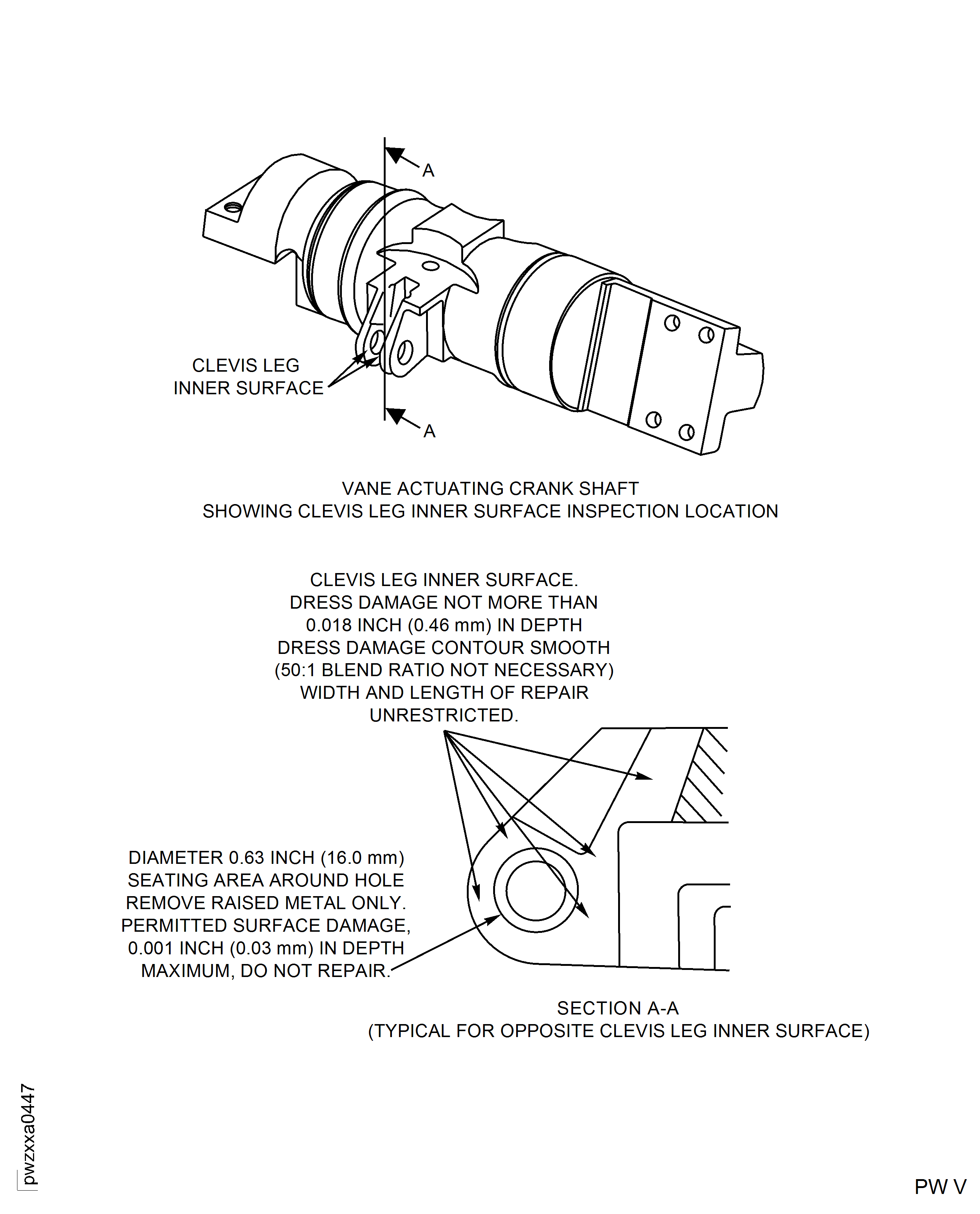
    1. SUBTASK 72-41-34-220-678 Examine the Clevis Leg Inner Face

    2. Refer to Figure.

      1. Clevis leg inner face.

      2. Make sure the depth of repair is 0.018 in. (0.46 mm) maximum. Width and length of repair unrestricted. Seating area around hole diameter is 0.63 in. (16.0 mm) - no raised metal. Maximum permitted surface damage is 0.001 in. (0.03 mm) in depth.

    1. SUBTASK 72-41-34-220-671 Examine the Vane Actuating Crank Shaft Surface Protection

      1. Damaged.

      2. Repair, VRS6391 TASK 72-41-34-300-055 (REPAIR-055).

  1. Figure: Vane actuating crank shaft - inspection locations

    Vane actuating crank shaft - inspection locations
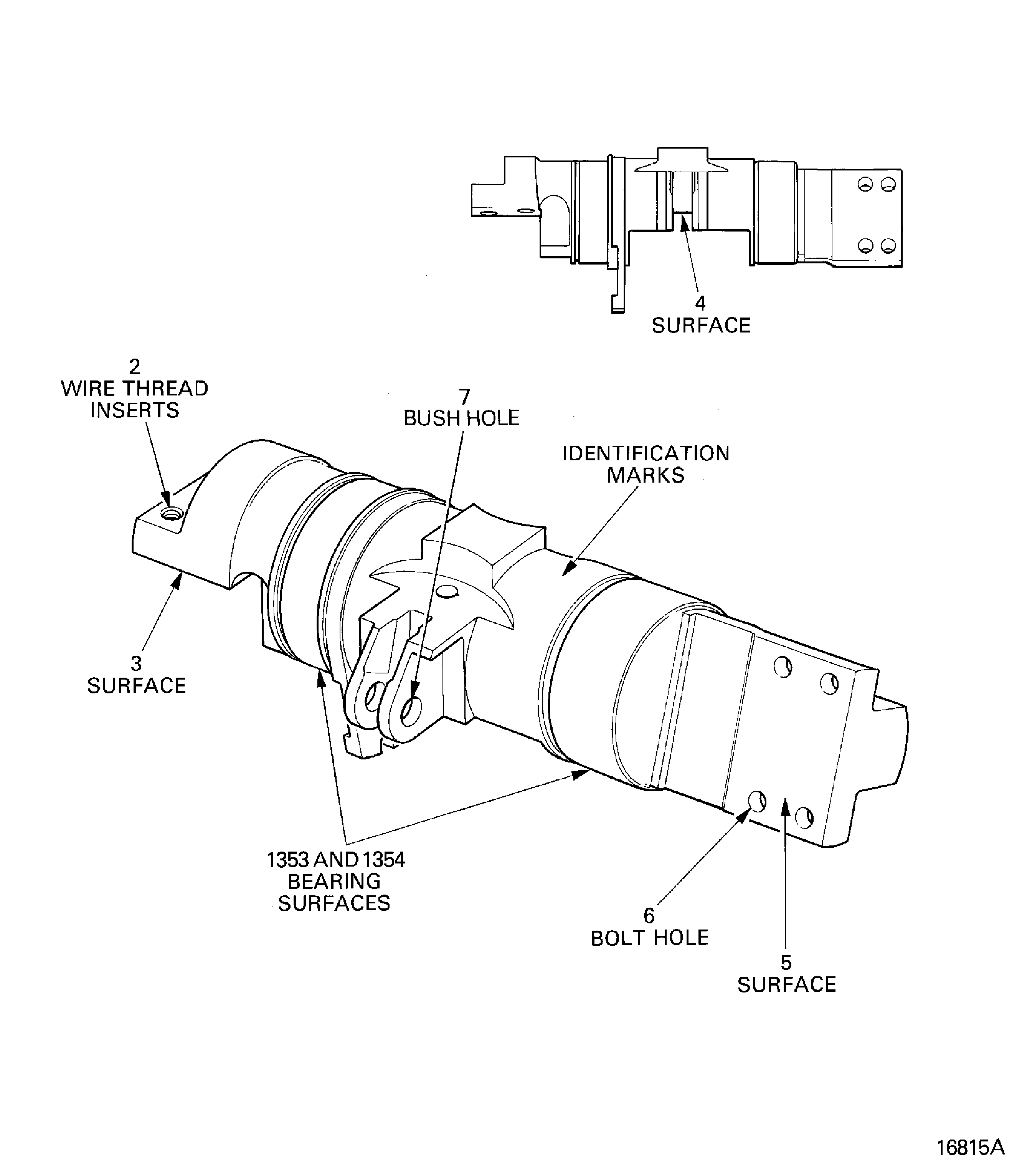
    Figure: Clevis Leg Inner Surface - Inspection Locations

    Clevis Leg Inner Surface - Inspection Locations
Requirements After Job Completion

Follow-On Conditions

NONE
Change Type:

Revised the procedure to update repair limits. (18VG257)

Change Type:

Revised procedure to correct limits at location 6. (18VG183)