
TASK 72-50-32-200-002-C00 LPT Stage 6 Blade - Examine, Inspection-002

DMC:V2500-A0-72-50-3206-00C-300A-C|Issue No:003.00|Issue Date:2018-05-01

Export Control

EAR Export Classification: Not subject to the EAR per 15 C.F.R. Chapter 1, Part 734.3(b)(3), except for the following Service Bulletins which are currently published as EAR Export Classification 9E991: SBE70-0992, SBE72-0483, SBE72-0580, SBE72-0588, SBE72-0640, SBE73-0209, SBE80-0024 and SBE80-0025.

Copyright

© IAE International Aero Engines AG (2001, 2014 - 2021) The information contained in this document is the property of © IAE International Aero Engines AG and may not be copied or used for any purpose other than that for which it is supplied without the express written authority of © IAE International Aero Engines AG. (This does not preclude use by engine and aircraft operators for normal instructional, maintenance or overhaul purposes.).

Applicability

All

Common Information

TASK 72-50-32-200-002-C00 LPT Stage 6 Blade - Examine, Inspection-002

Effectivity

FIG/ITEM

PART NO.

01-050

3A2704

General

This TASK gives the procedure for the inspection of the stage 6 turbine blades.

If there are signs of overheating, refer to TASK 72-50-32-200-009-A00 (INSPECTION/CHECK-009, CONFIG-001) before you do this inspection.

A ** following any repair referenced in this inspection indicates that the repair is not yet published in the current revision of the manual and the part must be rejected. Contact IAE for additional information concerning FAA approved repair data.

Fig/item numbers in parentheses in the procedure agree with those used in the EIPC.

The policy that is necessary for inspection is given in the SPP TASK 70-20-00-200-501.

All parts must be cleaned before any part is examined. Refer to the TASK 72-50-32-100-000 (CLEANING-000).

All parts must be visually examined for damage, corrosion and wear. Any defects that are not identified in the procedure must be referred to IAE.

The procedure for those parts which must have a crack test is given in Step. Do the crack test before the part is visually examined.

Do not discard any part until you are sure there are no repairs available. Refer to the instructions in Repair before a discarded part is used again or oversize parts are installed.

Parts which should be discarded can be held although no repair is available. The repair of a discarded part could be shown to be necessary at a later date.

All parts must be examined to make sure that all the repairs have been completed satisfactorily.

The practices and processes referred to in the procedure by the TASK numbers are in the SPP.

References

Refer to the SPP for data on these items.

Definitions of Damage, SPP TASK 70-02-02-350-501.

Record and Control of the Lives of Parts, SPP TASK 70-05-00-220-501.

Inspection of Parts, SPP TASK 70-20-00-200-501.

Some data on these items is contained in this TASK. For more data on these items refer to the SPP.

Method of Testing for Crack Indications

Chemical Processes

Surface Protection

NOTE

Special tools are identified in the procedure by the tool primary number.

Preliminary Requirements

Pre-Conditions

NONE

Support Equipment

NameManufacturerPart Number / IdentificationQuantityRemark
IAE 2M14191 Inspection gage0AM53IAE 2M141911
IAE 2M14184 Inspection mounting block0AM53IAE 2M141841

Consumables, Materials and Expendables

NONE

Spares

NONE

Safety Requirements

NONE

Procedure

    1. SUBTASK 72-50-32-230-181 Examine the Stage 6 Turbine Blades for Cracks

    2. Clean the parts. Refer to TASK 72-50-32-100-000 (CLEANING-000).

      1. Do the test for cracks on the parts that are given below. Use the applicable penetrant procedure.

        PART IDENT

        TASK/SUBTASK

        Stage 6 turbine blades

        1. Cracked in any area without the shroud notches or the knife edge seals

        2. Reject

        1. Cracked in the shroud notches

        2. Repair, VRS4187 TASK 72-50-32-300-009 (REPAIR-009)

        1. Cracked in the knife edge seals.

          1. Not more than 0.040 in. (1.00 mm) maximum depth

          2. Repair, VRS4186 TASK 72-50-32-300-008 (REPAIR-008)

          1. More than in Step

          2. Repair, VRS4560 TASK 72-50-32-300-072 (REPAIR-072)

    1. SUBTASK 72-50-32-220-401 Examine the Stage 6 Turbine Blades for Surface Defects

    2. Refer to Figure.

      NOTE

      This examination includes surface defects which are permitted per production standard. Surface defects are not caused by hit of some objects or service operation.
      Fluorescent penetrant examine or visually examine areas A1 to A7 for surface defects. Refer to the SPP TASK 70-23-08-230-501 or SPP TASK 70-21-01-220-501.
      Surface defects larger than 0.015 in. (0.38 mm) diameter must have a bottom which can be seen.
      Surface defects not larger than 0.015 in. (0.38 mm) can be non bottomed.
      A cluster is a defect of four or more surface defects, clearly apart, which can be contained within a 0.200 in. (5.08 mm) diameter circle. In the cluster all surface defects must be 0.015 in. (0.38 mm) or less.
      If not differently specified, surface defects of 0.015 in. (0.38 mm) or less must be ignored if they are not found in linear alignment or clusters, or in areas where 0.015 in. (0.38 mm) is the maximum permitted size.
      In areas where 0.015 in. (0.38 mm) is the maximum permitted size, surface defects 0.010 in. (0.25 mm) or less, not in linear alignment or clusters must be ignored.
      1. Examine the surface in area A1.

        1. Six defects, each on inner side, outer side or shroud edges, 0.046 in. (1.17 mm) maximum diameter, 0.125 in. (3.18 mm) minimum separation

        2. Accept

        1. Five clusters, 0.250 in. (6.35 mm) minimum separation

        2. Accept

        1. More than in Step or Step

        2. Reject

      1. Examine the surface in area A2 (hardface area).

        1. Two defects per 0.031 in. (0.79 mm) maximum diameter, clearly separated

        2. Accept

        1. Two linear defects including cracks or lack of fusion, 0.062 in. (1.58 mm) maximum length, clearly separated

        2. Accept

        1. More than in Step or Step or indications at break edge

        2. Reject

      1. Examine the surface in area A3.

        1. Six defects on inner or outer radius, 0.031 in. (0.79 mm) maximum diameter, 0.125 in. (3.18 mm) minimum separation

        2. Accept

        1. More than in Step

        2. Reject

      1. Examine the surface in area A4.

        1. Eight defects total per side, in area A4.1 0.031 in. (0.79 mm) maximum diameter, 0.125 in. (3.18 mm) minimum separation, in area A4.2 0.046 in. (1.17 mm) maximum diameter 0.125 in. (3.18 mm) minimum separation

        2. Accept

        1. Five clusters per side, 0.250 in. (6.35 mm) minimum separation

        2. Accept

        1. More than in Step or Step

        2. Reject

      1. Examine the surface in area A5.

        1. Six defects per side, per area for a total of 24 not back to back 0.015 in. (0.38 mm) maximum diameter, 0.125 in. (3.18 mm) minimum separation

        2. Accept

        1. More than in Step

        2. Reject

      1. Examine the surface in area A6.

        1. Six defects, each on inner side, outer side faces, 0.046 in. (1.17 mm) maximum diameter, 0.125 in. (3.18 mm) minimum separation

        2. Accept

        1. Five clusters, 0.250 in. (6.35 mm) minimum separation

        2. Accept

        1. More than in Step or Step

        2. Reject

      1. Examine the surface in area A7.

        1. Six defects on each side of loaded and unloaded surface, 0.015 in. (0.38 mm) maximum diameter, 0.125 in. (3.18 mm) minimum separation

        2. Accept

        1. Six defects on each side, front or back, 0.046 in. (1.17 mm) maximum diameter, 0.125 in. (3.18 mm) minimum separation

        2. Accept

        1. More than in Step or Step or defects in radii and break edges

        2. Reject

    1. SUBTASK 72-50-32-220-402 Examine the Stage 6 Turbine Blade in Area A8 for Surface Damage

    2. Refer to Figure.

      1. Examine the knife edge seals in area A8.

        1. Dented.

          1. Not more than 0.010 in. (0.25 mm) maximum depth

          2. Repair, VRS4186 TASK 72-50-32-300-008 (REPAIR-008)

          1. More than in Step

          2. Repair, VRS4560 TASK 72-50-32-300-072 (REPAIR-072)

        1. Nicked or pitted.

          1. Not more than 0.005 in. (0.13 mm) maximum depth

          2. Repair, VRS4186 TASK 72-50-32-300-008 (REPAIR-008)

          1. More than in Step

          2. Repair, VRS4560 TASK 72-50-32-300-072 (REPAIR-072)

    1. SUBTASK 72-50-32-220-403 Examine the Stage 6 Turbine Blade in Area A9 - A23 for Surface Damage

    2. Refer to Figure.

      1. Examine the surface in area A9.

        1. Nicked, dented or pitted

        2. Repair, VRS4185 TASK 72-50-32-300-007 (REPAIR-007)

      1. Examine the surface in area A10.

        1. Nicked, dented, pitted.

          1. Round bottom dents not more than 0.005 in. (0.13 mm) maximum depth

          2. Accept

          1. Nicked or pitted not more than 0.004 in. (0.10 mm) maximum depth

          2. Accept

          1. More than in Step or Step

          2. Repair, VRS4185 TASK 72-50-32-300-007 (REPAIR-007)

      1. Examine the surface in area A11.

        1. Nicked, dented, pitted.

          1. Round bottom dents not more than 0.005 in. (0.13 mm) maximum depth

          2. Accept

          1. Nicked or pitted not more than 0.004 in. (0.10 mm) maximum depth

          2. Accept

          1. More than in Step or Step

          2. Repair, VRS4185 TASK 72-50-32-300-007 (REPAIR-007)

      1. Examine the surface in area A12.

        1. Nicked, dented or pitted in area A12.1.

          1. Round bottom dents not more than 0.012 in. (0.30 mm) maximum depth

          2. Accept

          1. Nicked or pitted not more than 0.004 in. (0.10 mm) maximum depth

          2. Accept

        1. Nicked, dented, pitted in area A12.2.

          1. Round bottom dents not more than 0.012 in. (0.30 mm) maximum depth

          2. Accept

          1. Nicked or pitted not more than 0.004 in. (0.10 mm) maximum depth

          2. Accept

        1. Nicked, dented or pitted in area A12.3.

          1. Round bottom dents not more than 0.005 in. (0.13 mm) maximum depth

          2. Accept

        1. More than in Step or Step or Step

        2. Repair, VRS4185 TASK 72-50-32-300-007 (REPAIR-007)

      1. Examine the surface in area A13.

        1. Nicked, dented, pitted in area A13.1.

          1. Round bottom dents not more than 0.005 in. (0.13 mm) maximum depth

          2. Accept

          1. Nicked or pitted not more than 0.004 in. (0.10 mm) maximum depth

          2. Accept

        1. Nicked, dented, pitted in area A13.2.

          1. Round bottom dents not more than 0.005 in. (0.13 mm) maximum depth

          2. Accept

        1. More than in Step or Step

        2. Repair, VRS4185 TASK 72-50-32-300-007 (REPAIR-007)

      1. Examine the surface in area A14.

        1. Nicked, dented, pitted.

          1. Round bottom dents not more than 0.020 in. (0.51 mm) maximum depth, not visible from other side, not more than 10 percent of surface of area A14

          2. Accept

          1. Nicked not more than 0.004 in. (0.10 mm) maximum depth, 0.008 in. (0.20 mm) minimum separation

          2. Accept

          1. Pitted not more than 0.004 in. (0.10 mm) maximum depth

          2. Accept

          1. More than in Step or Step or Step

          2. Repair, VRS4185 TASK 72-50-32-300-007 (REPAIR-007)

      1. Examine the surface in area A15.

        1. Nicked, dented, pitted.

          1. Round bottom dents not more than 0.020 in. (0.51 mm) maximum depth, not visible from other side, not more than 10 percent of surface of area A15

          2. Accept

          1. Nicked not more than 0.004 in. (0.10 mm) maximum depth, 0.008 in. (0.20 mm) minimum separation

          2. Accept

          1. Pitted not more than 0.004 in. (0.10 mm) maximum depth

          2. Accept

          1. More than in Step or Step or Step

          2. Repair, VRS4185 TASK 72-50-32-300-007 (REPAIR-007)

      1. Examine the surface in area A16.

        1. Nicked, dented, pitted.

          1. Round bottom dents not more than 0.010 in. (0.25 mm) maximum depth

          2. Accept

          1. More than in Step

          2. Repair, VRS4185 TASK 72-50-32-300-007 (REPAIR-007)

      1. Examine the surface in area A17.

        1. Nicked, dented, pitted.

          1. Round bottom dents not more than 0.005 in. (0.13 mm) maximum depth, no raised material

          2. Accept

          1. More than in Step

          2. Reject

      1. Examine the surface in area A18.

        1. Nicked, dented, pitted.

          1. Round bottom dents not more than 0.005 in. (0.13 mm) maximum depth, no raised material

          2. Accept

          1. Pitted not more than 0.0027 in. (0.07 mm) maximum depth

          2. Accept

          1. More than in Step or Step

          2. Reject

      1. Examine the surface in area A19.

        1. Nicked, dented, pitted.

          1. Pitted not more than 0.0027 in. (0.07 mm) maximum depth

          2. Accept

          1. More than in Step

          2. Reject

      1. Examine the surface in area A20.

        1. Grooved because of airseal contact.

          1. Not more than 0.004 in. (0.10 mm) maximum depth

          2. Accept

          1. More than in Step

          2. Reject

      1. Examine the surface in area A21.

        1. Local fretted.

          1. Not more than 0.004in. (0.10 mm) maximum depth

          2. Accept

          1. More than in Step

          2. Reject

        1. Pitted.

          1. Not more than 0.0027 in. (0.07 mm) maximum depth

          2. Accept

          1. More than in Step

          2. Reject

      1. Examine the surface in area A22.

        1. Chipped, nicked, dented or pitted

          1. Pitted not more than 0.0027 in. (0,07 mm) maximum depth

          2. Accept

          1. More than in Step

          2. Reject

      1. Examine the surface in area A23.

        1. Pitted.

          1. Not more than 0.0027 in. (0.07 mm) maximum depth

          2. Accept

          1. More than in Step

          2. Reject

    1. SUBTASK 72-50-32-220-404 Examine the Stage 6 Turbine Blade in Area A24 - A27 for Sulphidation

    2. Refer to Figure.

      NOTE

      Sulphidation pits have a dark bottom after dry grit abrasive blast per the SPP TASK 70-12-09-120-501.
      1. Examine the surface in area A24.

        1. Sulphidation pits or pustules.

          1. Not more than 0.0197 in. (0.500 mm) in diameter or length

          2. Accept

          1. Other than in Step

          2. Reject

      1. Examine the surface in area A25.

        1. Sulphidation pits or pustules

        2. Repair, VRS4185 TASK 72-50-32-300-007 (REPAIR-007)

      1. Examine the surface in area A26.

        1. Sulphidation pits or pustules.

          1. Not more than 0.0157 in. (0.400 mm) in diameter or length

          2. Accept

          1. Other than in Step

          2. Reject

      1. Examine the surface in area A27.

        1. Sulphidation pits or pustules.

          1. Not more than 0.0157 in. (0,40 mm) in diameter or length if they are not connected

          2. Accept

          1. Other than in Step

          2. Reject

    1. SUBTASK 72-50-32-220-405 Examine the Outer Shroud Dimension D1 of the Turbine Blade

    2. Refer to Figure, Figure and Figure.

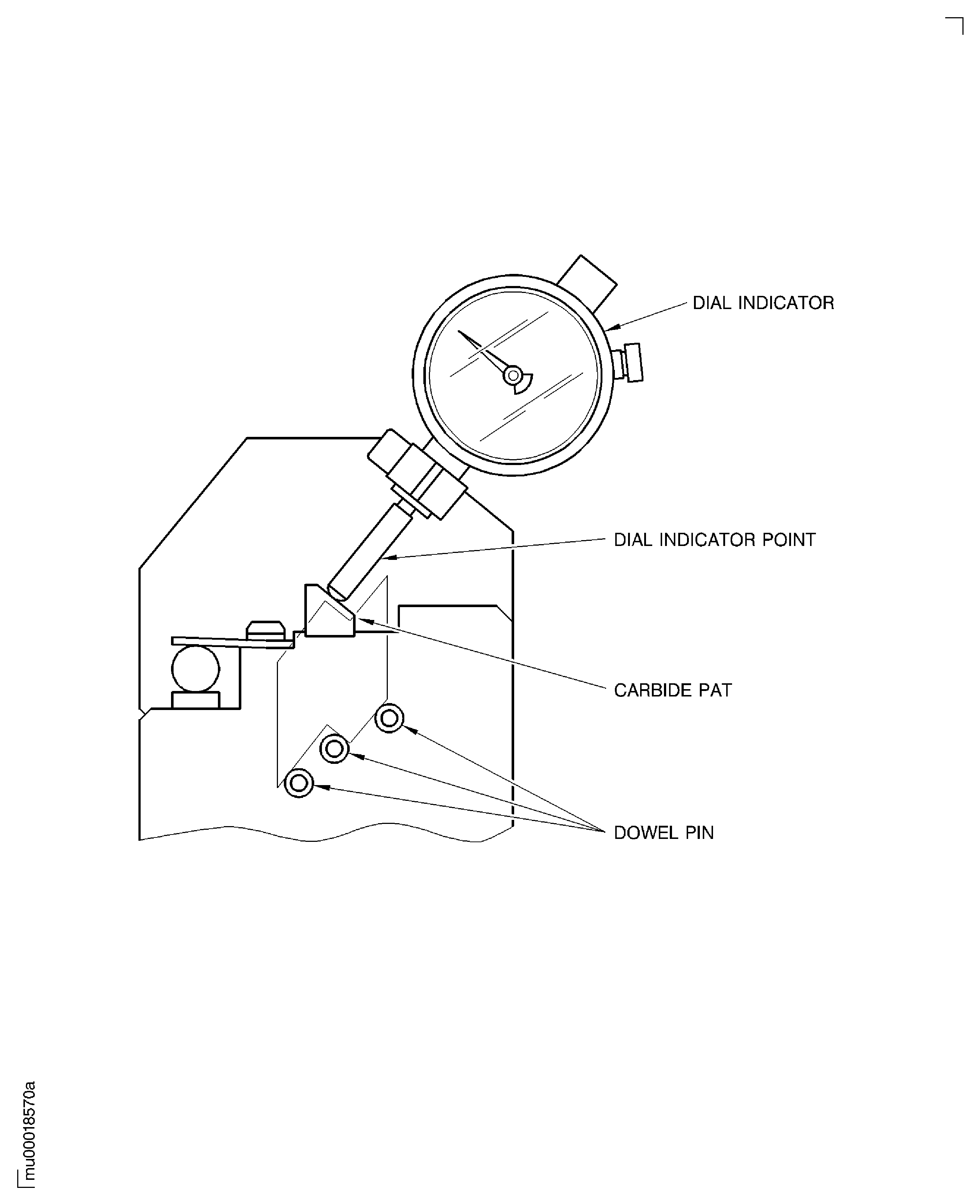
      1. Calibrate the dial indicator as follows:

      2. Retract the sliding block with the dial indicator to the locating block until the dial indicator point rests on the carbide pat.

      3. Adjust the dial indicator to zero position.

    3. Install the stage 6 turbine blade with convex side down to IAE 2M14191 Inspection gage 1 off. Make sure that the stage 6 turbine blade is correctly installed on the inspection gage.

      1. Measure the deviation against the basic outer shroud dimension.

      2. Slide the sliding block with the dial indicator to the shroud so that the dial indicator point rests on the shroud. Read the deviation on the dial indicator.

      1. Find the actual result of the outer shroud dimension D1 as follows:

      2. Add the minus or plus result of the deviation to the basic shroud band dimension 1.041 in. (26.43 mm).

      3. Monitor the actual dimension D1 of the outer shroud.

        1. Not less than 1.035 in. (26.28 mm)

        2. Accept

        1. Less than in Step and not less than 0.977 in. (24.81 mm)

        2. Repair, VRS4285 TASK 72-50-32-300-056 (REPAIR-056)

        1. Less than in Step

        2. Reject

    4. Return the sliding block with the dial indicator to the initial position.

    5. Remove the stage 6 turbine blade from the inspection gage.

    1. SUBTASK 72-50-32-220-406 Examine the Twist of the Turbine Blade

    2. Refer to Figure, Figure and Figure.

      1. Install the stage 6 turbine blade on to the IAE 2M14184 Inspection mounting block 1 off as follows, refer to Figure:

      2. Turn back the clamping screw 2.

      3. Turn back the clamping screw 1.

      4. Install the stage 6 turbine blade with rear knife edge seal located to the front of the inspection mounting block. The blade root nose must touch the locating block.

      5. Press the stage 6 turbine blade with finger pressure to the locating block. Turn clockwise the clamping screw 1 by hand to lock the blade in the vertical position on the inspection mounting block.

      6. Turn clockwise the clamping screw 2 by hand to safety the stage 6 turbine blade in position on the inspection mounting block.

    3. Turn by 90 degrees the inspection mounting block to bring the stage 6 turbine blade in horizontal position. The rear knife edge seal of the stage 6 turbine blade must be down.

      1. Measure the deviation between point P1 and point P2 on the front blade shroud face as follows:

      2. Adjust the tridimensional measuring unit at point P1 to zero.

      3. Measure the deviation D2 in the distance of x = 0.80 in. (20.32 mm) from point P1 to point P2.

      4. Monitor the result.

        1. Dimension D2 is up to 0.0290 in. (0.737 mm)

        2. Accept

        1. Other than in Step

        2. Repair, VRS4303 TASK 72-50-32-300-054 (REPAIR-054)

    1. SUBTASK 72-50-32-220-407 Examine the Knife Edge Seal of the Turbine Blade

    2. Refer to Figure and Figure.

      1. Measure the dimension D3 between the front knife edge seal and the plane A on the inspection mounting block.

        1. Not less than 7.896 in. (200.57 mm)

        2. Accept

        1. Less than in Step

        2. Repair, VRS4560 TASK 72-50-32-300-072 (REPAIR-072)

      1. Measure the dimension D4 between the rear knife edge seal and the plane A on the inspection mounting block.

        1. Not less than 7.975 in. (202.57 mm)

        2. Accept

        1. Less than in Step

        2. Repair, VRS4560 TASK 72-50-32-300-072 (REPAIR-072)

    3. Remove the stage 6 turbine blade from the inspection mounting block.

    1. SUBTASK 72-50-32-220-408 Examine the Blade Root of the Turbine Blade

    2. Refer to Figure.

      1. Measure the dimension D5.

        1. Not less than 0.506 in. (12.86 mm)

        2. Accept

        1. Less than in Step

        2. Reject

  1. Figure: Examine the Stage 6 Turbine Blades

    Examine the Stage 6 Turbine Blades
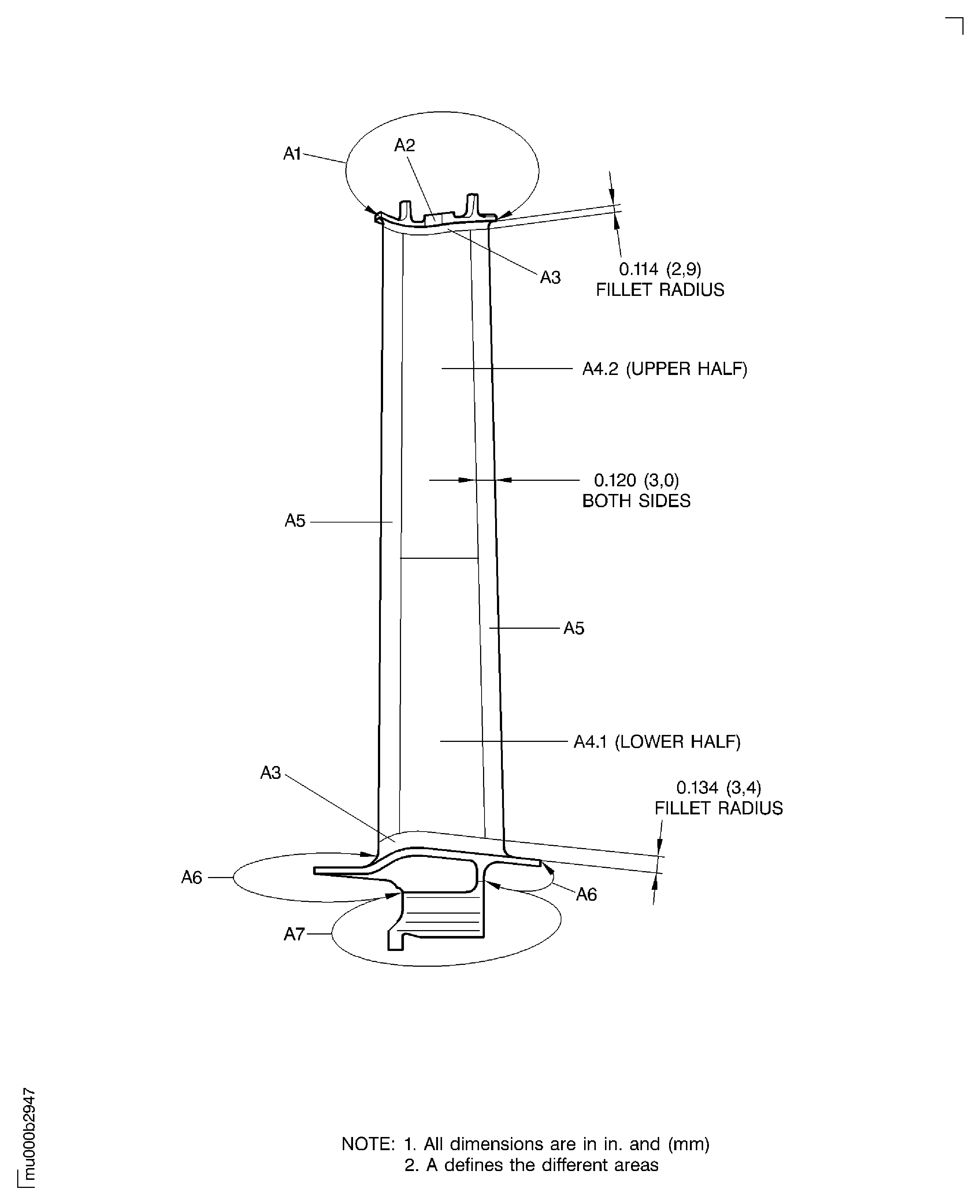
    Figure: Examine the Stage 6 Turbine Blades

    Examine the Stage 6 Turbine Blades
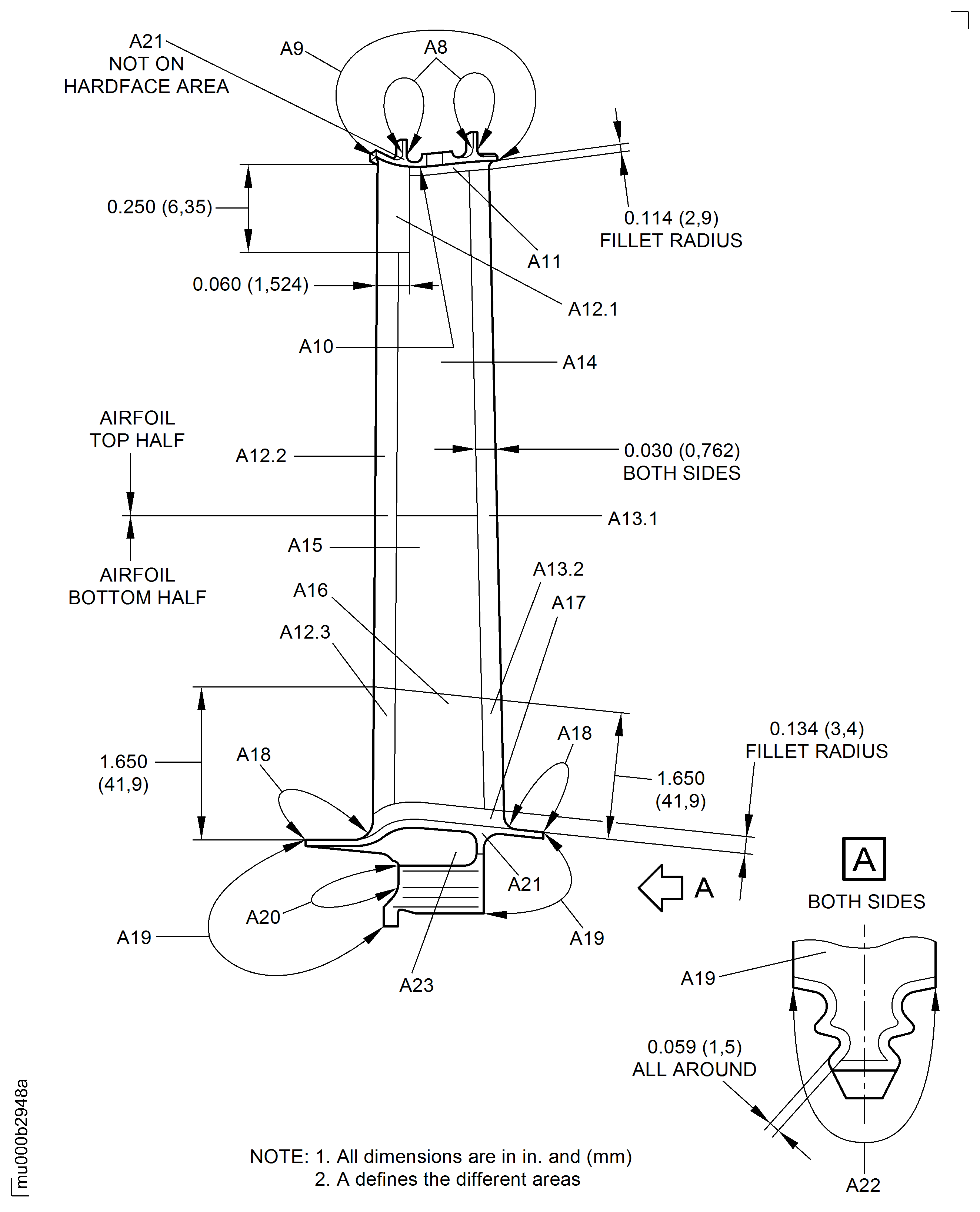
    Figure: Examine the Stage 6 Turbine Blades

    Examine the Stage 6 Turbine Blades
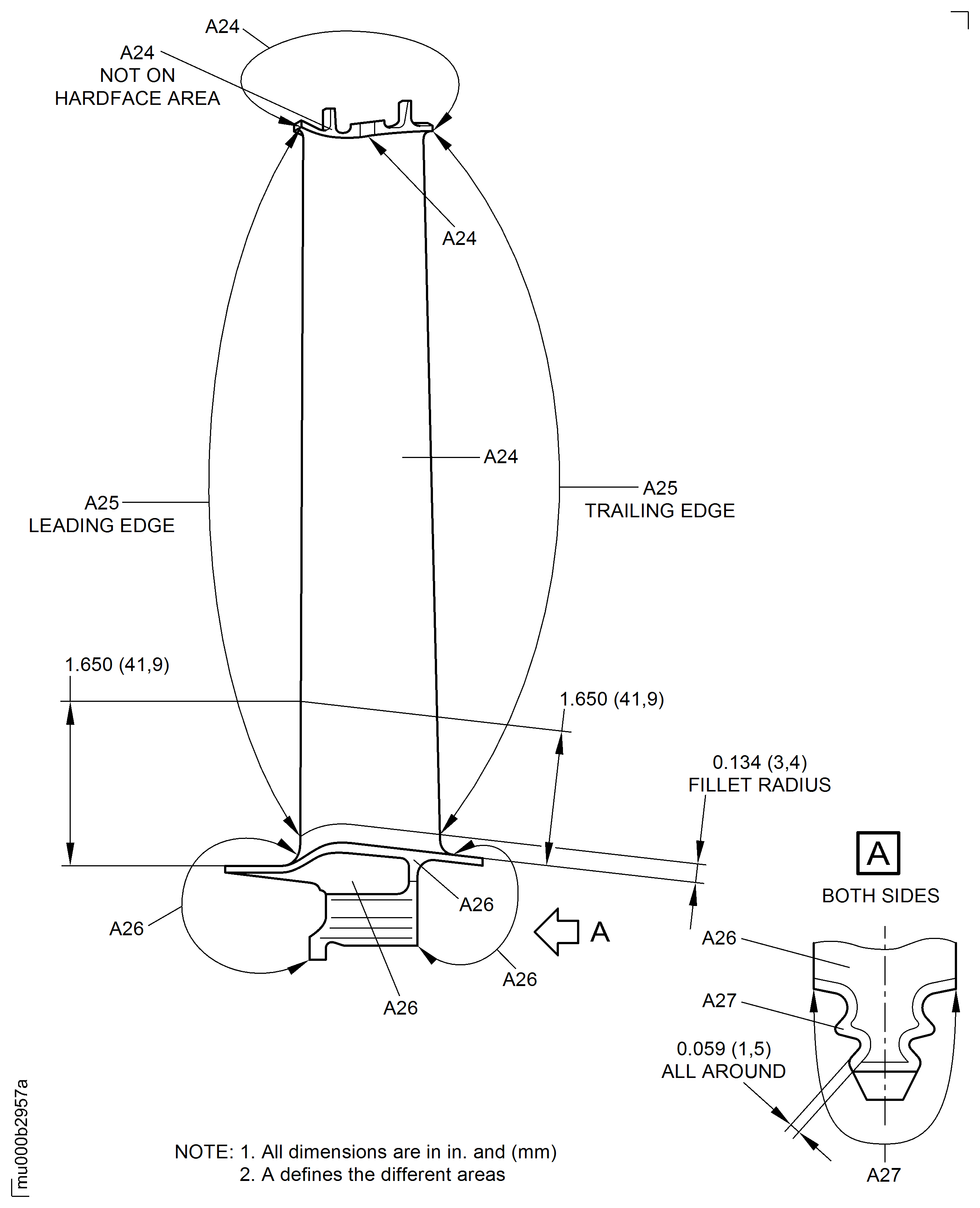
    Figure: Examine the Stage 6 Turbine Blades

    Examine the Stage 6 Turbine Blades
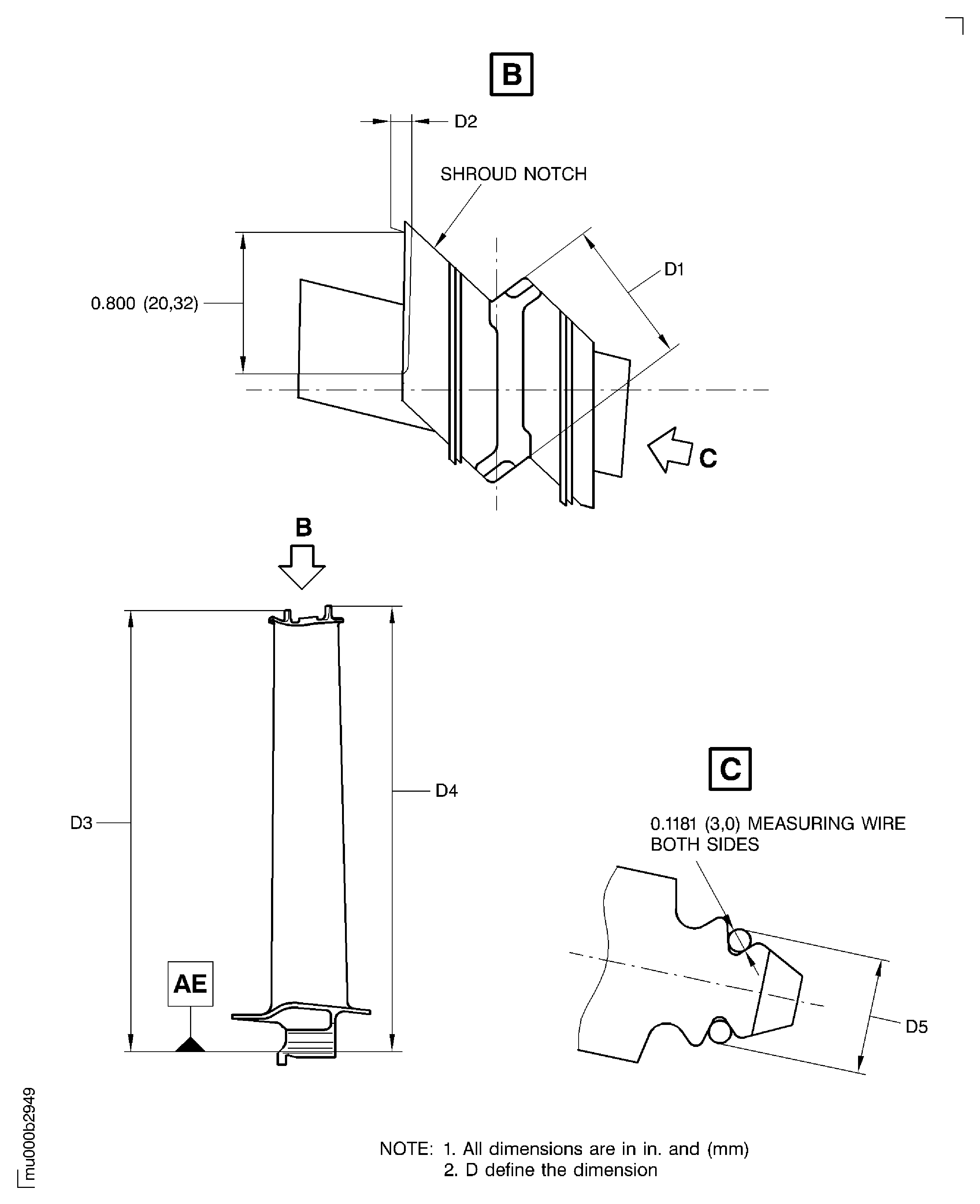
    Figure: Install the Stage 6 Turbine Blades on to the Inspection Mounting Block

    Install the Stage 6 Turbine Blades on to the Inspection Mounting Block
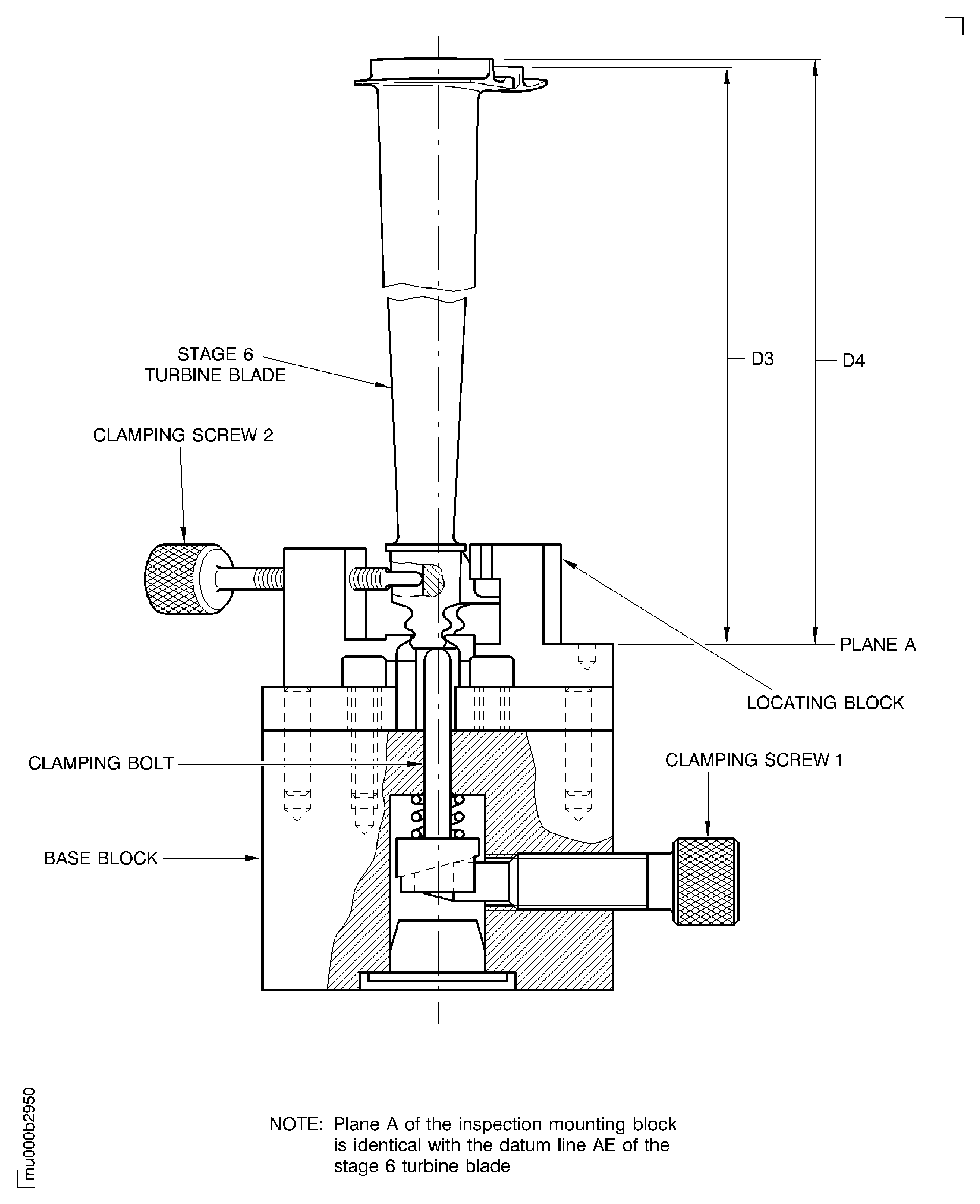
    Figure: Install the Stage 6 Turbine Blades on to the Inspection Mounting Block

    Install the Stage 6 Turbine Blades on to the Inspection Mounting Block
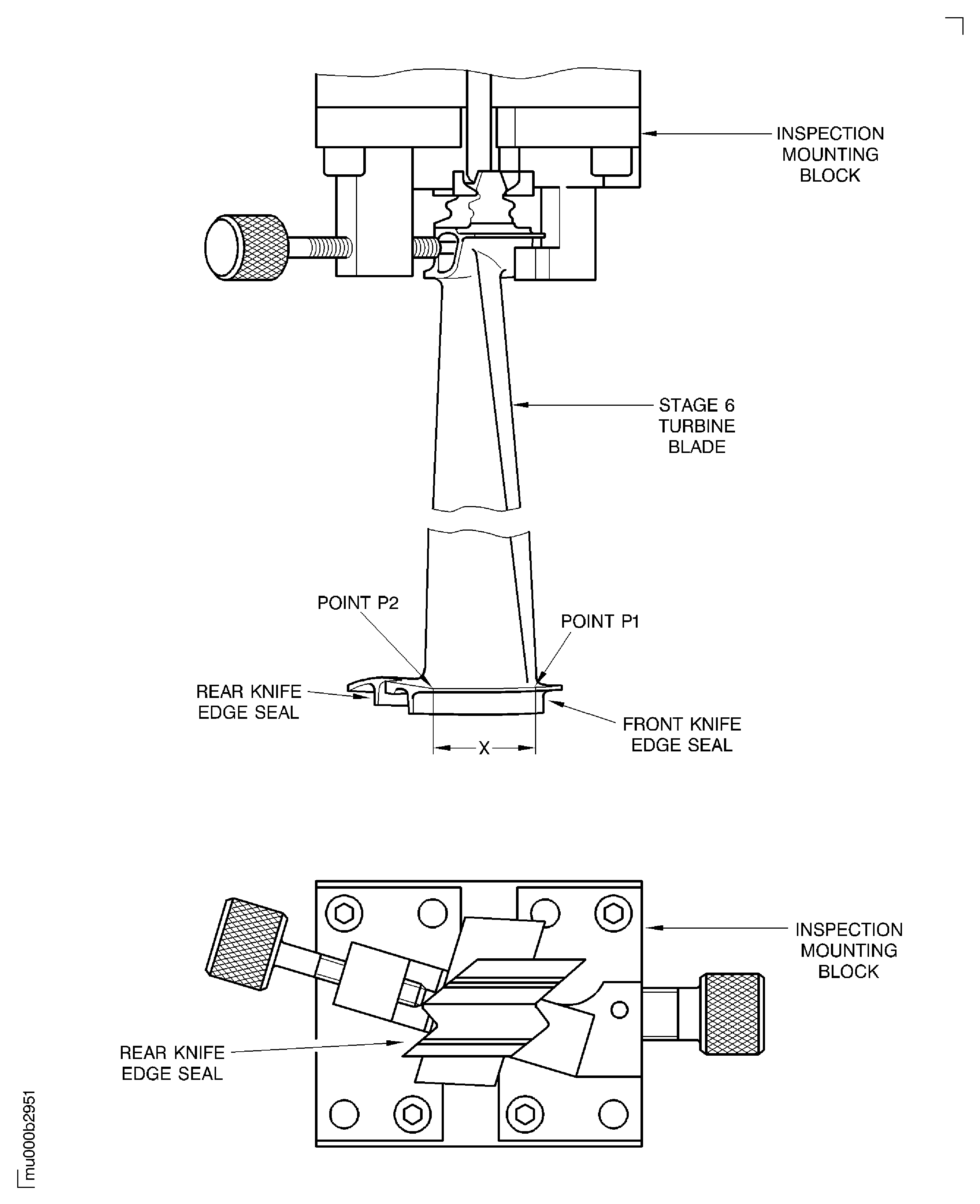
    Figure: Install the Stage 6 Turbine Blades on to the Inspection Gage

    Install the Stage 6 Turbine Blades on to the Inspection Gage
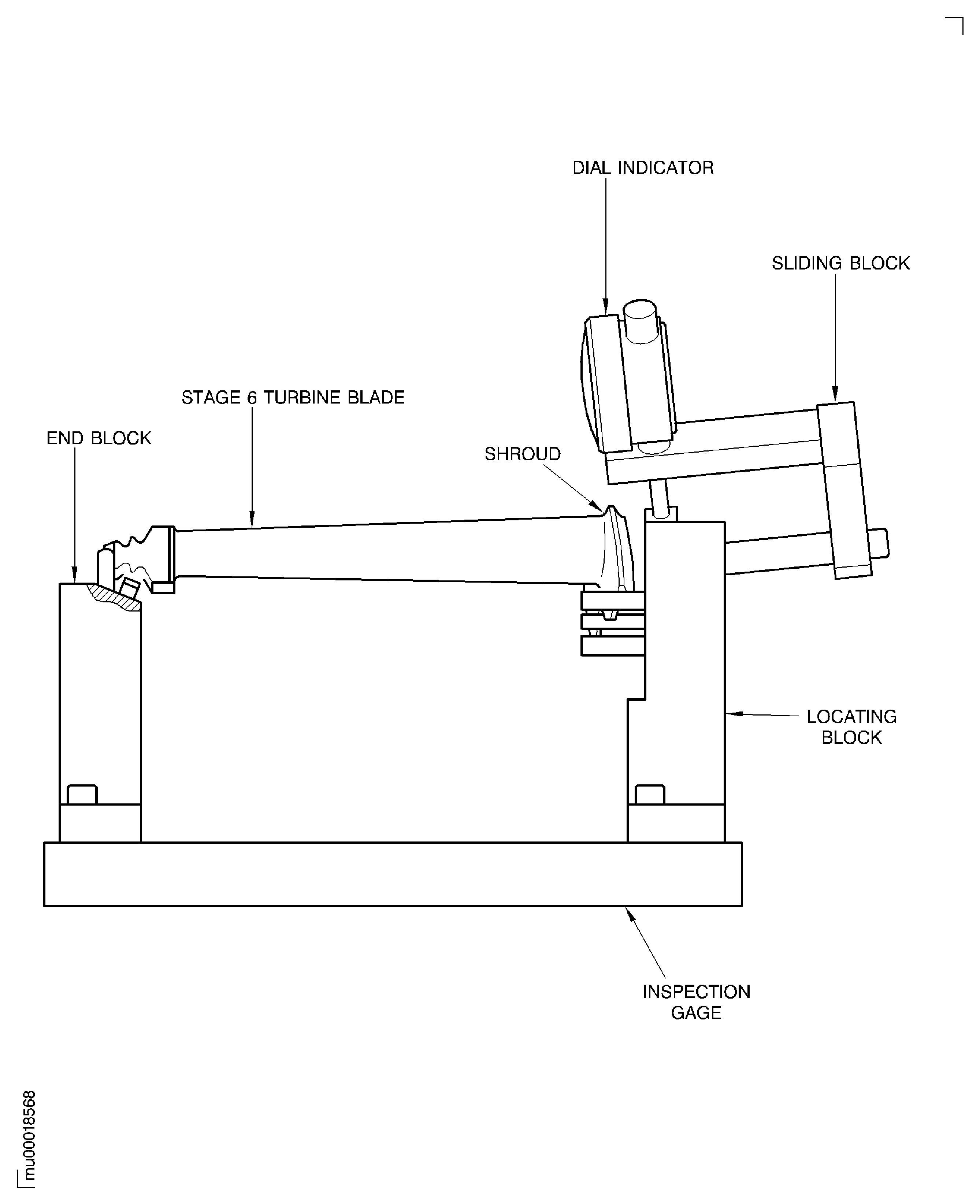
    Figure: Install the Stage 6 Turbine Blades on to the Inspection Gage

    Install the Stage 6 Turbine Blades on to the Inspection Gage
Requirements After Job Completion

Follow-On Conditions

NONE
Change Type:

Corrected Illustration

Manufacturer Code:0AM53
Enterprise Name:IAE INTERNATIONAL AERO ENGINES AG
BU Name:NULL
Building:SUITE 400
Street:628 HEBRON AVENUE
City:GLASTONBURY
State:CT
Zip Code:06033
Country:USA
Manufacturer Code:0AM53
Tool Number:IAE 2M14184
Tool Name:IAE 2M14184 Inspection mounting block
Manufacturer Code:0AM53
Tool Number:IAE 2M14191
Tool Name:IAE 2M14191 Inspection gage