
TASK 72-31-11-200-002-C00 LPC Fan Blade - Examine The LPC Fan Blade

DMC:V2500-A0-72-31-1101-00C-310A-C|Issue No:001.00|Issue Date:2013-11-01

Export Control

EAR Export Classification: Not subject to the EAR per 15 C.F.R. Chapter 1, Part 734.3(b)(3), except for the following Service Bulletins which are currently published as EAR Export Classification 9E991: SBE70-0992, SBE72-0483, SBE72-0580, SBE72-0588, SBE72-0640, SBE73-0209, SBE80-0024 and SBE80-0025.

Copyright

© IAE International Aero Engines AG (2001, 2014 - 2021) The information contained in this document is the property of © IAE International Aero Engines AG and may not be copied or used for any purpose other than that for which it is supplied without the express written authority of © IAE International Aero Engines AG. (This does not preclude use by engine and aircraft operators for normal instructional, maintenance or overhaul purposes.).

Applicability

All

Common Information

TASK 72-31-11-200-002-C00 LPC Fan Blade - Examine The LPC Fan Blade

Effectivity

FIG/ITEM

PART NO.

01-300

6A5485

01-300

6A6519

General

This TASK gives the procedure for the inspection of the LPC rotor blade assembly. For other LP compressor blades and fillers parts, refer to TASK 72-31-11-200-000 (INSPECTION/CHECK-000).

The policy that is necessary for inspection is given in the SPM TASK 70-20-01-200-501.

All the parts must be cleaned before any part is examined. Refer to TASK 72-31-11-100-000 (CLEANING-000).

All parts must be visually examined for damage, corrosion and wear. Any defects that are not identified in the procedure must be referred to IAE.

The procedure for those parts which must have a crack test is given in Step. Do the test before the part is visually examined.

Do not discard any part until you are sure there are no repairs available. Refer to the instructions in Repair before a discarded part is used again or oversize parts are installed.

Parts which should be discarded can be held although no repair is available. The repair of a discarded part could be shown to be necessary at a later date.

All parts must be examined to make sure that all the repairs have been completed satisfactorily.

The practices and processes referred to in the procedure by the TASK numbers are in the SPM.

References

Refer to the SPM for data on these items.

Definitions of Damage, SPM TASK 70-02-02-350-501

Inspection of Parts, SPM TASK 70-20-01-200-501

Some data on these items is contained in this TASK. For more data on these items refer to the SPM.

Methods of Testing for Crack Indications

Chemical Processes

Surface Protection

NOTE

Special tools are identified in the procedure by the tool primary number.

Preliminary Requirements

Pre-Conditions

NONE

Support Equipment

NameManufacturerPart Number / IdentificationQuantityRemark
IAE 3R19397 Perspex template c/c Assembly A and B0AM53IAE 3R193971
IAE 3R19399 Perspex template c/c Assembly A and B0AM53IAE 3R193991

Consumables, Materials and Expendables

NONE

Spares

NONE

Safety Requirements

NONE

Procedure

    1. SUBTASK 72-31-11-220-113 Examine the LPC Rotor Blade Assembly (01-300) for Damage

      NOTE

      An arc burn is evident by a small circular or semi-circular heat-affected area on the blade surface that may contain a shallow pitting, remelting or cracking. Visually a derk blue oxide discoloration is associated with the heat-affected area.
      1. Examine for electrical arc burns.

        1. Arc burned

        2. Reject

    1. SUBTASK 72-31-11-280-055 Examine the LPC Rotor Blade Assembly (01-300) for Crack Indications

      1. Transient acoustic propagating (TAP) examine for crack. Refer to TASK 72-00-00-200-000 (INSPECTION/CHECK-000).

        PART IDENT

        TASK/SUBTASK

        LPC rotor blade assembly

        (INSPECTION)

        1. Evidence of vacuum

        2. Accept

        1. Lack of vacuum

        2. Reject

    1. SUBTASK 72-31-11-250-054 Examine the LPC Rotor Blade Assembly (01-300) for Leading Edge Cracks

      1. Do the eddy current inspection of the leading edge for cracks.

        PART IDENT

        TASK/SUBTASK

        LPC rotor blade assembly

        (INSPECTION)

        1. Cracks

        2. Reject

    1. SUBTASK 72-31-11-270-059 Examine the LPC Rotor Blade Assembly (01-300) for Debond at Dovetail

      1. Do the ultrasonic inspection of the dovetail for debond at location 6.

        PART IDENT

        TASK/SUBTASK

        LPC rotor blade assembly

        (INSPECTION)

        1. Debond

        2. Reject

    1. SUBTASK 72-31-11-220-131 Examine the LPC Rotor Blade Assembly (01-300) for Panel Defects

      1. Do the C scan inspection and examine for panel defects and cracks.

        PART IDENT

        TASK/SUBTASK

        LPC rotor blade assembly

        (INSPECTION)

        1. Panel defects/Cracks

        2. Reject

    1. SUBTASK 72-31-11-230-065 Examine the LPC Rotor Blade Assembly (01-300) for Cracks

    2. Clean the parts. Refer to TASK 72-31-11-100-000 (CLEANING-000).

      1. Do the crack test on the parts that are given below.

        PART IDENT

        TASK/SUBTASK

        LPC rotor blade assembly

        1. Cracked.

          1. Blade tips.

            1. If there are cracks on no more than 0.050 in (1.27 mm) of the adjacent airfoil surfaces radially from the blade tip

            2. Accept

            1. If there are cracks on more than 0.050 in (1.27 mm) of the adjacent airfoil surfaces radially from the balde tip

            2. Reject

          1. Other areas

          2. Reject

    1. SUBTASK 72-31-11-220-114 Examine the LPC Rotor Blade Assembly (01-300) Concave and Convex Airfoil Surfaces

    2. Refer to Figure, Figure, Figure and Figure.

      1. Examine the concave and convex airfoil surfaces at locations 1 and 2.

        1. Nicked, scored, scratched or dented.

          1. Non-critical areas.

            1. Up to 0.007 in. (0.17 mm) in depth

            2. Accept

            1. Between 0.007 in. and 0.015 in. (0.17 and 0.38 mm)

            2. Repair, VRS1003 TASK 72-31-11-300-008 (REPAIR-008)

            1. More than in Step

            2. Reject

          1. Critical area 1.

            1. Up to 0.004 in (0.10 mm) in depth without high metal

            2. Repair, VRS1724 TASK 72-31-11-300-026, (REPAIR-026)

            1. More than in Stepand up to 0.012 in (0.30 mm) in depth

            2. Repair, VRS1003 TASK 72-31-11-300-008 (REPAIR-008)

            1. More than in Step

            2. Reject

          1. Critical area 2.

            1. Up to 0.007 in. (0.17 mm) in depth

            2. Repair, VRS1003, TASK 72-31-11-300-008 (REPAIR-008)

            1. More than in Step

            2. Reject

          1. Critical area 3.

            1. Up to 0.004 in. (0.10 mm) in depth

            2. Accept and apply Repair, VRS1724 TASK 72-31-11-300-026 (REPAIR-026)

            1. More than in Step and up to 0.015 in. (0.38 mm) in depth provided panel thickness is not more than 10 percent below the minimum limit given on the template after the blend repair

            2. Repair, VRS1003 TASK 72-31-11-300-008 (REPAIR-008)

            1. More than in Step

            2. Reject

          1. Critical area 4.

            1. Up to 0.004 in. (0.10 mm) in depth

            2. Accept and apply Repair, VRS1724 TASK 72-31-11-300-026 (REPAIR-026)

            1. More than in Step and up to 0.015 in. (0.38 mm) in depth provided panel thickness is not more than 5 percent below the minimum limit given in the template after the blend repair

            2. Repair, VRS1003 TASK 72-31-11-300-008 (REPAIR-008)

            1. More than in Step

            2. Reject

        1. Surface finish.

          1. Up to 25 microinches (0.63 micrometers)

          2. Accept

          1. More than in Step

          2. Repair, VRS1025 TASK 72-31-11-300-010 (REPAIR-010)

            NOTE

            This inspection gives an acceptance limit with no dressing requirement. If airfoil dressing is specified at another part of inspection, then all damage must be repaired.
      1. Examine the concave and convex airfoil surfaces at locations 1 and 2 in the contact area with the annulus filler.

        1. Galled or scored.

          1. Up to 0.004 in. (0.10 mm) in depth

          2. Accept

          1. More than in Step

          2. Repair, VRS1003, TASK 72-31-11-300-008 (REPAIR-008)

    1. SUBTASK 72-31-11-220-115 Examine the LPC Rotor Blade Assembly (01-300) Leading Edge

    2. Refer to Figure, Figure, Figure, Figure and Figure.

      1. Examine the leading edge at location 3.

        1. Eroded.

          1. Critical area

          2. Reject

          1. Non-critical area.

            1. Erosion up to 0.138 in. (3.50 mm) reduction in chord

            2. Repair, VRS1064 TASK 72-31-11-300-030 (REPAIR-030)

            1. More than in Step

            2. Reject

        1. Bends.

          NOTE

          The maximum number of bent blades in any fan rotor assembly must not be more than two.
          1. General.

            1. More than one bend

            2. Reject

            1. Bend contains kinks, creases, tears, cracks or nicks

            2. Reject

            1. Untwist

            2. Reject

            1. Transition between the undamaged airfoil and bent area is not smooth

            2. Reject

          1. Circumferential deviation (X) not more than a maximum of 0.20 in. (5.08 mm) and within the following limits, Step to Step.

          2. Accept

        2. The axial length of the bend (Y) is not less than 8 times circumferential deviation (X).

        3. The radial length of bend (Z) is not less than 15 times circumferential deviation (X).

        4. Bends do not go into the panel area by more than 2.0 in. (50.8 mm) from leading edge.

          1. Circumferential deviation (X) greater than 0.20 in. (5.08 mm)

          2. Reject

        1. Damage not in Step or Step

        2. Repair, VRS1002 TASK 72-31-11-300-007 (REPAIR-007)

    1. SUBTASK 72-31-11-220-132 Examine the LPC Rotor Blade Assembly (01-300) Trailing Edge

    2. Refer to Figure, Figure, Figure, Figure and Figure.

      1. Examine the trailing edge at location 4.

        1. Bends.

          NOTE

          The maximum number of bent blades in any fan rotor assembly must not be more than two.
          1. General.

            1. More than one bend

            2. Reject

            1. Bend contains kinks, creases, tears, cracks or nicks

            2. Reject

            1. Untwist

            2. Reject

            1. Transition between the undamaged airfoil and bent area is not smooth

            2. Reject

          1. Circumferential deviation (X) not more than a maximum of 0.20 in. (5.08 mm) and within the following limits, Step to Step

          2. Accept

        2. The axial length of the bend (Y) is not less than 8 times circumferential deviation (X).

        3. The radial length of bend (Z) is not less than 15 times circumferetial deviation (X).

        4. Bends do not go into panel area by more than 2.0 in. (5.08 mm) from trailing edge.

          1. Circumferential deviation (X) greater than 0.20 in (5.08 mm)

          2. Reject

        1. Damage not in Step

        2. Repair, VRS1002 TASK 72-31-11-300-007 (REPAIR-007)

    1. SUBTASK 72-31-11-220-116 Examine the LPC Rotor Blade Assembly (01-300) Blade Tip

    2. Refer to Figure, Figure, Figure and Figure.

      1. Examine the blade tip at location 5.

        1. Damaged

        2. Repair, VRS1002 TASK 72-31-11-300-007 (REPAIR-007)

      1. Examine the blade tips for discoloration/blueing/scoring caused by heat/contact with the fan case attrition lining.

        1. If there is discoloration/blueing on the blade tips and on no more than 0.25 in. (6.35 mm) of the adjacent airfoil surfaces radially from the blade tip

        2. Accept

        1. If there is discolouration/blueing on the blade tips and on more than 0.25 in. (6.35 mm) of the adjacent airfoil surfaces radially from the blade tip

        2. Reject

        1. If there is scoring on the blade tips caused by contact with the fan case attrition lining

        2. Accept

    1. SUBTASK 72-31-11-220-117 Examine the LPC Rotor Blade Assembly (01-300) Dovetail

      CAUTION

      MAKE SURE THAT NMSB 72-0387 IS COMPLIED WITH.
    2. Refer to Figure and Figure.

      1. Examine area AD of the dovetail at location 6.

        1. Scored

        2. Reject

        1. Galled.

          1. Less than 0.003 in. (0.076 mm)

          2. Accept

          1. More than in Step

          2. Repair, VRS1723 TASK 72-31-11-300-024 (REPAIR-024)

        1. Apply dry film lubricant

        2. Repair, VRS1023 TASK 72-31-11-300-021 (REPAIR-021)

      1. Examine the dovetail at location 6 except area AD.

        1. Nicked, scored, scratched or dented.

          1. Less than 0.016 in. (0.42 mm) in depth

          2. Repair, VRS1066 TASK 72-31-11-300-031 (REPAIR-031)

          1. More than in Step

          2. Reject

    1. SUBTASK 72-31-11-220-118 Examine the LPC Rotor Blade Assembly (01-300) Face

    2. Refer to Figure, Figure, Figure and Figure.

      1. Examine the face at location 7.

        1. Nicked, scored, scratched, dented or galled.

          1. Up to 0.006 in. (0.15 mm) in depth

          2. Repair, VRS1066 TASK 72-31-11-300-031 (REPAIR-031)

          1. More than in Step

          2. Reject

    1. SUBTASK 72-31-11-220-119 Examine the LPC Rotor Blade Assembly (01-300) Chocking Pads

    2. Refer to Figure, Figure, Figure and Figure.

      1. Examine the chocking pads at location 8.

        1. Unbond

        2. Repair, VRS1022 TASK 72-31-11-300-009 (REPAIR-009)

        1. Missing

        2. Repair, VRS1022 TASK 72-31-11-300-009 (REPAIR-009)

    1. SUBTASK 72-31-11-220-133 Examine the LPC Rotor Blade Assembly (01-300) Corner

    2. Refer to Figure, Figure, Figure and Figure.

      1. Examine the corner at location 9.

        1. Up to 0.012 in. (0.30 mm) in depth

        2. Repair, VRS1066 TASK 72-31-11-300-031 (REPAIR-031)

        1. More than in Step

        2. Reject

  1. Figure: Locations on the LPC Rotor Blade Assembly

    Sheet 1
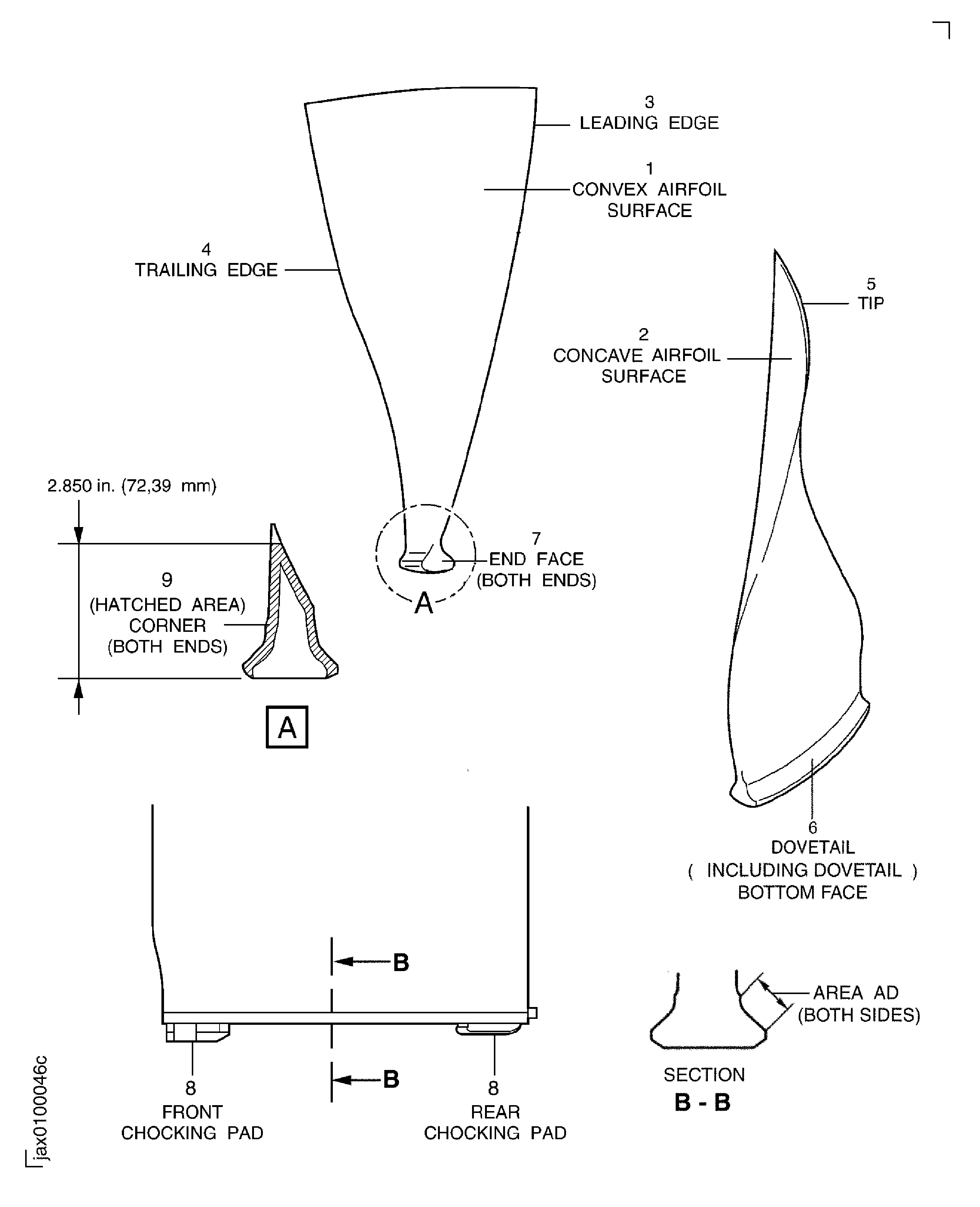
    Legend
    Locations on the LPC Rotor Blade Assembly

    Sheet 1

    Close

    Figure: Locations on the LPC Rotor Blade Assembly

    Sheet 2

    Legend
    Locations on the LPC Rotor Blade Assembly

    Sheet 2

    Close

    Figure: Locations on the LPC Rotor Blade Assembly

    Sheet 3
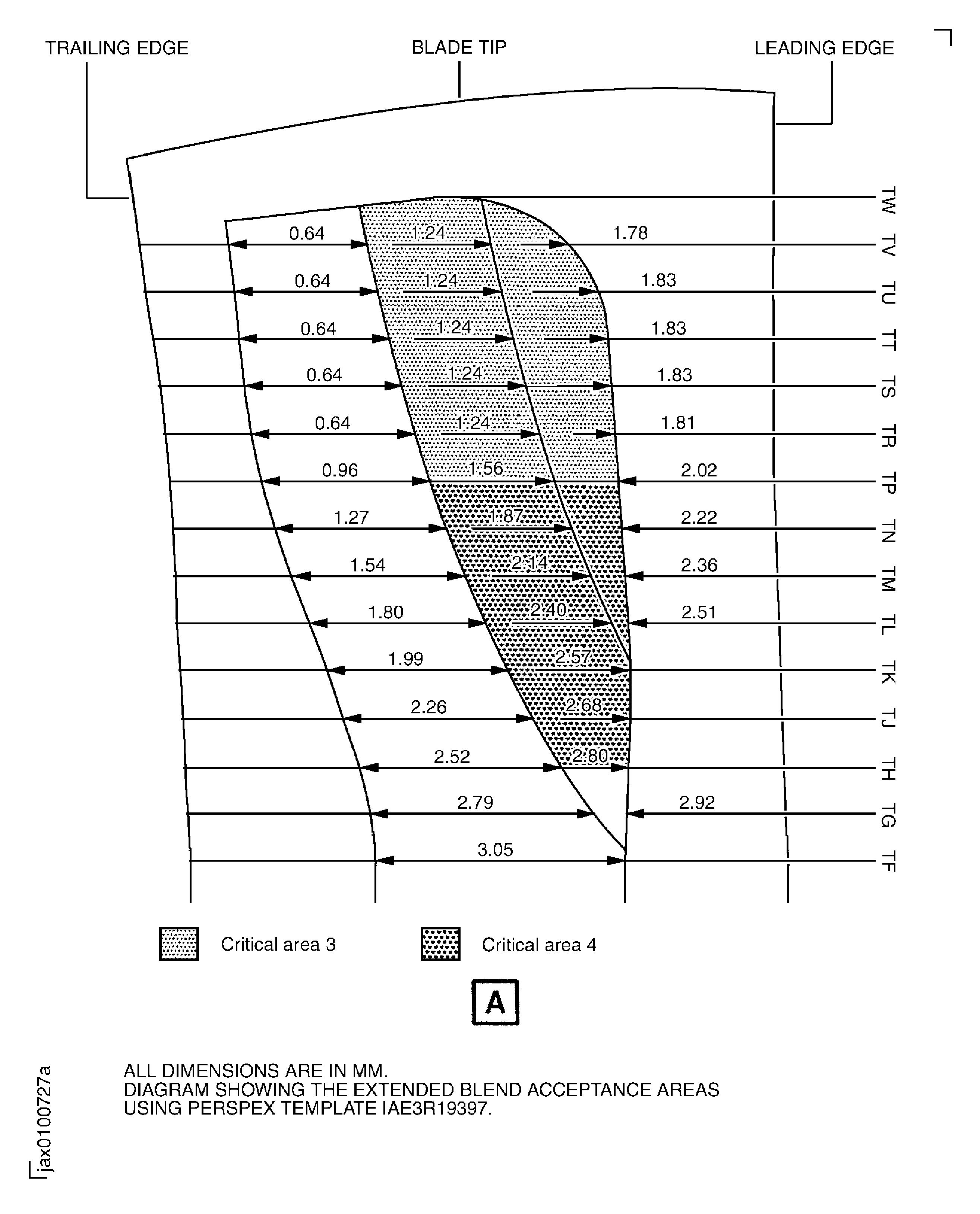
    Legend
    Locations on the LPC Rotor Blade Assembly

    Sheet 3

    Close

    Figure: Locations on the LPC Rotor Blade Assembly

    Sheet 4
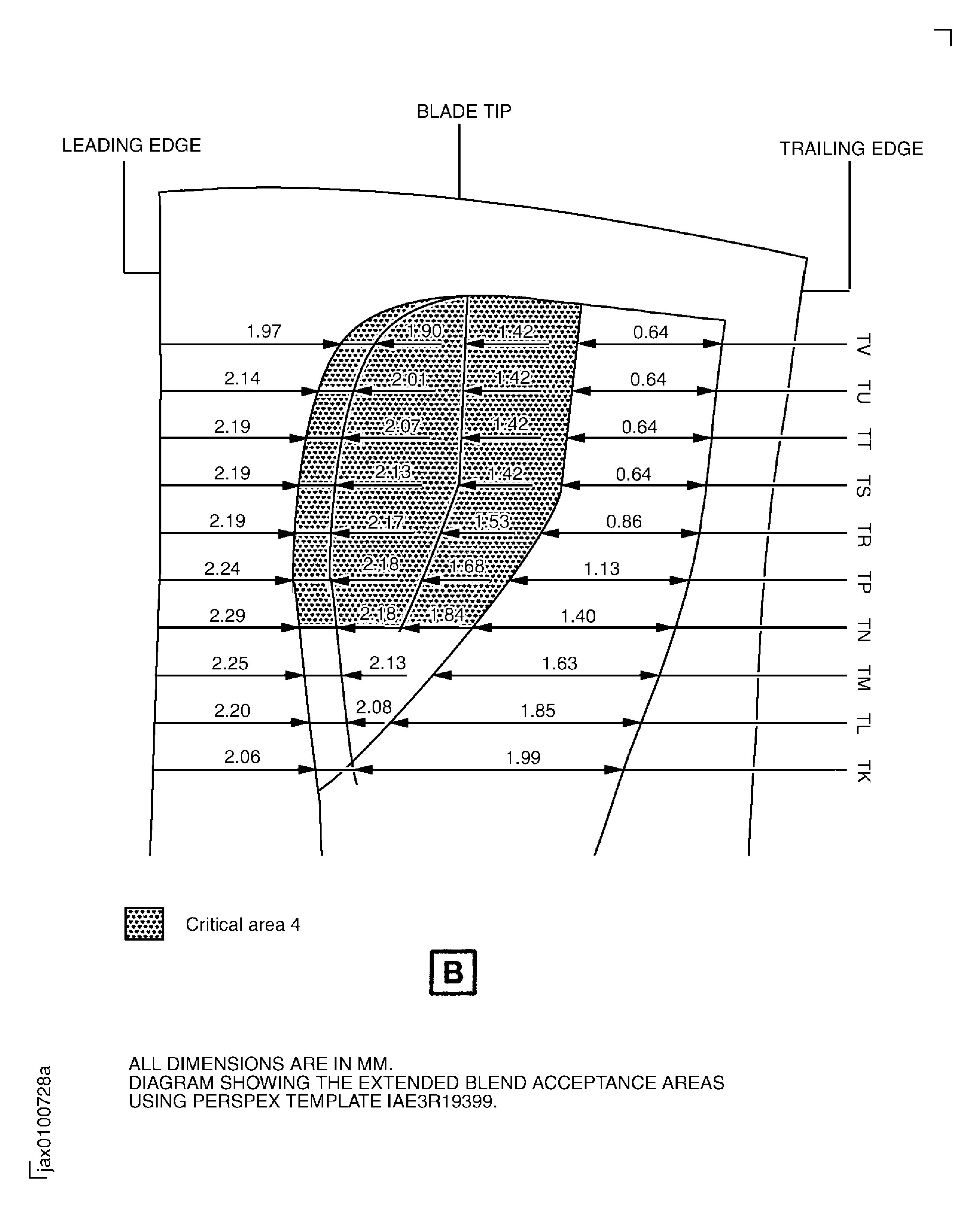
    Legend
    Locations on the LPC Rotor Blade Assembly

    Sheet 4

    Close

    Figure: Locations on the LPC Rotor Blade Assembly

    Locations on the LPC Rotor Blade Assembly

Requirements After Job Completion

Follow-On Conditions

NONE
Manufacturer Code:0AM53
Enterprise Name:IAE INTERNATIONAL AERO ENGINES AG
BU Name:NULL
Building:SUITE 400
Street:628 HEBRON AVENUE
City:GLASTONBURY
State:CT
Zip Code:06033
Country:USA
Manufacturer Code:0AM53
Tool Number:IAE 3R19397
Tool Name:IAE 3R19397 Perspex template c/c Assembly A and B
Manufacturer Code:0AM53
Tool Number:IAE 3R19399
Tool Name:IAE 3R19399 Perspex template c/c Assembly A and B